

Ready & Packaged Foods
All →Vegetables & Legumes
All →Desserts & Confectionery
All →Meat & Protein
All →Grains & Bakery
All →Beverages
All →Milk & Dairy
All →

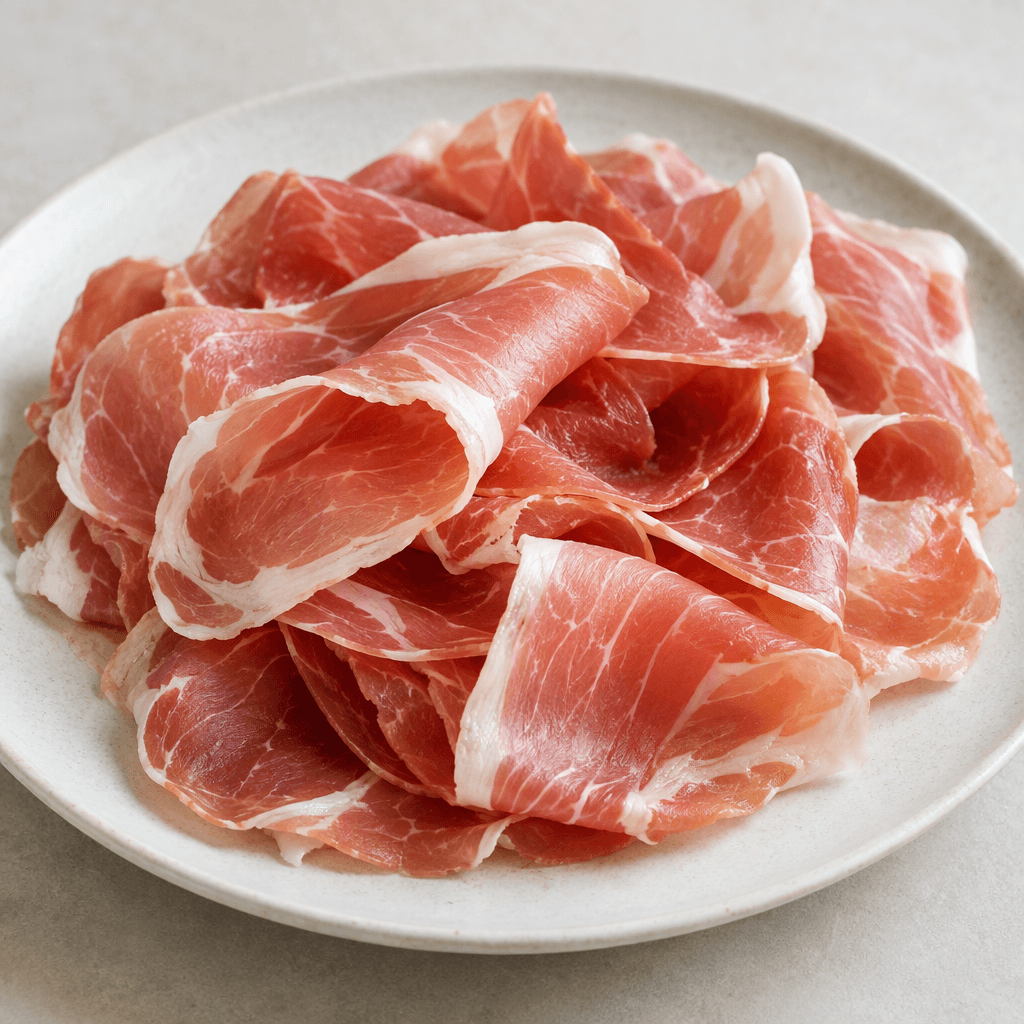
Prosciutto Calories
Italian dry-cured ham, high protein, rich flavor
In season: Spring · Summer · Autumn · Winter
CALORIES
GI
POTASSIUM
FIBER
Quick answer
3 slice (medium) of Prosciutto (30 g) has 81 calories. That works out to 270 calories per 100 g. It contains 0 g of carbs, 7.8 g of protein, 5.5 g of fat and 0 g of fiber. Its 486 mg of Sodium covers 21% of the Daily Value. Its glycemic index is 0 (low), so it raises blood sugar slowly.
What is Prosciutto?
Prosciutto is an Italian dry-cured ham made from pork leg that is salted and aged, then sliced very thinly. It is usually served uncooked, with a delicate, tender texture and a savory, distinctly salty taste. Fine ribbons of creamy fat add richness to each slice.
In Italy, it often appears on antipasti platters, in sandwiches, or paired with melon; English-speaking diners also enjoy it with cheese, salads, and crusty bread. It provides plenty of protein, though its fat content makes it quite rich. A few slices can bring plenty of flavor, so pair a modest portion with vegetables or fruit for a lighter plate.
Prosciutto Nutrition Facts
Selected: 100 g
270
KCAL / 100G
Carbs
0g
· 0% DV
Protein
25.9g
· 52% DV
Fat
18.3g
· 23% DV
Fiber
0g
· 0% DV
DV is the share of the daily value covered, on a 2,000 kcal reference diet.
Calories come from: Carbs 0% · Protein 39% · Fat 61%
Prosciutto Vitamins & Minerals
Vitamins
B1
0.65mg · 54% DV
B12
0.8µg · 33% DV
B6
0.5mg · 29% DV
B3
4.5mg · 28% DV
Minerals
Sodium
1620mg · 70% DV
Phosphorus
220mg · 31% DV
Selenium
13µg · 24% DV
Zinc
2mg · 18% DV
How Nutritious Is Prosciutto?
Nutrient density
Medium
How many vitamins, minerals and how much fiber this food carries per calorie. A high score means a lot of nutrition for few calories.
Satiety score
Medium
An EatBetter score computed from fiber, protein and calorie density. A high score means staying full longer on the same calories.
Both scores are calculated per 100 g and do not change with the selected portion. The satiety score is EatBetter's own calculation, not a clinical measure.
Prosciutto Glycemic Index
GLYCEMIC INDEX
GLYCEMIC LOAD
Accounts for portion size — a more realistic measure than GI alone.
How to Burn Off Prosciutto
To burn the 270 calories in 100 g:
🚶
Walking (5 km/h)
🏃
Running (8 km/h)
🚴
Cycling
🏊
Swimming
Times are calculated with the MET equation for a 70 kg adult. Actual burn varies with your weight, age and pace.
Is Prosciutto Processed?
NOVA 3
Processed
1. Unprocessed
2. Minimally Processed
3. Processed
4. Ultra-Processed
NOVA classifies foods into 4 groups by industrial processing. NOVA 1 (unprocessed) is the healthiest.
Does Prosciutto Contain Allergens?
No known major allergens
Which Diets Is Prosciutto Good For?
Vegan
— Not suitable
Vegetarian
— Not suitable
Gluten-Free
✓ Suitable
Dairy-Free
— Not suitable
Mediterranean
✓ Suitable
Paleo
✓ Suitable
Whole30
— Not suitable
DASH
— Not suitable
Keto
✓ Suitable
Low FODMAP
— Not suitable
Prosciutto Fat Profile
SATURATED
6.2g
MONOUNSATURATED
8.1g
POLYUNSATURATED
2.2g
Omega 6:3 ratio 7.8:1
Above the ideal 4:1 (7.8:1).
Compare Prosciutto
Foods Similar to Prosciutto
Frequently Asked Questions About Prosciutto
What is prosciutto made from?
Prosciutto is Italian dry-cured ham, usually made from a pork hind leg. The meat is salted and aged, then sliced very thinly; it is commonly served without further cooking.
Is prosciutto raw or cooked?
Prosciutto crudo is not cooked, but it is cured and aged, so it is ready to eat rather than raw fresh pork. Prosciutto cotto is the cooked version and has a different texture and flavor.
How is prosciutto made?
Traditional prosciutto is made by salting a pork leg and aging it under controlled conditions. The curing and drying process develops its savory flavor and firm texture; the finished ham is sliced thinly for serving.
What is the difference between prosciutto and pancetta?
Prosciutto is cured pork leg, usually served in thin slices, while pancetta is cured pork belly with a fattier texture. Pancetta is commonly diced and cooked; prosciutto is often eaten as is or added to dishes.
How is prosciutto different from bacon?
Prosciutto is an Italian dry-cured ham made from pork leg, while bacon is usually pork belly that is cured and often smoked. Bacon is generally cooked before eating; prosciutto is commonly served ready to eat.
What is the difference between prosciutto crudo and prosciutto cotto?
Prosciutto crudo is salted and air-aged without being cooked, giving it a firmer texture and concentrated flavor. Prosciutto cotto is cooked ham, with a softer texture and milder taste.
How do you serve prosciutto?
Serve prosciutto in thin, loosely folded slices as an appetizer, or add it to sandwiches, salads, and pasta. Letting it sit briefly at room temperature can bring out its aroma; avoid leaving it out for an extended time.
What foods pair well with prosciutto?
Prosciutto pairs especially well with melon, figs, pears, crusty bread, and mild cheeses. Sweet fruit balances its salty, savory flavor, while bread and cheese make it easy to serve as part of a snack board.
How should you store prosciutto after opening?
Keep opened prosciutto refrigerated and tightly wrapped or in an airtight container. Follow the package’s storage directions and use it promptly; discard it if it develops an off smell, a sticky surface, or visible spoilage.
Can you freeze prosciutto?
Yes, prosciutto can be frozen in an airtight package, preferably with slices separated so you can take out only what you need. Thaw it in the refrigerator; freezing may affect its delicate texture, so use thawed slices in cooked dishes.
Have another question about Prosciutto?
Ask the AI nutrition coach — calories, portions, alternatives and more, answered in seconds in the app.

Scan calories with your camera
Instant AI nutrition analysis

Nutrition data compiled from USDA FoodData Central and scientific sources.