

Ready & Packaged Foods
All →Vegetables & Legumes
All →Desserts & Confectionery
All →Meat & Protein
All →Grains & Bakery
All →Beverages
All →Milk & Dairy
All →

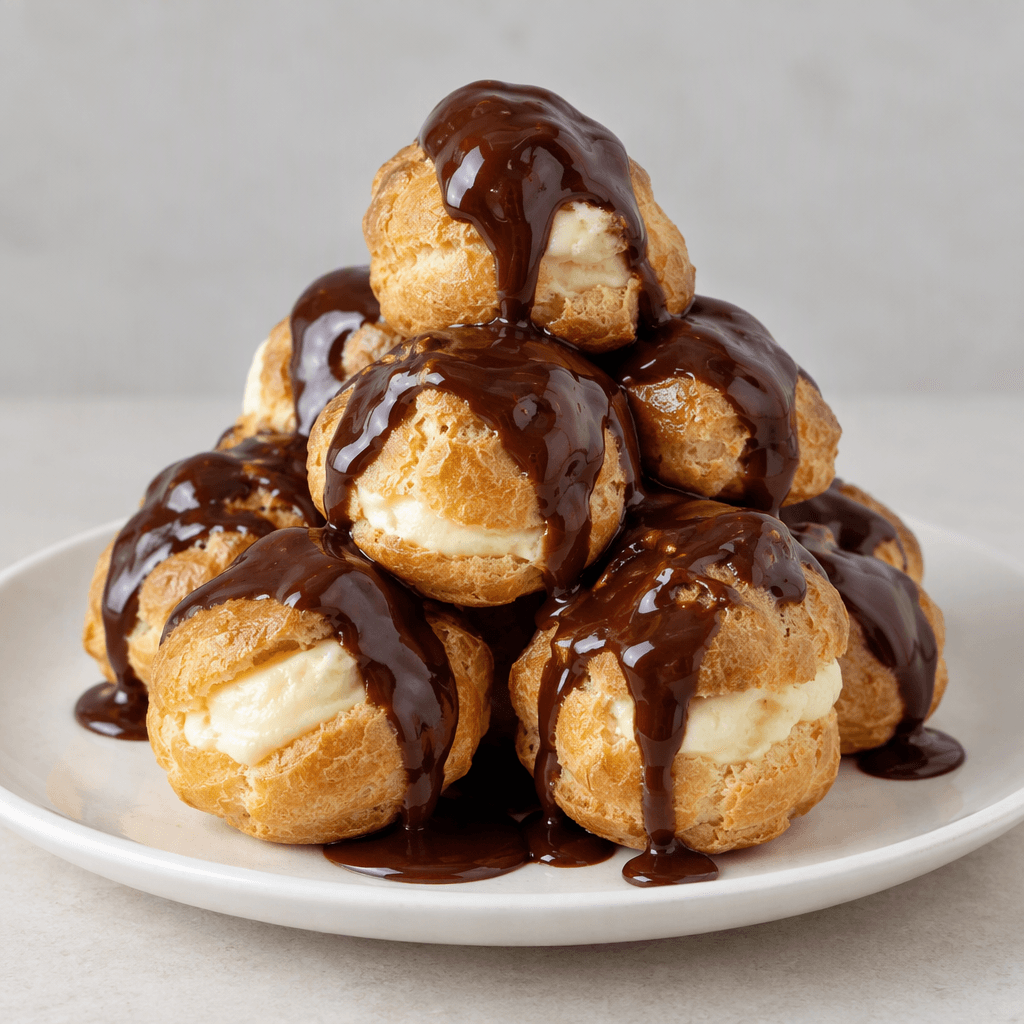
Profiterole Calories
Cream-filled French pastry with chocolate
In season: Winter · Spring · Autumn · Summer
CALORIES
GI
POTASSIUM
FIBER
Quick answer
3 piece (medium) of Profiterole (75 g) has 214 calories. That works out to 285 calories per 100 g. It contains 25.7 g of carbs, 3.8 g of protein, 10.6 g of fat and 0.9 g of fiber. Its 0.1 mg of B2 covers 11% of the Daily Value. Its glycemic index is 65 (medium), so it raises blood sugar at a moderate pace.
What is Profiterole?
A profiterole is a French pastry made from small, airy choux buns, typically filled with pastry cream and finished with chocolate sauce. The buns are baked until lightly crisp, then turn tender around the creamy filling; recipes may use whipped cream or another filling instead.
It is commonly served chilled as a plated dessert, sometimes piled into a mound and topped just before serving. In Turkey, profiterol is a familiar patisserie and homemade treat, often brought out after a meal or with tea when guests visit. It is a sweet with a notable share of carbohydrate and fat, rather than a substantial source of protein. A modest serving works well after dinner, or share a plate if you want just a taste.
Profiterole Nutrition Facts
Selected: 100 g
285
KCAL / 100G
Carbs
34.2g
· 12% DV
Protein
5.1g
· 10% DV
Fat
14.1g
· 18% DV
Fiber
1.2g
· 4% DV
DV is the share of the daily value covered, on a 2,000 kcal reference diet.
Calories come from: Carbs 48% · Protein 7% · Fat 45%
Profiterole Vitamins & Minerals
Vitamins
B2
0.19mg · 15% DV
B12
0.35µg · 15% DV
Biotin
3.5µg · 12% DV
B5
0.5mg · 10% DV
Minerals
Selenium
5.5µg · 10% DV
Zinc
1mg · 9% DV
Phosphorus
65mg · 9% DV
Calcium
55mg · 6% DV
How Nutritious Is Profiterole?
Nutrient density
Low
How many vitamins, minerals and how much fiber this food carries per calorie. A high score means a lot of nutrition for few calories.
Satiety score
Low
An EatBetter score computed from fiber, protein and calorie density. A high score means staying full longer on the same calories.
Both scores are calculated per 100 g and do not change with the selected portion. The satiety score is EatBetter's own calculation, not a clinical measure.
Profiterole Glycemic Index
GLYCEMIC INDEX
GLYCEMIC LOAD
Accounts for portion size — a more realistic measure than GI alone.
How to Burn Off Profiterole
To burn the 285 calories in 100 g:
🚶
Walking (5 km/h)
🏃
Running (8 km/h)
🚴
Cycling
🏊
Swimming
Times are calculated with the MET equation for a 70 kg adult. Actual burn varies with your weight, age and pace.
Is Profiterole Processed?
NOVA 3
Processed
1. Unprocessed
2. Minimally Processed
3. Processed
4. Ultra-Processed
NOVA classifies foods into 4 groups by industrial processing. NOVA 1 (unprocessed) is the healthiest.
Does Profiterole Contain Allergens?
Contains these allergens:
Which Diets Is Profiterole Good For?
Vegan
— Not suitable
Vegetarian
— Not suitable
Gluten-Free
— Not suitable
Dairy-Free
— Not suitable
Mediterranean
✓ Suitable
Paleo
— Not suitable
Whole30
— Not suitable
DASH
— Not suitable
Keto
— Not suitable
Low FODMAP
— Not suitable
Profiterole Fat Profile
SATURATED
7.2g
MONOUNSATURATED
4.1g
POLYUNSATURATED
1.1g
Omega 6:3 ratio 9:1
Above the ideal 4:1 (9:1).
Compare Profiterole
Foods Similar to Profiterole
Frequently Asked Questions About Profiterole
What is a profiterole?
A profiterole is a small choux pastry puff, usually filled with pastry cream and topped with chocolate sauce. The crisp shell puffs up in the oven, leaving a hollow center for the filling.
Where did profiteroles originate?
Profiteroles are associated with French pastry, where choux pastry became a foundation for both sweet and savory dishes. Their exact early history is less clear, but the cream-filled, chocolate-topped version is now a familiar French-style dessert.
Are profiteroles the same as cream puffs?
They are very similar: both are hollow choux pastry puffs that can be filled with cream. Profiteroles are often smaller and served with chocolate sauce, while cream puffs may be served plain or with other toppings.
What are profiteroles filled with?
Profiteroles are most often filled with pastry cream, though whipped cream or ice cream are also used. A piping bag makes it easier to fill each puff through a small opening without breaking the shell.
Why do profiteroles collapse after baking?
Profiteroles often collapse if the shells are still moist inside when removed from the oven. Bake them until well browned and firm, and avoid opening the oven door while they rise.
Can you make profiteroles ahead of time?
Yes, you can prepare profiteroles ahead by baking the shells and making the filling separately. Store them apart, then fill and add the chocolate sauce shortly before serving so the pastry does not turn soggy.
How should profiteroles be served?
Profiteroles are usually served chilled or at cool room temperature with chocolate sauce poured over the filled puffs. For a classic presentation, arrange them in a mound and add the sauce just before serving.
Can profiteroles be frozen?
Yes, unfilled profiterole shells freeze well and can be crisped again in the oven after thawing. Filled profiteroles can also be frozen, but the pastry may soften and the cream may change texture as it thaws.
How long do profiteroles last in the fridge?
Filled profiteroles keep best in a covered container in the refrigerator and should be eaten promptly. Their shells gradually absorb moisture from the cream and sauce, so they lose their crisp texture over time.
Why are my profiteroles soggy?
Profiteroles turn soggy when the shells are underbaked or sit too long after filling and saucing. Bake the shells until dry inside, let them cool fully, and add the filling and chocolate sauce close to serving.
Have another question about Profiterole?
Ask the AI nutrition coach — calories, portions, alternatives and more, answered in seconds in the app.

Scan calories with your camera
Instant AI nutrition analysis

Nutrition data compiled from USDA FoodData Central and scientific sources.