

Ready & Packaged Foods
All →Vegetables & Legumes
All →Desserts & Confectionery
All →Meat & Protein
All →Grains & Bakery
All →Beverages
All →Milk & Dairy
All →

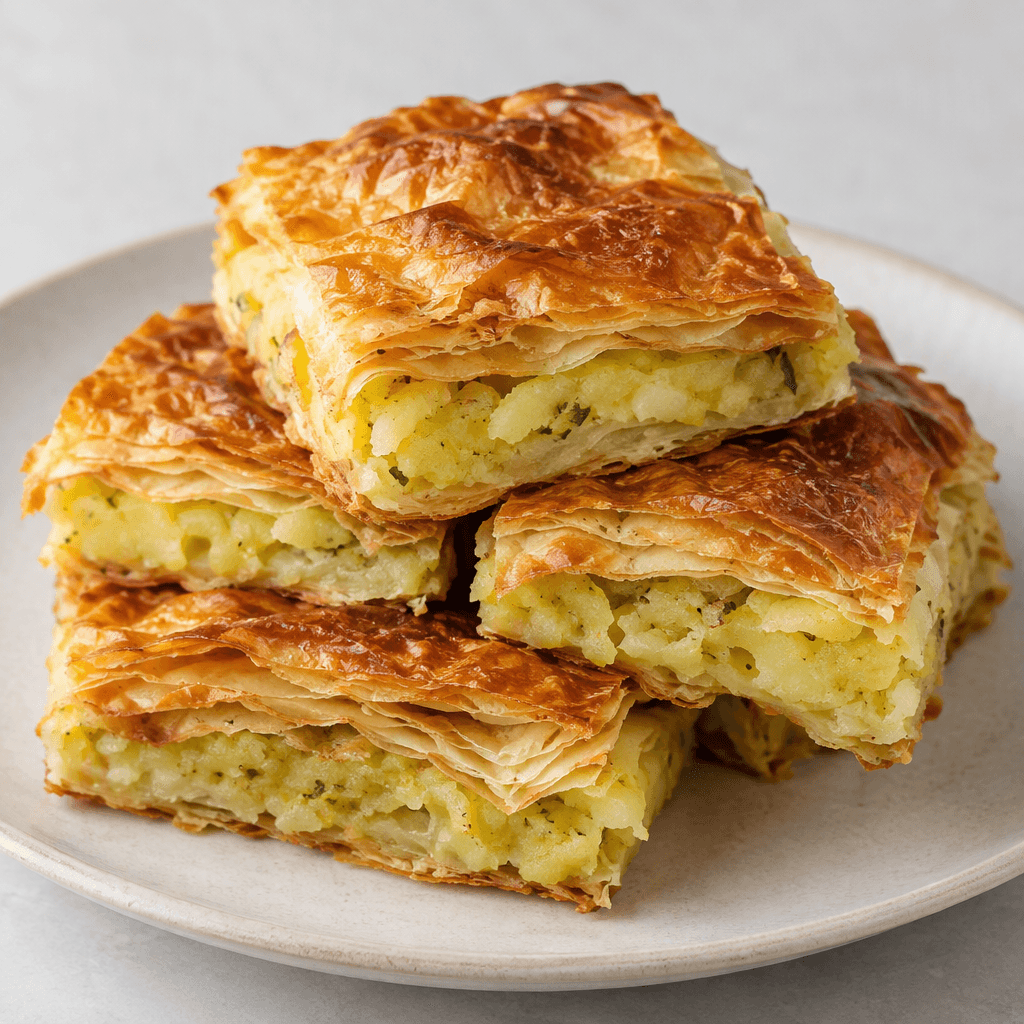
Potato pastry Calories
Soft pastry filled with potato
In season: Spring · Summer · Autumn · Winter
CALORIES
GI
POTASSIUM
FIBER
Quick answer
1 piece (medium) of Potato pastry (70 g) has 168 calories. That works out to 240 calories per 100 g. It contains 25.2 g of carbs, 3.6 g of protein, 5.9 g of fat and 1.8 g of fiber. Its 224 mg of Sodium covers 10% of the Daily Value. Its glycemic index is 65 (medium), so it raises blood sugar at a moderate pace.
What is Potato pastry?
Potato pastry is a Turkish bakery favourite: dough is filled with seasoned mashed potato, sometimes with onion or herbs, then baked. Recipes vary, so the pastry may be soft and bread-like or have crisp, flaky layers. It is sold in bakeries and also made at home.
In Turkey, it is commonly eaten for breakfast, as a snack, or alongside tea, and it travels well for lunch on the go. The potato filling makes it satisfying, while the pastry contributes much of its carbohydrate; a 100 g portion has 36 g. For a lighter plate, pair a piece with fresh salad or sliced vegetables, or choose a smaller portion.
Potato pastry Nutrition Facts
Selected: 100 g
240
KCAL / 100G
Carbs
36g
· 13% DV
Protein
5.2g
· 10% DV
Fat
8.5g
· 11% DV
Fiber
2.6g
· 9% DV
DV is the share of the daily value covered, on a 2,000 kcal reference diet.
Calories come from: Carbs 60% · Protein 9% · Fat 31%
Potato pastry Vitamins & Minerals
Vitamins
B1
0.13mg · 11% DV
B6
0.18mg · 11% DV
B2
0.09mg · 7% DV
B3
1.1mg · 7% DV
Minerals
Sodium
320mg · 14% DV
Selenium
7µg · 13% DV
Phosphorus
62mg · 9% DV
Iron
1mg · 6% DV
How Nutritious Is Potato pastry?
Nutrient density
Low
How many vitamins, minerals and how much fiber this food carries per calorie. A high score means a lot of nutrition for few calories.
Satiety score
Medium
An EatBetter score computed from fiber, protein and calorie density. A high score means staying full longer on the same calories.
Both scores are calculated per 100 g and do not change with the selected portion. The satiety score is EatBetter's own calculation, not a clinical measure.
Potato pastry Glycemic Index
GLYCEMIC INDEX
GLYCEMIC LOAD
Accounts for portion size — a more realistic measure than GI alone.
How to Burn Off Potato pastry
To burn the 240 calories in 100 g:
🚶
Walking (5 km/h)
🏃
Running (8 km/h)
🚴
Cycling
🏊
Swimming
Times are calculated with the MET equation for a 70 kg adult. Actual burn varies with your weight, age and pace.
Is Potato pastry Processed?
NOVA 3
Processed
1. Unprocessed
2. Minimally Processed
3. Processed
4. Ultra-Processed
NOVA classifies foods into 4 groups by industrial processing. NOVA 1 (unprocessed) is the healthiest.
Does Potato pastry Contain Allergens?
Contains these allergens:
Which Diets Is Potato pastry Good For?
Vegan
— Not suitable
Vegetarian
✓ Suitable
Gluten-Free
— Not suitable
Dairy-Free
— Not suitable
Mediterranean
— Not suitable
Paleo
— Not suitable
Whole30
— Not suitable
DASH
— Not suitable
Keto
— Not suitable
Low FODMAP
— Not suitable
Potato pastry Fat Profile
SATURATED
2.3g
MONOUNSATURATED
3.1g
POLYUNSATURATED
1.1g
Omega 6:3 ratio 15:1
Above the ideal 4:1 (15:1).
Compare Potato pastry
Foods Similar to Potato pastry
Frequently Asked Questions About Potato pastry
What is potato pastry?
Potato pastry is a savory baked dough filled with seasoned potato; in this case, it refers to the Turkish-style poğaça. Recipes vary, but the filling often includes mashed potato and may have onion or spices.
How do you make potato pastry?
Make potato pastry by preparing a soft dough, filling portions with cooled seasoned mashed potato, sealing them, and baking until golden. You can use yeast dough for a tender, bread-like result or a baking-powder dough for a quicker version.
What goes into the filling for potato pastry?
Potato pastry filling is usually made with boiled, mashed potatoes, salt, and pepper. Many home cooks add sautéed onion, paprika, or herbs. Let the filling cool before shaping so it is easier to handle and does not soften the dough.
How do you keep potato pastry soft?
Keep potato pastry soft by using a supple dough and avoiding excess flour while kneading. Let the dough rest as directed, and take the pastries out once they are cooked and lightly golden; overbaking can make the crust dry.
Can you make potato pastry without yeast?
Yes, potato pastry can be made without yeast using baking powder instead. The result is quicker to prepare and usually a little less bread-like than a yeast-raised version. Follow a recipe designed for baking powder rather than simply omitting the yeast.
Why does potato pastry split open while baking?
Potato pastry often splits when the filling is overpacked, the dough is dry, or the edges are not sealed firmly. Use cooled filling, leave room around the edges, and pinch the seam closed before placing each piece on the baking tray.
Can you freeze potato pastry?
Yes, you can freeze potato pastry after it has cooled completely. Pack the pieces airtight to prevent freezer burn, then thaw and warm them in the oven. Reheating in the oven helps restore a firmer exterior better than microwaving.
How long does potato pastry keep?
Potato pastry keeps for about a day or two at room temperature in a covered container. Refrigerate it if your kitchen is warm or you need to keep it longer, and reheat it before serving for a fresher texture.
What do you serve with potato pastry?
Potato pastry is commonly served with tea as a snack or as part of a light meal. A crisp salad, olives, or yogurt can make it more substantial, while Turkish tea is a familiar pairing in Turkey.
Can you use puff pastry to make potato pastry?
Yes, puff pastry can hold a potato filling, but it makes a flaky parcel rather than the soft, bread-like Turkish poğaça. Keep the filling cool and fairly dry so steam does not make the pastry soggy or cause the seams to open.
Have another question about Potato pastry?
Ask the AI nutrition coach — calories, portions, alternatives and more, answered in seconds in the app.

Scan calories with your camera
Instant AI nutrition analysis

Nutrition data compiled from USDA FoodData Central and scientific sources.