

Ready & Packaged Foods
All →Vegetables & Legumes
All →Desserts & Confectionery
All →Meat & Protein
All →Grains & Bakery
All →Beverages
All →Milk & Dairy
All →

Pomegranate Calories
Vitamin C, antioxidant, fiber source
In season: Autumn · Winter
CALORIES
GI
POTASSIUM
FIBER
Quick answer
1 piece (medium) of Pomegranate (250 g) has 208 calories. That works out to 83 calories per 100 g. It contains 46.8 g of carbs, 4.3 g of protein, 3 g of fat and 10 g of fiber. Its 0.4 mg of Copper covers 44% of the Daily Value. Its glycemic index is 35 (low), so it raises blood sugar slowly.
What is Pomegranate?
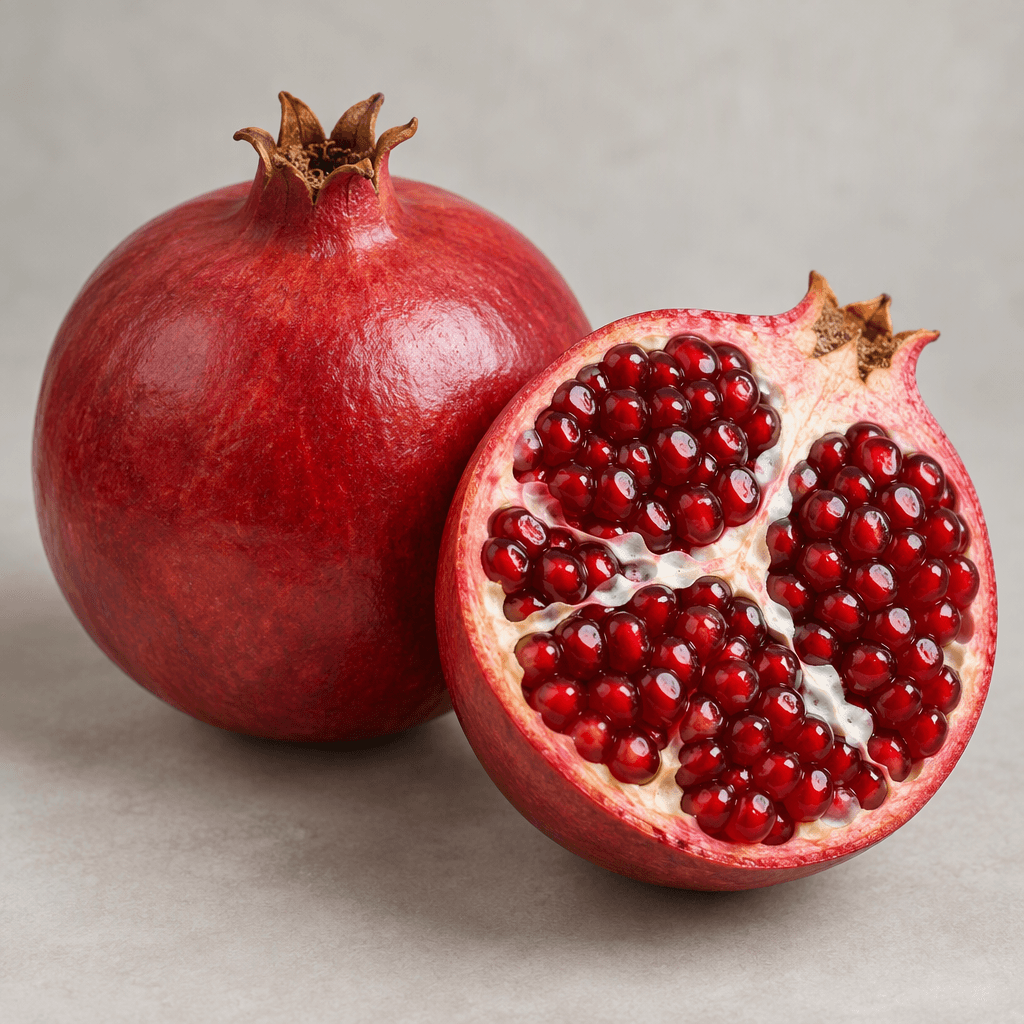
Pomegranate grows across a broad region stretching from western and central Asia to the Mediterranean. Its leathery skin encloses glossy, juicy arils, packed into sections separated by thin pale membranes; the arils are the part usually eaten.
Their flavour balances sweetness with a pleasant tartness, and each bite is juicy with a little crunch from the seed inside. Pomegranate is eaten fresh, scattered over salads and grain dishes, or used in sauces and drinks across the Mediterranean, Middle East and beyond. It provides fibre and vitamin C, with 4 g of fibre per 100 g. Add the arils to yoghurt or a savoury salad for colour and a bright, fresh contrast.
Pomegranate Nutrition Facts
Selected: 100 g
83
KCAL / 100G
Carbs
18.7g
· 7% DV
Protein
1.7g
· 3% DV
Fat
1.2g
· 2% DV
Fiber
4g
· 14% DV
DV is the share of the daily value covered, on a 2,000 kcal reference diet.
Calories come from: Carbs 81% · Protein 7% · Fat 12%
Pomegranate Vitamins & Minerals
Vitamins
Vitamin K
16.4µg · 14% DV
Vitamin C
10.2mg · 11% DV
Folate
38µg · 10% DV
B5
0.38mg · 8% DV
Minerals
Potassium ⭐
236mg · 7% DV
Phosphorus
36mg · 5% DV
Magnesium
12mg · 3% DV
Calcium
10mg · 1% DV
How Nutritious Is Pomegranate?
Nutrient density
High
How many vitamins, minerals and how much fiber this food carries per calorie. A high score means a lot of nutrition for few calories.
Satiety score
Medium
An EatBetter score computed from fiber, protein and calorie density. A high score means staying full longer on the same calories.
Both scores are calculated per 100 g and do not change with the selected portion. The satiety score is EatBetter's own calculation, not a clinical measure.
Pomegranate Glycemic Index
GLYCEMIC INDEX
GLYCEMIC LOAD
Accounts for portion size — a more realistic measure than GI alone.
How to Burn Off Pomegranate
To burn the 83 calories in 100 g:
🚶
Walking (5 km/h)
🏃
Running (8 km/h)
🚴
Cycling
🏊
Swimming
Times are calculated with the MET equation for a 70 kg adult. Actual burn varies with your weight, age and pace.
Is Pomegranate Processed?
NOVA 1
Unprocessed
1. Unprocessed
2. Minimally Processed
3. Processed
4. Ultra-Processed
NOVA classifies foods into 4 groups by industrial processing. NOVA 1 (unprocessed) is the healthiest.
Does Pomegranate Contain Allergens?
No known major allergens
Which Diets Is Pomegranate Good For?
Vegan
✓ Suitable
Vegetarian
✓ Suitable
Gluten-Free
✓ Suitable
Dairy-Free
— Not suitable
Mediterranean
✓ Suitable
Paleo
✓ Suitable
Whole30
— Not suitable
DASH
— Not suitable
Keto
— Not suitable
Low FODMAP
— Not suitable
Pomegranate Fat Profile
SATURATED
0.12g
MONOUNSATURATED
0.09g
POLYUNSATURATED
0.09g
Omega 6:3 ratio 4:1
Below the ideal 4:1 — a good omega balance.
Compare Pomegranate
Foods Similar to Pomegranate
Frequently Asked Questions About Pomegranate
How do you cut a pomegranate without making a mess?
Score the pomegranate skin around the crown and along its natural ridges, then pull it apart over a bowl. Removing the arils in a bowl of water helps contain splashes; the arils sink while much of the pale membrane floats.
Are pomegranate seeds edible?
Yes, the crunchy seed inside each pomegranate aril is edible. The aril includes both the juicy outer part and its seed, and most people eat them together. If you dislike the crunch, you can spit out the seed after enjoying the juice.
How can you tell if a pomegranate is ripe?
A ripe pomegranate usually feels heavy for its size and has taut, firm skin. Color alone is not a reliable test because varieties differ. Avoid fruit with soft, damaged patches or signs of mold.
How do you remove arils from a pomegranate?
Cut off the crown, score the skin along the ridges, and gently break the fruit into sections over a bowl. You can loosen the arils with your fingers or submerge the sections in water to make separating them from the membrane less messy.
How should you store a pomegranate?
Store a whole pomegranate in a cool, dry place away from direct sunlight, or refrigerate it. Once cut or seeded, keep the fruit in a covered container in the refrigerator and eat it while it is fresh.
Can you freeze pomegranate seeds?
Yes, pomegranate arils freeze well. Spread them in a single layer until firm, then transfer them to a sealed freezer container. They may soften after thawing, so frozen arils work especially well in smoothies, sauces, and cooked dishes.
Is pomegranate good for you?
Pomegranate provides fiber and vitamin C, and its arils contain antioxidant plant compounds. Eating the arils gives you more fiber than drinking their juice. It can be part of a varied diet, but it is not a treatment or cure for disease.
Does pomegranate juice stain clothes?
Yes, pomegranate juice can leave a stubborn stain because its pigments can cling to fabric. Rinse the spot promptly with cold water and wash according to the garment’s care instructions. Avoid heat until the stain has come out.
Can you eat the white part of a pomegranate?
Yes, the pale membrane between pomegranate arils is edible, but it tastes bitter and has a tough texture. Most people remove it while separating the arils; accidentally eating a small amount is generally harmless.
What does a pomegranate taste like?
Pomegranate arils taste juicy, bright, and sweet-tart, with a crunchy seed inside. The balance of sweetness and acidity varies by fruit, so ripe arils can taste milder while less-ripe ones are more tart.
Have another question about Pomegranate?
Ask the AI nutrition coach — calories, portions, alternatives and more, answered in seconds in the app.

Scan calories with your camera
Instant AI nutrition analysis

Nutrition data compiled from USDA FoodData Central and scientific sources.