

Ready & Packaged Foods
All →Vegetables & Legumes
All →Desserts & Confectionery
All →Meat & Protein
All →Grains & Bakery
All →Beverages
All →Milk & Dairy
All →

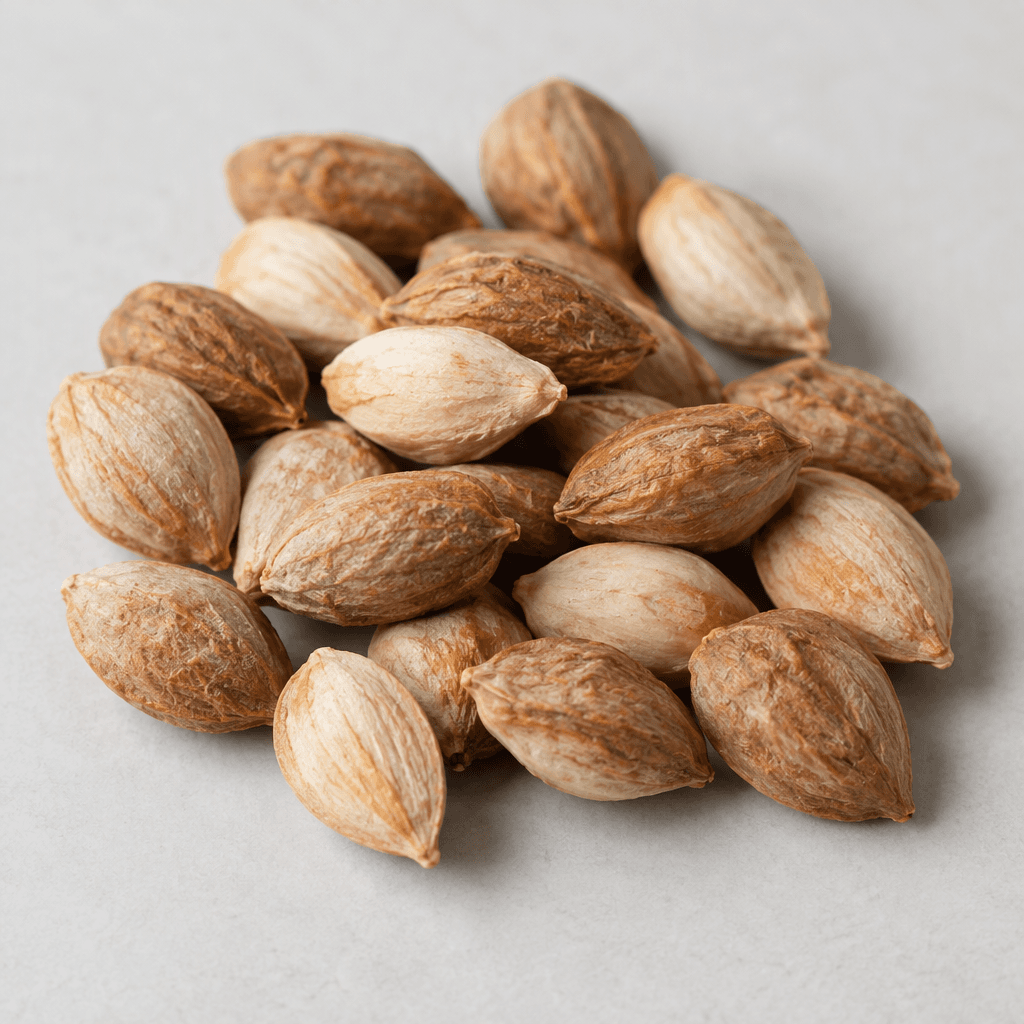
Plum kernel Calories
Rich in fats and vitamin E; bitter kernels may contain amygdalin.
CALORIES
GI
POTASSIUM
FIBER
Quick answer
1 tablespoon (whole) of Plum kernel (10 g) has 58 calories. That works out to 575 calories per 100 g. It contains 1.8 g of carbs, 2.1 g of protein, 4.9 g of fat and 1 g of fiber. Its 2.4 mg of Vitamin E covers 16% of the Daily Value. Its glycemic index is 15 (low), so it raises blood sugar slowly.
What is Plum kernel?
A plum kernel is the small seed inside a plum’s hard stone. The fruit is commonly eaten fresh or cooked, while its kernel is usually discarded rather than treated like a familiar nut or everyday ingredient. It is not a standard snack or cooking staple in most English-speaking households.
The kernel can taste mildly bitter and feel soft yet crisp, with a rich, oily character; it contains fats and vitamin E. Some bitter kernels may contain amygdalin, which can release cyanide in the body, so don’t eat plum kernels raw as a snack. Avoid products unless they are clearly prepared for safe consumption, and enjoy the plum itself instead.
Plum kernel Nutrition Facts
Selected: 100 g
575
KCAL / 100G
Carbs
18g
· 7% DV
Protein
21g
· 42% DV
Fat
49g
· 63% DV
Fiber
10g
· 36% DV
DV is the share of the daily value covered, on a 2,000 kcal reference diet.
Calories come from: Carbs 12% · Protein 14% · Fat 74%
Plum kernel Vitamins & Minerals
Vitamins
Vitamin E
24mg · 160% DV
B2
0.52mg · 40% DV
B3
3.6mg · 23% DV
Biotin
5µg · 17% DV
Minerals
Copper
1mg · 111% DV
Manganese
2mg · 87% DV
Phosphorus
480mg · 69% DV
Magnesium
270mg · 64% DV
How Nutritious Is Plum kernel?
Nutrient density
Medium
How many vitamins, minerals and how much fiber this food carries per calorie. A high score means a lot of nutrition for few calories.
Satiety score
High
An EatBetter score computed from fiber, protein and calorie density. A high score means staying full longer on the same calories.
Both scores are calculated per 100 g and do not change with the selected portion. The satiety score is EatBetter's own calculation, not a clinical measure.
Plum kernel Glycemic Index
GLYCEMIC INDEX
GLYCEMIC LOAD
Accounts for portion size — a more realistic measure than GI alone.
How to Burn Off Plum kernel
To burn the 575 calories in 100 g:
🚶
Walking (5 km/h)
🏃
Running (8 km/h)
🚴
Cycling
🏊
Swimming
Times are calculated with the MET equation for a 70 kg adult. Actual burn varies with your weight, age and pace.
Is Plum kernel Processed?
NOVA 2
Minimally Processed
1. Unprocessed
2. Minimally Processed
3. Processed
4. Ultra-Processed
NOVA classifies foods into 4 groups by industrial processing. NOVA 1 (unprocessed) is the healthiest.
Does Plum kernel Contain Allergens?
Contains these allergens:
Which Diets Is Plum kernel Good For?
Vegan
✓ Suitable
Vegetarian
✓ Suitable
Gluten-Free
✓ Suitable
Dairy-Free
— Not suitable
Mediterranean
✓ Suitable
Paleo
✓ Suitable
Whole30
— Not suitable
DASH
— Not suitable
Keto
✓ Suitable
Low FODMAP
— Not suitable
Plum kernel Fat Profile
SATURATED
3.8g
MONOUNSATURATED
31g
POLYUNSATURATED
12.8g
Omega 6:3 ratio 250:1
Above the ideal 4:1 (250:1).
Compare Plum kernel
Foods Similar to Plum kernel
Frequently Asked Questions About Plum kernel
Can you eat a plum kernel?
No; eating or chewing the kernel inside a plum pit is not considered safe. It may contain amygdalin, which can release cyanide during digestion, so don’t crack plum pits to eat the kernels.
Are plum kernels poisonous?
Plum kernels can pose a poisoning risk because they may contain amygdalin. The amount varies, so a kernel’s appearance or taste cannot tell you whether it is safe to eat.
What happens if you swallow a plum pit?
Swallowing a whole plum pit is different from chewing its kernel; the pit may pass through without being digested. If it was cracked or chewed, or symptoms develop, contact poison control or emergency services.
What should I do if a child eats a plum kernel?
If a child chews or swallows the kernel inside a plum pit, contact poison control or emergency services promptly for advice. Don’t try to make the child vomit, and share how much was eaten and when.
Does amygdalin in plum kernels release cyanide?
Yes; amygdalin can release cyanide when it is broken down in the body. That makes plum kernels unsuitable as a snack, even though they may contain nutrients such as fats and vitamin E.
Does roasting or boiling make plum kernels safe to eat?
No household roasting or boiling method is established as a reliable way to make plum kernels safe. Heating them does not guarantee that the potential amygdalin risk has been removed.
Are plum kernels the same as apricot kernels?
No; plum kernels and apricot kernels come from different fruits. Both may contain amygdalin, so don’t assume that advice or customs about eating one type make the other safe.
Can you use plum kernel oil in food?
Use plum kernel oil in food only when it is specifically produced and sold as edible. Oil made at home from cracked pits, or sold only for cosmetic use, should not be treated as food.
How do you remove a plum kernel from its pit?
Don’t crack a plum pit to get a kernel for eating, since this exposes the part that may contain amygdalin. To remove the pit from the fruit, cut the flesh away around it and discard the pit.
How should plum kernels be stored?
Keep plum kernels in a closed container out of reach of children and pets, and don’t leave them with foods as if they were edible nuts. Storage does not make them safe to eat; discard cracked kernels securely.
Have another question about Plum kernel?
Ask the AI nutrition coach — calories, portions, alternatives and more, answered in seconds in the app.

Scan calories with your camera
Instant AI nutrition analysis

Nutrition data compiled from USDA FoodData Central and scientific sources.