

Ready & Packaged Foods
All →Vegetables & Legumes
All →Desserts & Confectionery
All →Meat & Protein
All →Grains & Bakery
All →Beverages
All →Milk & Dairy
All →

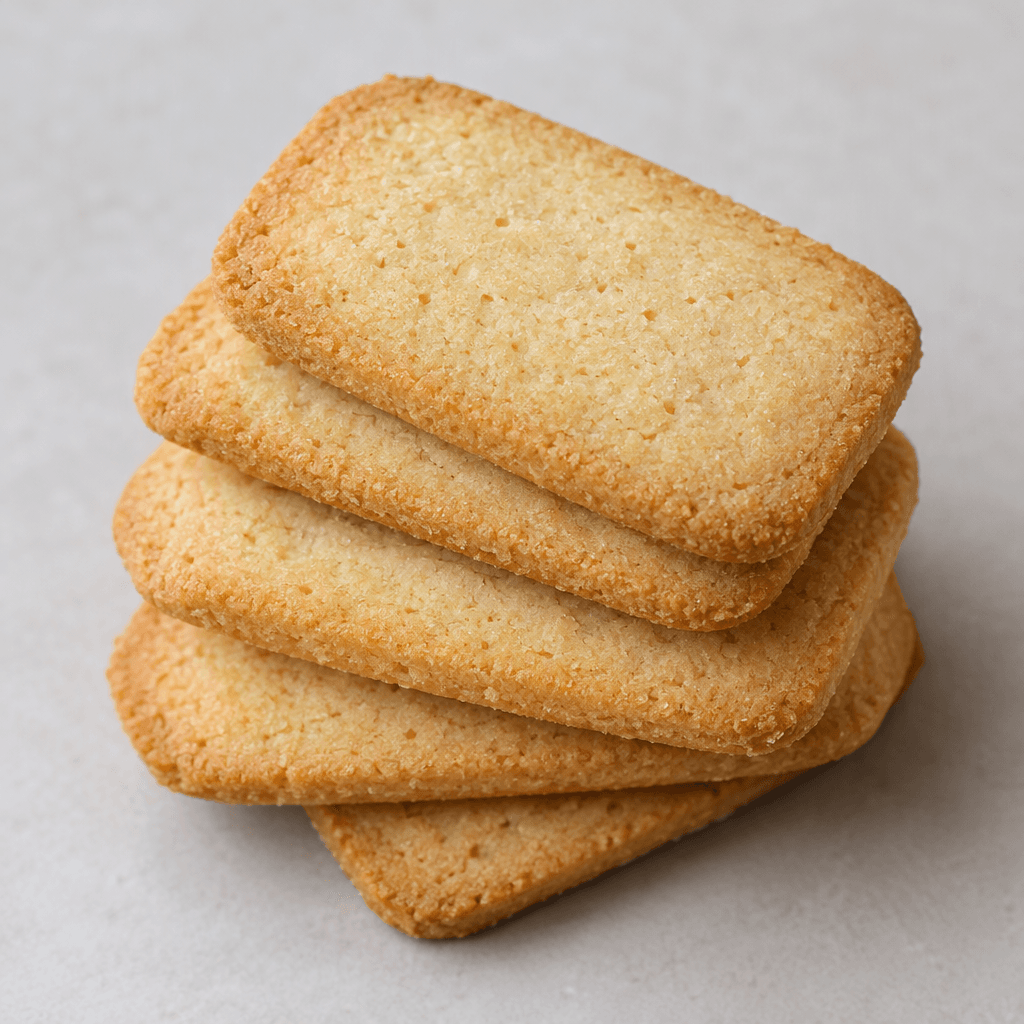
Plain Biscuit Calories
Classic plain biscuit, commonly enjoyed with tea or coffee.
CALORIES
GI
POTASSIUM
FIBER
Quick answer
2 piece (medium) of Plain Biscuit (20 g) has 88 calories. That works out to 440 calories per 100 g. It contains 14.4 g of carbs, 1.4 g of protein, 2.8 g of fat and 0.4 g of fiber. Its glycemic index is 65 (high), so it raises blood sugar quickly.
What is Plain Biscuit?
Plain biscuit refers to a small, crisp, lightly sweet baked biscuit, usually made from a simple flour-based dough. Its pale golden surface and delicate, crumbly texture make it an everyday pantry snack rather than a richly flavoured treat. In the UK and many other places, “biscuit” means a crisp baked snack, not the soft, savoury American-style biscuit.
It is commonly served with tea or coffee, eaten plain, or paired with fruit and a little cheese. Plain Biscuit is mostly a source of carbohydrates and has relatively little fibre, so it works well as a quick accompaniment but may not be especially filling on its own. For a more substantial snack, have it with yoghurt or fruit.
Plain Biscuit Nutrition Facts
Selected: 100 g
440
KCAL / 100G
Carbs
72g
· 26% DV
Protein
7g
· 14% DV
Fat
14g
· 18% DV
Fiber
2g
· 7% DV
DV is the share of the daily value covered, on a 2,000 kcal reference diet.
Calories come from: Carbs 65% · Protein 6% · Fat 29%
Plain Biscuit Vitamins & Minerals
Vitamins
B1
0.18mg · 15% DV
B2
0.12mg · 9% DV
B3
1.2mg · 8% DV
Biotin
2µg · 7% DV
Minerals
Sodium
350mg · 15% DV
Selenium
7µg · 13% DV
Phosphorus
90mg · 13% DV
Iron
2mg · 11% DV
How Nutritious Is Plain Biscuit?
Nutrient density
Low
How many vitamins, minerals and how much fiber this food carries per calorie. A high score means a lot of nutrition for few calories.
Satiety score
Low
An EatBetter score computed from fiber, protein and calorie density. A high score means staying full longer on the same calories.
Both scores are calculated per 100 g and do not change with the selected portion. The satiety score is EatBetter's own calculation, not a clinical measure.
Plain Biscuit Glycemic Index
GLYCEMIC INDEX
GLYCEMIC LOAD
Accounts for portion size — a more realistic measure than GI alone.
How to Burn Off Plain Biscuit
To burn the 440 calories in 100 g:
🚶
Walking (5 km/h)
🏃
Running (8 km/h)
🚴
Cycling
🏊
Swimming
Times are calculated with the MET equation for a 70 kg adult. Actual burn varies with your weight, age and pace.
Is Plain Biscuit Processed?
NOVA 3
Processed
1. Unprocessed
2. Minimally Processed
3. Processed
4. Ultra-Processed
NOVA classifies foods into 4 groups by industrial processing. NOVA 1 (unprocessed) is the healthiest.
Does Plain Biscuit Contain Allergens?
Contains these allergens:
Which Diets Is Plain Biscuit Good For?
Vegan
— Not suitable
Vegetarian
✓ Suitable
Gluten-Free
— Not suitable
Dairy-Free
— Not suitable
Mediterranean
— Not suitable
Paleo
— Not suitable
Whole30
— Not suitable
DASH
— Not suitable
Keto
— Not suitable
Low FODMAP
— Not suitable
Plain Biscuit Fat Profile
SATURATED
5.5g
MONOUNSATURATED
4.2g
POLYUNSATURATED
2.3g
Omega 6:3 ratio 110:1
Above the ideal 4:1 (110:1).
Compare Plain Biscuit
Foods Similar to Plain Biscuit
Frequently Asked Questions About Plain Biscuit
What are plain biscuits made of?
Plain biscuits are usually made with flour, fat, sugar, and a raising agent, with salt and sometimes milk or egg. Recipes vary, so “plain” describes their mild flavour rather than a fixed ingredient list.
Are plain biscuits the same as shortbread?
No, plain biscuits and shortbread are not the same. Shortbread is traditionally rich in butter and has a distinctive crumbly texture, while plain biscuits are a broader category and are often lighter and less buttery.
Why do plain biscuits go soft in tea?
Plain biscuits go soft because their porous baked structure quickly absorbs liquid. Dip one briefly if you want it to hold together; leaving it in tea for too long can make it collapse into the cup.
Can you use plain biscuits for a cheesecake base?
Yes, plain biscuits work well as a cheesecake base. Crush them finely, mix with melted butter, and press the mixture firmly into the tin before chilling or baking it as your recipe directs.
How do you make a biscuit pudding with plain biscuits?
Plain biscuits can be layered with custard or pudding to make a simple chilled dessert. Alternate the biscuits and filling in a dish, then refrigerate until the biscuits soften; add fruit or cocoa if you want extra flavour.
How should you store plain biscuits after opening?
Store opened plain biscuits in an airtight container in a cool, dry cupboard. Exposure to air and humidity makes them lose their crispness, so fold the packet closed only if it seals tightly.
Can plain biscuits be frozen?
Yes, plain biscuits can be frozen in a tightly sealed freezer-safe container. They may lose some crispness after thawing, so freezing works best when you plan to crumble them into a dessert rather than serve them plain.
What can you use instead of plain biscuits in a recipe?
Digestive biscuits or graham crackers can replace plain biscuits in many crumb crusts and layered desserts. They may taste sweeter or more strongly flavoured, so the finished recipe will not taste exactly the same.
Are plain biscuits a good snack for weight loss?
Plain biscuits can fit into a weight-loss eating plan, but they are not especially filling on their own. Pairing a small portion with a protein-rich food, such as yoghurt, may make a snack more satisfying.
Can children eat plain biscuits every day?
Children can eat plain biscuits occasionally, but they are better treated as a snack than a daily staple. Offer them alongside more nourishing foods, and supervise young children because dry, crumbly pieces can be difficult to manage.
Have another question about Plain Biscuit?
Ask the AI nutrition coach — calories, portions, alternatives and more, answered in seconds in the app.

Scan calories with your camera
Instant AI nutrition analysis

Nutrition data compiled from USDA FoodData Central and scientific sources.