

Ready & Packaged Foods
All →Vegetables & Legumes
All →Desserts & Confectionery
All →Meat & Protein
All →Grains & Bakery
All →Beverages
All →Milk & Dairy
All →

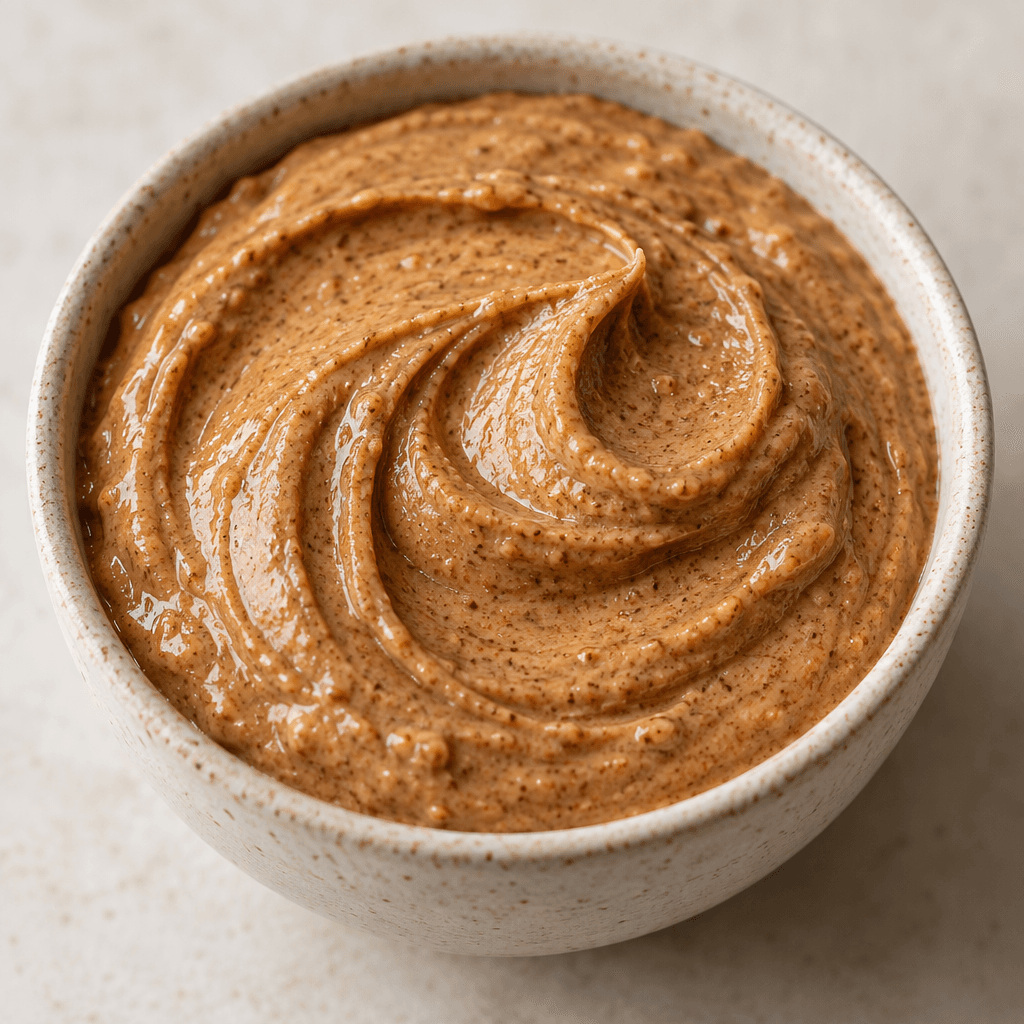
Plain almond butter Calories
Rich in healthy fats and vitamin E
CALORIES · 100 G
GI
POTASSIUM · 100 G
FIBER · 100 G
Quick answer
1 tablespoon (medium) of Plain almond butter (16 g) has 98 calories. That works out to 614 calories per 100 g. It contains 3 g of carbs, 3.4 g of protein, 8.9 g of fat and 1.7 g of fiber. Its 3.9 mg of Vitamin E covers 26% of the Daily Value. Its glycemic index is 15 (low), so it raises blood sugar slowly.
Plain almond butter Nutrition Facts
Selected: 1 tablespoon (medium) · 16 g
98
KCAL / 16G
Carbs
3g
· 1% DV
Protein
3.4g
· 7% DV
Fat
8.9g
· 11% DV
Fiber
1.7g
· 6% DV
DV is the share of the daily value covered, on a 2,000 kcal reference diet.
Calories come from: Carbs 11% · Protein 13% · Fat 76%
Plain almond butter nutrition facts table · 1 tablespoon (medium) (16 g)
| Nutrient | Amount | % DV |
|---|---|---|
| Calories | 98 kcal | |
| Total fat | 8.9 g | 11% |
| Saturated fat | 0.67 g | 3% |
| Trans fat | 0 g | |
| Sodium | 0.8 mg | 0% |
| Total carbohydrate | 3 g | 1% |
| Fiber | 1.7 g | 6% |
| Protein | 3.4 g | 7% |
Calories: Calories measure energy. Average daily need is 2,000 kcal. Excess calories are stored as fat, too few cause weight loss.
Carbs: Your body's primary energy source. The brain runs exclusively on carbs. Daily need: 275g.
Protein: Essential for muscle repair and cell growth. Daily need: 50g. Keeps you full and boosts metabolism.
Fat: Needed for hormone production and vitamin absorption. Daily need: 78g. Limit saturated fats, choose unsaturated.
Fiber: Critical for digestive health and satiety. Daily need: 28g. Stabilizes blood sugar, lowers cholesterol.

Log this food in EatBetter
100,000+ people use it
- Get your daily calorie target
- Snap your meal, log it in seconds
- See every vitamin and mineral

📸 Scan the code to get the app free.

How Many Calories in 1 Tablespoon of Plain almond butter?
| Serving | Amount | Calories |
|---|---|---|
| 1 tablespoon (medium) | 16 g | 98 kcal |
| 1 teaspoon (small) | 5 g | 31 kcal |
| 1 serving (small) | 20 g | 123 kcal |
| 1 ounce (medium) | 28 g | 172 kcal |
| 1 serving (medium) | 30 g | 184 kcal |
| 2 tablespoon (double) | 32 g | 196 kcal |
| 1 serving (large) | 45 g | 276 kcal |
| 100 g | 100 g | 614 kcal |
| 1 cup (whole) | 256 g | 1572 kcal |
Calculated from 614 calories per 100 g.
Frequently Asked Questions About Plain almond butter
What is the difference between plain almond butter and almond paste?
Plain almond butter is usually ground almonds with a spreadable texture, while almond paste is typically made with sugar and is used in baking. They are not interchangeable in equal amounts: almond paste makes recipes sweeter and denser.
Why does plain almond butter separate?
The oil on top is natural almond oil separating from the ground nuts, not a sign that plain almond butter has gone bad. Stir it thoroughly from the bottom up with a clean, dry spoon, then close the jar tightly.
How do you make plain almond butter at home?
To make plain almond butter, blend roasted almonds in a food processor, stopping to scrape down the sides until they release their oils and turn smooth. It can take several minutes; adding water can make the texture less stable.
Can plain almond butter replace peanut butter in baking?
Yes, plain almond butter can often replace peanut butter in cookies, bars, and other recipes in a similar amount. It has a milder, slightly sweeter flavor, and a different thickness may change the texture, so adjust other ingredients only if needed.
Should plain almond butter be refrigerated after opening?
Follow the storage directions on the jar; many plain almond butters can be kept tightly closed in a cool, dry cupboard. Refrigeration can slow oil separation but makes the spread firmer. Always use a clean, dry utensil to avoid introducing moisture.
Is it normal for plain almond butter to be gritty?
Yes, plain almond butter can be slightly gritty, especially when it is minimally processed or made from whole almonds. Stirring may make it more uniform, but it will not always become as silky as a product made with extra processing.
Can you eat plain almond butter straight from the jar?
Yes, plain almond butter can be eaten on its own, though its thick texture makes it easy to take a large spoonful. It is also easy to pair with apple slices, toast, oatmeal, or yogurt for a more filling snack.
How can you tell if plain almond butter has gone bad?
Plain almond butter may be rancid if it smells like old oil or tastes unpleasantly bitter or stale. Natural oil on the surface is normal, but discard the product if you see mold or notice an unusual smell after stirring.
Is plain almond butter good for weight loss?
Plain almond butter is not a weight-loss food by itself. Its fat and fiber may help make a snack satisfying, but it is energy-dense, so spreading a small amount rather than eating freely from the jar can help keep portions in check.
Can people with diabetes eat plain almond butter?
Yes, people with diabetes can generally include plain almond butter, especially an unsweetened kind, as part of a meal or snack. What it is paired with and the portion matter; anyone adjusting diabetes medication or meal plans should consult their healthcare professional.
Plain almond butter Vitamins & Minerals
Vitamins
Vitamin E
3.87mg · 26% DV
B2
0.16mg · 12% DV
Biotin
2.72µg · 9% DV
B3
0.54mg · 3% DV
Minerals
Copper
0.14mg · 16% DV
Manganese
0.32mg · 14% DV
Phosphorus
77mg · 11% DV
Magnesium
43mg · 10% DV
Potassium ⭐
117mg · 3% DV
Sodium
0.8mg · 0% DV
Plain almond butter Glycemic Index
GLYCEMIC INDEX
GLYCEMIC LOAD
Accounts for portion size — a more realistic measure than GI alone.
How to Burn Off Plain almond butter
To burn the 98 calories in 1 tablespoon (medium) (16 g):
🚶
Walking (5 km/h)
🏃
Running (8 km/h)
🚴
Cycling
🏊
Swimming
Times are calculated with the MET equation for a 70 kg adult. Actual burn varies with your weight, age and pace.
What is Plain almond butter?
Plain almond butter is made by grinding almonds into a thick spread, usually without added sugar or salt. It may be smooth or slightly coarse, with a gently sweet, toasted-nut flavour. It is enjoyed in many places, though recipes and serving habits vary.
Spread it on toast, stir it into porridge or yoghurt, or pair it with apple or banana slices. It also works in baking and sauces, adding a rich, nutty taste. Plain almond butter is high in unsaturated fats and provides protein and fibre, so a modest spoonful can make a snack feel more satisfying. For a lighter pairing, use a thin layer with fresh fruit rather than adding it to several rich ingredients.
How Nutritious Is Plain almond butter?
Nutrient density
High
How many vitamins, minerals and how much fiber this food carries per calorie. A high score means a lot of nutrition for few calories.
Satiety score
High
An EatBetter score computed from fiber, protein and calorie density. A high score means staying full longer on the same calories.
Both scores are calculated per 100 g and do not change with the selected portion. The satiety score is EatBetter's own calculation, not a clinical measure.
Is Plain almond butter Processed?
NOVA 2
Minimally Processed
1. Unprocessed
2. Minimally Processed
3. Processed
4. Ultra-Processed
NOVA classifies foods into 4 groups by industrial processing. NOVA 1 (unprocessed) is the healthiest.
Does Plain almond butter Contain Allergens?
Contains these allergens:
Which Diets Is Plain almond butter Good For?
Vegan
✓ Suitable
Vegetarian
✓ Suitable
Gluten-Free
✓ Suitable
Dairy-Free
— Not suitable
Mediterranean
✓ Suitable
Paleo
✓ Suitable
Whole30
— Not suitable
DASH
— Not suitable
Keto
✓ Suitable
Low FODMAP
— Not suitable
Plain almond butter Fat Profile
SATURATED
0.67g
MONOUNSATURATED
5.46g
POLYUNSATURATED
1.98g
Compare Plain almond butter
Foods Similar to Plain almond butter
Have another question about Plain almond butter?
Ask the AI nutrition coach — calories, portions, alternatives and more, answered in seconds in the app.

Scan calories with your camera
Instant AI nutrition analysis

Nutrition data compiled from USDA FoodData Central and scientific sources.