

Ready & Packaged Foods
All →Vegetables & Legumes
All →Desserts & Confectionery
All →Meat & Protein
All →Grains & Bakery
All →Beverages
All →Milk & Dairy
All →

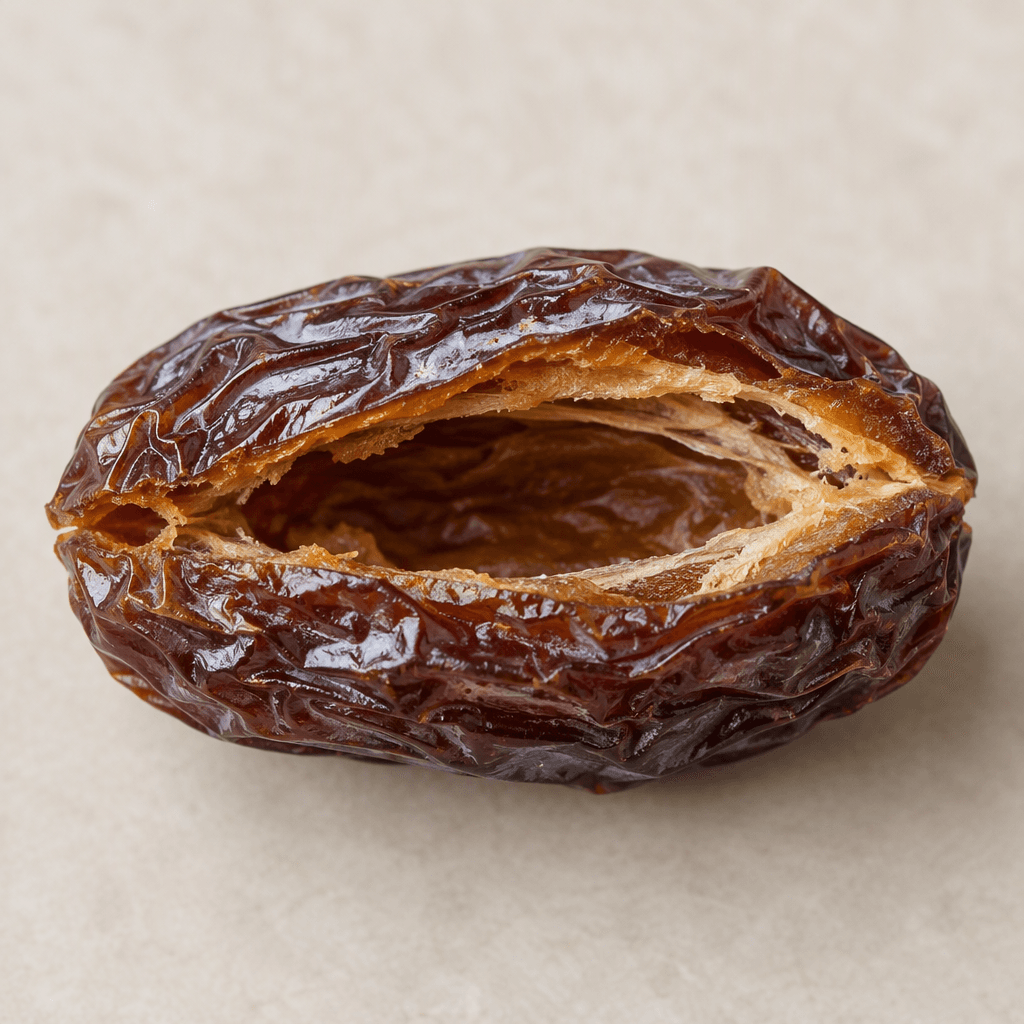
Pitted date Calories
Naturally sweet and fiber-rich
In season: Spring · Summer · Autumn · Winter
CALORIES · 100 G
GI
POTASSIUM · 100 G
FIBER · 100 G
Quick answer
3 piece (medium) of Pitted date (24 g) has 68 calories. That works out to 282 calories per 100 g. It contains 18 g of carbs, 0.6 g of protein, 0.1 g of fat and 1.9 g of fiber. Its 0.1 mg of Copper covers 6% of the Daily Value. Its glycemic index is 62 (medium), so it raises blood sugar at a moderate pace.
Pitted date Nutrition Facts
Selected: 3 piece (medium) · 24 g
68
KCAL / 24G
Carbs
18g
· 7% DV
Protein
0.6g
· 1% DV
Fat
0.1g
· 0% DV
Fiber
1.9g
· 7% DV
DV is the share of the daily value covered, on a 2,000 kcal reference diet.
Calories come from: Carbs 96% · Protein 3% · Fat 1%
Pitted date nutrition facts table · 3 piece (medium) (24 g)
| Nutrient | Amount | % DV |
|---|---|---|
| Calories | 68 kcal | |
| Total fat | 0.1 g | 0% |
| Saturated fat | 0.01 g | 0% |
| Trans fat | 0 g | |
| Sodium | 0.48 mg | 0% |
| Total carbohydrate | 18 g | 7% |
| Fiber | 1.9 g | 7% |
| Protein | 0.6 g | 1% |
Calories: Calories measure energy. Average daily need is 2,000 kcal. Excess calories are stored as fat, too few cause weight loss.
Carbs: Your body's primary energy source. The brain runs exclusively on carbs. Daily need: 275g.
Protein: Essential for muscle repair and cell growth. Daily need: 50g. Keeps you full and boosts metabolism.
Fat: Needed for hormone production and vitamin absorption. Daily need: 78g. Limit saturated fats, choose unsaturated.
Fiber: Critical for digestive health and satiety. Daily need: 28g. Stabilizes blood sugar, lowers cholesterol.

Log this food in EatBetter
100,000+ people use it
- Get your daily calorie target
- Snap your meal, log it in seconds
- See every vitamin and mineral

📸 Scan the code to get the app free.

How Many Calories in 3 Pieces of Pitted date?
| Serving | Amount | Calories |
|---|---|---|
| 3 piece (medium) | 24 g | 68 kcal |
| 1 piece (small) | 8 g | 23 kcal |
| 30 g | 30 g | 85 kcal |
| 5 piece (large) | 40 g | 113 kcal |
| 0.25 cup (chopped) | 40 g | 113 kcal |
| 7 piece (extra large) | 56 g | 158 kcal |
| ½ cup (chopped) | 80 g | 226 kcal |
| 100 g | 100 g | 282 kcal |
| 1 cup (chopped) | 160 g | 451 kcal |
Calculated from 282 calories per 100 g.
Frequently Asked Questions About Pitted date
Can you freeze pitted dates?
Yes, pitted dates freeze well. Seal them in an airtight freezer container or bag, ideally in portions, so you can take out only what you need. Thaw them in the refrigerator or use them straight from frozen in smoothies and baking.
How do you use pitted dates as a sweetener?
Blend pitted dates with a little warm water to make a paste for oatmeal, sauces, or baked goods. Date paste adds sweetness and texture, so it may not replace granulated sugar cup for cup in recipes that rely on sugar for structure.
Do you need to wash pitted dates before eating them?
You can rinse pitted dates under cool running water just before eating, then pat them dry. Washing is especially useful if they feel dusty or sticky, but avoid leaving them wet in storage because extra moisture can encourage spoilage.
How can you tell if pitted dates have gone bad?
Discard pitted dates if you see mold, notice a sour or fermented smell, or find that they have become unusually wet. A pale, sugary coating can be harmless crystallized sugar, so check the smell and texture rather than judging by color alone.
Are pitted dates a good pre-workout snack?
Yes, pitted dates can be a convenient pre-workout snack because their carbohydrates provide readily available energy. For a longer session, pair them with something more filling, such as yogurt or nuts, and allow time to see how your stomach responds.
What does “pitted” mean on a package of dates?
“Pitted” means the hard stone has been removed from the date before packaging. The fruit is still a date, but its exposed center can dry out more readily, so reseal the package after opening.
Should pitted dates be refrigerated after opening?
Refrigeration is a good choice after opening, particularly if your kitchen is warm or you want to keep the dates soft for longer. Keep pitted dates sealed in a clean container so they do not absorb odors or dry out.
Can you eat the skin on pitted dates?
Yes, the thin skin on pitted dates is edible and is normally eaten with the fruit. You do not need to peel it; simply check the dates for any damaged or moldy spots before eating.
Why are my pitted dates hard, and how can I soften them?
Pitted dates can harden as they lose moisture during storage. Soften them by soaking briefly in warm water, then drain well; if you are adding them to a smoothie or paste, blending with liquid can do the same job.
Are Medjool and Deglet Noor pitted dates different?
Yes, Medjool and Deglet Noor are different date varieties, even when both are pitted. Medjool dates are generally larger and softer, while Deglet Noor dates tend to be firmer and less moist; either can be eaten as-is or used in recipes.
Pitted date Vitamins & Minerals
Vitamins
B5
0.14mg · 3% DV
B3
0.38mg · 2% DV
B6
0.04mg · 2% DV
Biotin
0.36µg · 1% DV
Minerals
Copper
0.05mg · 6% DV
Potassium ⭐
157mg · 5% DV
Manganese
0.06mg · 3% DV
Magnesium
10mg · 2% DV
Sodium
0.48mg · 0% DV
Pitted date Glycemic Index
GLYCEMIC INDEX
GLYCEMIC LOAD
Accounts for portion size — a more realistic measure than GI alone.
How to Burn Off Pitted date
To burn the 68 calories in 3 piece (medium) (24 g):
🚶
Walking (5 km/h)
🏃
Running (8 km/h)
🚴
Cycling
🏊
Swimming
Times are calculated with the MET equation for a 70 kg adult. Actual burn varies with your weight, age and pace.
What is Pitted date?
Pitted dates are the sweet fruits of the date palm, dried and had their stones removed. They are widely grown across the Middle East and North Africa, with varieties ranging from soft and chewy to firmer and drier. Their flavour is rich and honeyed, often with caramel-like notes, so a little can bring plenty of sweetness to a snack or recipe.
In date-growing regions they are eaten plain, offered with coffee, or used in sweets; elsewhere, they work well chopped into porridge, yoghurt, salads and baking. They are naturally sweet and provide 8 g of fibre per 100 g, with very little fat. Pair one or two with nuts for a more filling snack, or use them to sweeten a dish in place of some added sugar.
How Nutritious Is Pitted date?
Nutrient density
Medium
How many vitamins, minerals and how much fiber this food carries per calorie. A high score means a lot of nutrition for few calories.
Satiety score
Medium
An EatBetter score computed from fiber, protein and calorie density. A high score means staying full longer on the same calories.
Both scores are calculated per 100 g and do not change with the selected portion. The satiety score is EatBetter's own calculation, not a clinical measure.
Is Pitted date Processed?
NOVA 2
Minimally Processed
1. Unprocessed
2. Minimally Processed
3. Processed
4. Ultra-Processed
NOVA classifies foods into 4 groups by industrial processing. NOVA 1 (unprocessed) is the healthiest.
Does Pitted date Contain Allergens?
No known major allergens
Which Diets Is Pitted date Good For?
Vegan
✓ Suitable
Vegetarian
✓ Suitable
Gluten-Free
✓ Suitable
Dairy-Free
— Not suitable
Mediterranean
✓ Suitable
Paleo
✓ Suitable
Whole30
— Not suitable
DASH
— Not suitable
Keto
— Not suitable
Low FODMAP
— Not suitable
Pitted date Fat Profile
SATURATED
0.01g
MONOUNSATURATED
0.01g
POLYUNSATURATED
0g
Compare Pitted date
Foods Similar to Pitted date
Have another question about Pitted date?
Ask the AI nutrition coach — calories, portions, alternatives and more, answered in seconds in the app.

Scan calories with your camera
Instant AI nutrition analysis

Nutrition data compiled from USDA FoodData Central and scientific sources.