

Ready & Packaged Foods
All →Vegetables & Legumes
All →Desserts & Confectionery
All →Meat & Protein
All →Grains & Bakery
All →Beverages
All →Milk & Dairy
All →

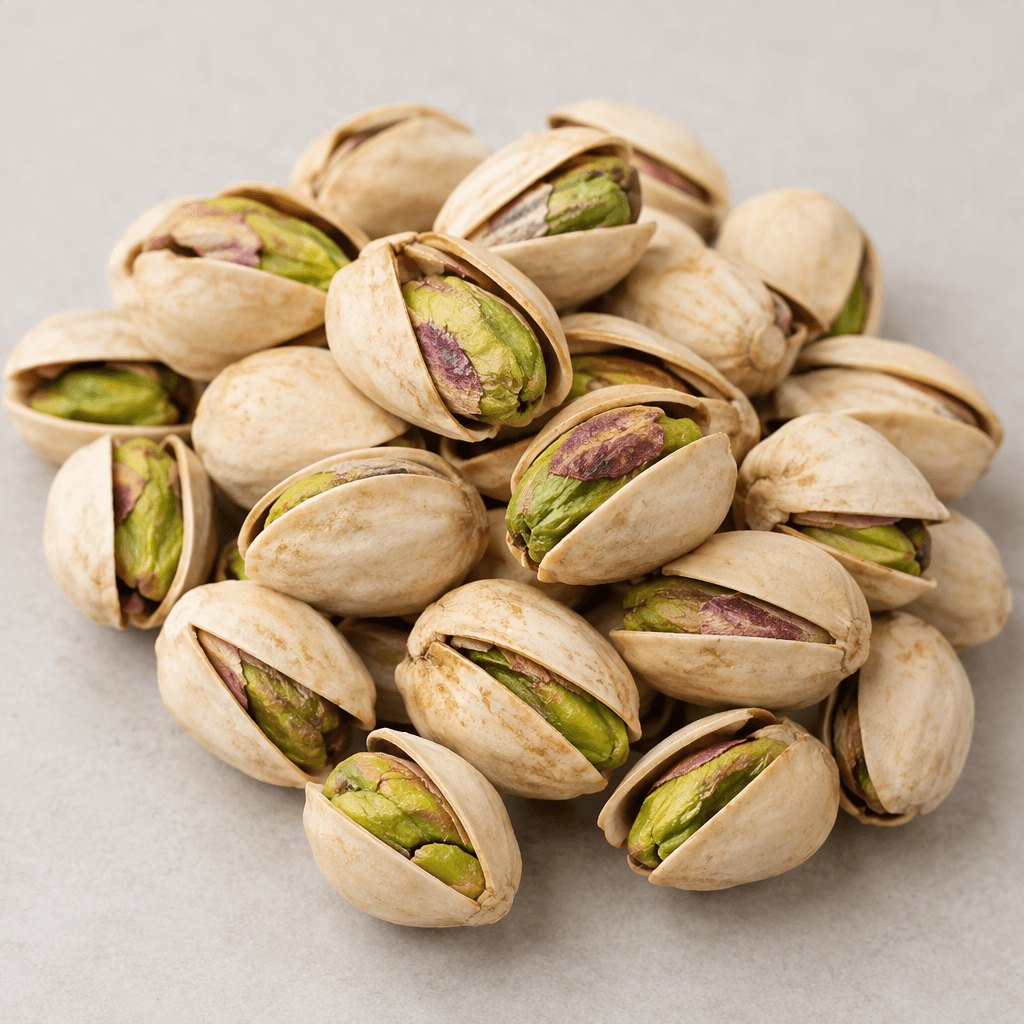
Pistachios (shell-on) Calories
Shell-on, rich in fiber and healthy fats
In season: Summer · Autumn
CALORIES
GI
POTASSIUM
FIBER
Quick answer
1 piece (whole) of Pistachios (shell-on) (3 g) has 14 calories. That works out to 560 calories per 100 g. It contains 0.7 g of carbs, 0.5 g of protein, 1.1 g of fat and 0.3 g of fiber. Its glycemic index is 15 (low), so it raises blood sugar slowly.
What is Pistachios (shell-on)?
Pistachios (shell-on) are the kernels of the pistachio tree still enclosed in their naturally split, pale shells. Antep pistachios are especially associated with Gaziantep and southeastern Turkey, where they are also prized in sweets such as baklava. Sold roasted or plain, shell-on pistachios are commonly eaten as a snack: crack each shell open, then eat the kernel.
They have a gently sweet, earthy flavour and a firm crunch, with a tender centre. Their fat and fibre make them a satisfying choice between meals; 100 grams provides 10.3 grams of fibre. For a lighter snack, choose an unsalted version and serve a modest handful with fresh fruit or tea.
Pistachios (shell-on) Nutrition Facts
Selected: 100 g
560
KCAL / 100G
Carbs
27.2g
· 10% DV
Protein
20.3g
· 41% DV
Fat
45.4g
· 58% DV
Fiber
10.3g
· 37% DV
DV is the share of the daily value covered, on a 2,000 kcal reference diet.
Calories come from: Carbs 18% · Protein 14% · Fat 68%
Pistachios (shell-on) Vitamins & Minerals
Vitamins
B6
1.7mg · 100% DV
B1
0.87mg · 73% DV
Vitamin E
2.3mg · 15% DV
Folate
51µg · 13% DV
Minerals
Copper
1mg · 111% DV
Phosphorus
490mg · 70% DV
Manganese
1mg · 43% DV
Potassium ⭐
1020mg · 30% DV
How Nutritious Is Pistachios (shell-on)?
Nutrient density
Very high
How many vitamins, minerals and how much fiber this food carries per calorie. A high score means a lot of nutrition for few calories.
Satiety score
High
An EatBetter score computed from fiber, protein and calorie density. A high score means staying full longer on the same calories.
Both scores are calculated per 100 g and do not change with the selected portion. The satiety score is EatBetter's own calculation, not a clinical measure.
Pistachios (shell-on) Glycemic Index
GLYCEMIC INDEX
GLYCEMIC LOAD
Accounts for portion size — a more realistic measure than GI alone.
How to Burn Off Pistachios (shell-on)
To burn the 560 calories in 100 g:
🚶
Walking (5 km/h)
🏃
Running (8 km/h)
🚴
Cycling
🏊
Swimming
Times are calculated with the MET equation for a 70 kg adult. Actual burn varies with your weight, age and pace.
Is Pistachios (shell-on) Processed?
NOVA 2
Minimally Processed
1. Unprocessed
2. Minimally Processed
3. Processed
4. Ultra-Processed
NOVA classifies foods into 4 groups by industrial processing. NOVA 1 (unprocessed) is the healthiest.
Does Pistachios (shell-on) Contain Allergens?
Contains these allergens:
Which Diets Is Pistachios (shell-on) Good For?
Vegan
✓ Suitable
Vegetarian
✓ Suitable
Gluten-Free
✓ Suitable
Dairy-Free
— Not suitable
Mediterranean
✓ Suitable
Paleo
✓ Suitable
Whole30
— Not suitable
DASH
— Not suitable
Keto
✓ Suitable
Low FODMAP
— Not suitable
Pistachios (shell-on) Fat Profile
SATURATED
5.6g
MONOUNSATURATED
23.3g
POLYUNSATURATED
13.7g
Omega 6:3 ratio 54:1
Above the ideal 4:1 (54:1).
Compare Pistachios (shell-on)
Foods Similar to Pistachios (shell-on)
Frequently Asked Questions About Pistachios (shell-on)
How do you open pistachios (shell-on) that are closed?
Use the edge of an empty pistachio shell as a small wedge: push it into the narrow gap and twist gently. If there is no gap at all, the kernel may be underdeveloped, and forcing the shell with your teeth can damage them.
Can you eat the shell of pistachios (shell-on)?
No, the hard outer shell of pistachios (shell-on) is not meant to be eaten; eat the kernel inside instead. The thin purplish or reddish skin covering the kernel is edible, though you can remove it if you prefer.
Why do pistachios (shell-on) have shells that split open?
Pistachios (shell-on) naturally split as the nut matures and the kernel grows inside its shell. A closed shell is not automatically a sign of spoilage, but it may contain a smaller kernel and can be difficult to open.
How do you roast pistachios (shell-on) at home?
Spread pistachios (shell-on) in a single layer on a baking tray and roast them in a moderate oven, stirring occasionally. Watch closely near the end so they do not burn. Add salt after roasting if desired, rather than relying on salted nuts.
How should you store pistachios (shell-on)?
Keep pistachios (shell-on) in an airtight container in a cool, dry place away from sunlight. Heat and moisture can make their natural oils turn rancid. For longer storage, refrigerate or freeze them in a well-sealed container.
Are pistachios (shell-on) raw or roasted?
Pistachios (shell-on) can be sold raw or roasted, so the shells alone do not tell you which they are. Raw kernels taste milder; roasting brings out a deeper, toastier flavor. Salted roasted versions contain added salt, unlike unsalted nuts.
Why are some pistachios (shell-on) empty?
Some pistachios (shell-on) develop without a full kernel because pollination or growing conditions were not ideal. An empty shell is usually a natural variation, not evidence that the whole batch has gone bad; discard any nuts that smell or taste rancid.
How can you tell if pistachios (shell-on) have gone bad?
Pistachios (shell-on) that smell sour, musty, or like old paint, or taste distinctly bitter, may have rancid oils and should be discarded. Fresh kernels are crisp and have a mild, nutty aroma rather than a stale or oily one.
Are pistachios (shell-on) good for weight loss?
Pistachios (shell-on) can fit into a weight-loss eating plan, but they are easy to overeat because they are energy-dense. Having them in their shells may slow snacking, and setting aside a portion is more useful than eating from a large bag.
Can dogs eat pistachios (shell-on)?
Pistachios (shell-on) are not a good treat for dogs: the shells can pose a choking or intestinal blockage risk, and salted or moldy nuts can be harmful. If a dog swallows shells or becomes unwell after eating pistachios, contact a veterinarian.
Have another question about Pistachios (shell-on)?
Ask the AI nutrition coach — calories, portions, alternatives and more, answered in seconds in the app.

Scan calories with your camera
Instant AI nutrition analysis

Nutrition data compiled from USDA FoodData Central and scientific sources.