

Ready & Packaged Foods
All →Vegetables & Legumes
All →Desserts & Confectionery
All →Meat & Protein
All →Grains & Bakery
All →Beverages
All →Milk & Dairy
All →

Pistachio halva Calories
Traditional sweet, enriched with pistachios, high energy
In season: Spring · Summer · Autumn · Winter
CALORIES
GI
POTASSIUM
FIBER
Quick answer
1 slice (medium) of Pistachio halva (40 g) has 192 calories. That works out to 480 calories per 100 g. It contains 21.2 g of carbs, 3.4 g of protein, 10.4 g of fat and 1.4 g of fiber. Its 0.1 mg of Copper covers 14% of the Daily Value. Its glycemic index is 65 (high), so it raises blood sugar quickly.
What is Pistachio halva?
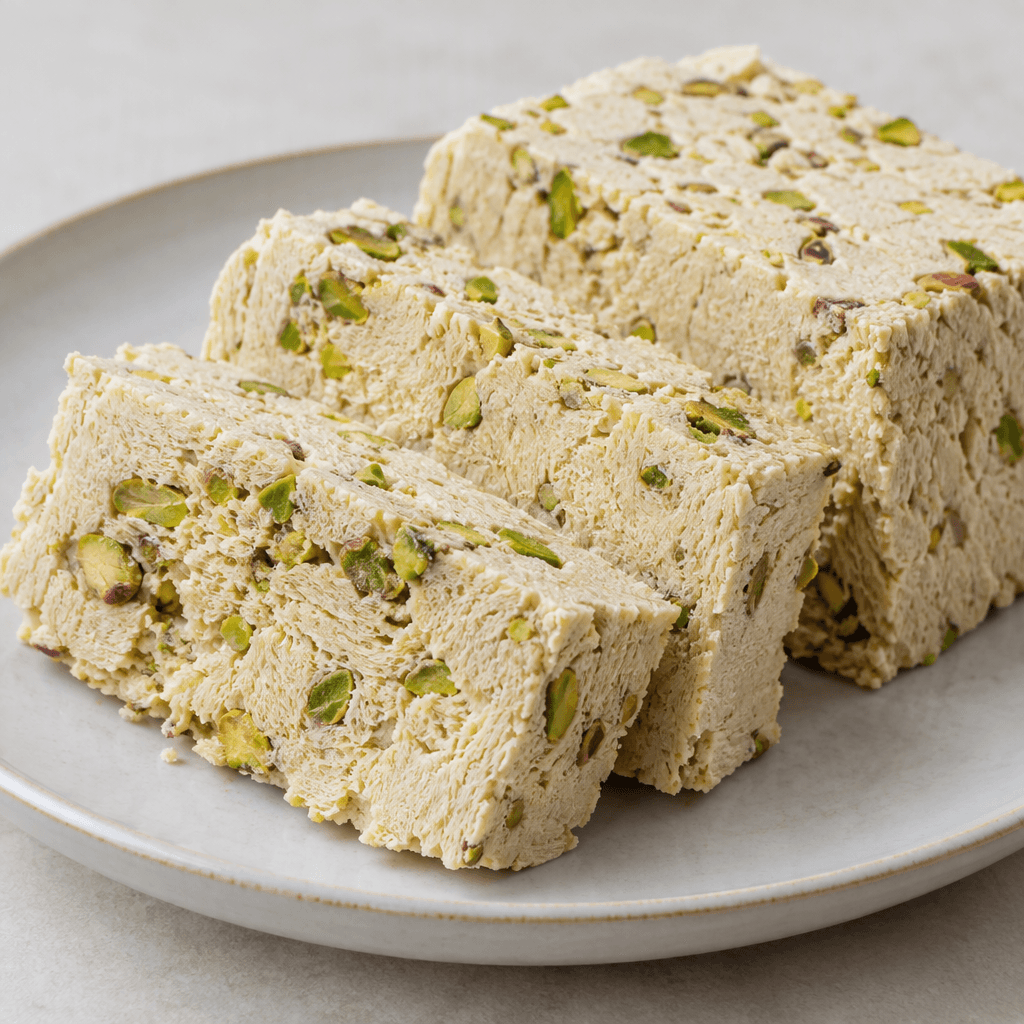
Pistachio halva is a traditional Turkish-style sweet, usually made by combining tahini with sugar and folding in pistachios. It has a dense, crumbly texture that pulls into fine strands, with the toasted, nutty taste of sesame balanced by the pistachios.
In Turkey and across communities familiar with Middle Eastern sweets, it is often served in small slices with tea or after a meal; elsewhere, it also makes a rich treat to share. It is energy-dense, with some protein and fat from the sesame and nuts. For a lighter serving, cut a thin slice and pair it with fresh fruit or unsweetened tea.
Pistachio halva Nutrition Facts
Selected: 100 g
480
KCAL / 100G
Carbs
53g
· 19% DV
Protein
8.5g
· 17% DV
Fat
26g
· 33% DV
Fiber
3.5g
· 13% DV
DV is the share of the daily value covered, on a 2,000 kcal reference diet.
Calories come from: Carbs 44% · Protein 7% · Fat 49%
Pistachio halva Vitamins & Minerals
Vitamins
Vitamin E
2.1mg · 14% DV
B1
0.12mg · 10% DV
B6
0.13mg · 8% DV
Biotin
2.5µg · 8% DV
Minerals
Phosphorus
120mg · 17% DV
Calcium
110mg · 11% DV
Iron
2mg · 11% DV
Magnesium
45mg · 11% DV
How Nutritious Is Pistachio halva?
Nutrient density
Medium
How many vitamins, minerals and how much fiber this food carries per calorie. A high score means a lot of nutrition for few calories.
Satiety score
Low
An EatBetter score computed from fiber, protein and calorie density. A high score means staying full longer on the same calories.
Both scores are calculated per 100 g and do not change with the selected portion. The satiety score is EatBetter's own calculation, not a clinical measure.
Pistachio halva Glycemic Index
GLYCEMIC INDEX
GLYCEMIC LOAD
Accounts for portion size — a more realistic measure than GI alone.
How to Burn Off Pistachio halva
To burn the 480 calories in 100 g:
🚶
Walking (5 km/h)
🏃
Running (8 km/h)
🚴
Cycling
🏊
Swimming
Times are calculated with the MET equation for a 70 kg adult. Actual burn varies with your weight, age and pace.
Is Pistachio halva Processed?
NOVA 3
Processed
1. Unprocessed
2. Minimally Processed
3. Processed
4. Ultra-Processed
NOVA classifies foods into 4 groups by industrial processing. NOVA 1 (unprocessed) is the healthiest.
Does Pistachio halva Contain Allergens?
Contains these allergens:
Which Diets Is Pistachio halva Good For?
Vegan
— Not suitable
Vegetarian
✓ Suitable
Gluten-Free
— Not suitable
Dairy-Free
— Not suitable
Mediterranean
✓ Suitable
Paleo
— Not suitable
Whole30
— Not suitable
DASH
— Not suitable
Keto
— Not suitable
Low FODMAP
— Not suitable
Pistachio halva Fat Profile
SATURATED
4.5g
MONOUNSATURATED
13.2g
POLYUNSATURATED
6.1g
Omega 6:3 ratio 46.3:1
Above the ideal 4:1 (46.3:1).
Compare Pistachio halva
Foods Similar to Pistachio halva
Frequently Asked Questions About Pistachio halva
What is pistachio halva made from?
Pistachio halva is commonly made from tahini, sugar syrup and pistachios. The tahini-and-syrup mixture gives it its dense, fibrous texture, while chopped pistachios add flavour and crunch; recipes and extra ingredients vary by maker.
Is pistachio halva made with tahini or flour?
Most pistachio halva sold in the dense, crumbly style is tahini-based, not flour-based. Flour halva is a different kind of halva with a cooked flour-and-fat base, so check the product’s ingredients if you need to distinguish them.
Why is pistachio halva so crumbly and stringy?
Pistachio halva gets its fibrous, crumbly texture from the way tahini and cooked sugar syrup are combined and worked during production. That texture is normal; mould or an unusual sour or rancid smell is not.
How should you store pistachio halva after opening?
Keep pistachio halva tightly wrapped or in an airtight container in a cool, dry place away from sunlight. A well-sealed package helps prevent it from drying out and absorbing strong odours from other foods.
Can you freeze pistachio halva?
Yes, you can freeze pistachio halva in an airtight, freezer-safe package. Thaw it in the refrigerator before serving; freezing may slightly alter its crumbly texture, so avoid freezing it again once thawed.
How do you serve pistachio halva?
Pistachio halva is usually sliced and served on its own with tea or coffee. You can also pair it with fresh fruit or a scoop of ice cream; its rich sweetness works best in modest portions alongside less-sweet foods.
Can you bake pistachio halva?
Yes, pistachio halva can be warmed or baked briefly in an oven-safe dish. It softens as it heats, making a warm dessert, but the pistachio pieces can toast quickly, so keep an eye on it.
Is pistachio halva the same as Turkish delight?
No, pistachio halva is not Turkish delight. Halva is a dense, sesame-based sweet with a crumbly or fibrous texture, while Turkish delight is a soft, chewy confection; pistachios can be used in either.
Does pistachio halva go bad, and how can you tell?
Yes, pistachio halva can spoil or lose quality over time. Follow the date and storage directions on its package, and discard it if you see mould or notice an unusual sour, stale, or rancid smell or taste.
Can pistachio halva fit into a weight-loss diet?
Yes, pistachio halva can fit as an occasional small sweet, but its concentrated energy makes large portions easy to overdo. Serve a small slice rather than eating directly from the package, and count it as your dessert.
Have another question about Pistachio halva?
Ask the AI nutrition coach — calories, portions, alternatives and more, answered in seconds in the app.

Scan calories with your camera
Instant AI nutrition analysis

Nutrition data compiled from USDA FoodData Central and scientific sources.