

Ready & Packaged Foods
All →Vegetables & Legumes
All →Desserts & Confectionery
All →Meat & Protein
All →Grains & Bakery
All →Beverages
All →Milk & Dairy
All →

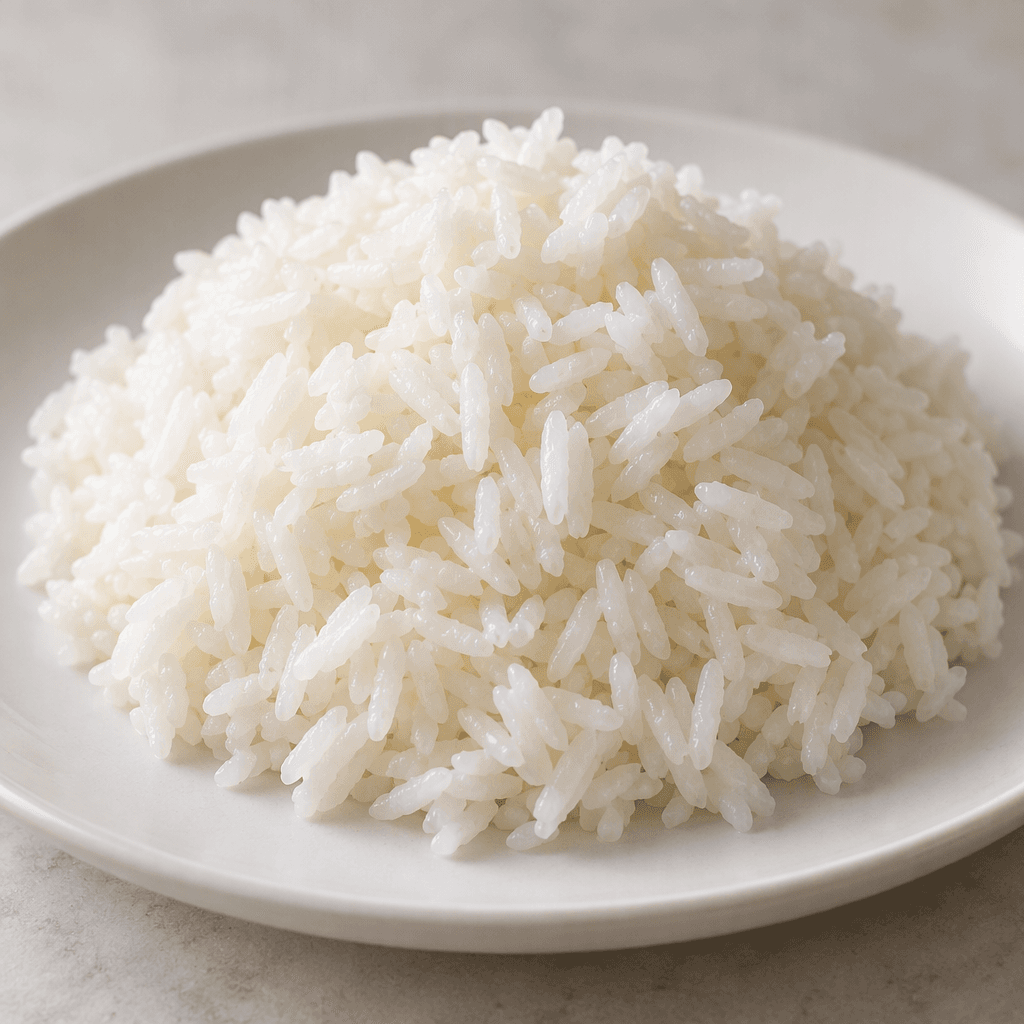
Cooked rice Calories
White rice, boiled, staple carbohydrate
In season: Spring · Summer · Autumn · Winter
CALORIES
GI
POTASSIUM
FIBER
Quick answer
1 cup (medium) of Cooked rice (200 g) has 260 calories. That works out to 130 calories per 100 g. It contains 56 g of carbs, 5.4 g of protein, 0.6 g of fat and 0.8 g of fiber. Its 1 mg of Manganese covers 43% of the Daily Value. Its glycemic index is 73 (high), so it raises blood sugar quickly.
What is Cooked rice?
Cooked rice is rice softened in water, served plain or used as the base for other dishes. Rice has long been a staple across Asia and is now cooked in kitchens worldwide; the exact variety and method vary by region.
The grains are tender and lightly glossy, and may be fluffy or softly clinging depending on how they are cooked. It accompanies curries, stir-fries, stews and grilled foods, or forms the base of bowls and salads. White cooked rice is mainly a source of carbohydrates, with little fat or fibre. Pair it with vegetables and beans, lentils, eggs, fish or meat for a more varied meal; for a lighter plate, keep added oil and rich toppings modest.
Cooked rice Nutrition Facts
Selected: 100 g
130
KCAL / 100G
Carbs
28g
· 10% DV
Protein
2.7g
· 5% DV
Fat
0.3g
· 0% DV
Fiber
0.4g
· 1% DV
DV is the share of the daily value covered, on a 2,000 kcal reference diet.
Calories come from: Carbs 89% · Protein 9% · Fat 2%
Cooked rice Vitamins & Minerals
Vitamins
B6
0.09mg · 5% DV
B3
0.4mg · 3% DV
B1
0.02mg · 2% DV
B5
0.1mg · 2% DV
Minerals
Manganese
1mg · 43% DV
Selenium
7.5µg · 14% DV
Phosphorus
43mg · 6% DV
Magnesium
12mg · 3% DV
How Nutritious Is Cooked rice?
Nutrient density
Low
How many vitamins, minerals and how much fiber this food carries per calorie. A high score means a lot of nutrition for few calories.
Satiety score
Low
An EatBetter score computed from fiber, protein and calorie density. A high score means staying full longer on the same calories.
Both scores are calculated per 100 g and do not change with the selected portion. The satiety score is EatBetter's own calculation, not a clinical measure.
Cooked rice Glycemic Index
GLYCEMIC INDEX
GLYCEMIC LOAD
Accounts for portion size — a more realistic measure than GI alone.
How to Burn Off Cooked rice
To burn the 130 calories in 100 g:
🚶
Walking (5 km/h)
🏃
Running (8 km/h)
🚴
Cycling
🏊
Swimming
Times are calculated with the MET equation for a 70 kg adult. Actual burn varies with your weight, age and pace.
Is Cooked rice Processed?
NOVA 2
Minimally Processed
1. Unprocessed
2. Minimally Processed
3. Processed
4. Ultra-Processed
NOVA classifies foods into 4 groups by industrial processing. NOVA 1 (unprocessed) is the healthiest.
Does Cooked rice Contain Allergens?
No known major allergens
Which Diets Is Cooked rice Good For?
Vegan
✓ Suitable
Vegetarian
✓ Suitable
Gluten-Free
✓ Suitable
Dairy-Free
— Not suitable
Mediterranean
✓ Suitable
Paleo
— Not suitable
Whole30
— Not suitable
DASH
— Not suitable
Keto
— Not suitable
Low FODMAP
— Not suitable
Cooked rice Fat Profile
SATURATED
0.08g
MONOUNSATURATED
0.09g
POLYUNSATURATED
0.09g
Omega 6:3 ratio 9:1
Above the ideal 4:1 (9:1).
Compare Cooked rice
Foods Similar to Cooked rice
Frequently Asked Questions About Cooked rice
How long does cooked rice last in the fridge?
Cooked rice keeps for 3–4 days in the refrigerator when chilled promptly and stored in a covered container. Divide a large batch into shallow portions so it cools faster instead of leaving it on the counter.
How long can cooked rice sit out?
Cooked rice should not sit at room temperature for more than 2 hours. In hot weather, refrigerate it sooner. If it has been left out too long, reheating will not make it safe to eat.
Can you freeze cooked rice?
Yes, cooked rice freezes well. Cool it quickly, portion it into airtight containers or freezer bags, and freeze it; reheat from frozen or thaw it in the refrigerator before using.
What is the safest way to reheat cooked rice?
Reheat cooked rice until it is steaming hot all the way through, either on the stove or in the microwave. Add a splash of water and cover it to restore moisture, and reheat only the portion you plan to eat.
Can you eat cooked rice cold?
Yes, cooked rice can be eaten cold if it was cooled promptly and kept refrigerated. Cold rice left at room temperature for too long can still cause food poisoning, so chilling it quickly matters.
Why does cooked rice get hard in the fridge?
Cooked rice firms up in the refrigerator as its starch changes structure, and it can also dry out. Sprinkle on a little water and cover it while reheating to help the grains soften again.
Why is my cooked rice mushy?
Cooked rice often turns mushy because it absorbed too much water, cooked for too long, or was stirred repeatedly. Measure the water, keep the lid on while it cooks, and let the rice rest briefly after cooking.
How do you keep cooked rice from sticking together?
Rinse the rice before cooking until the water runs mostly clear, then drain it well; this removes surface starch that can make cooked grains cling. Avoid stirring while it cooks and fluff it gently with a fork afterward.
Can you reheat cooked rice more than once?
It is safer to reheat cooked rice only once. Repeated cooling and warming gives bacteria more opportunity to grow, so refrigerate it promptly and take out only the serving you intend to reheat.
Is cooked rice good for weight loss?
Cooked rice can fit into a weight-loss meal, but a large serving can make the meal energy-dense without keeping you full for long. Pair a moderate portion with vegetables and a protein source to make a more satisfying plate.
Have another question about Cooked rice?
Ask the AI nutrition coach — calories, portions, alternatives and more, answered in seconds in the app.

Scan calories with your camera
Instant AI nutrition analysis

Nutrition data compiled from USDA FoodData Central and scientific sources.