

Ready & Packaged Foods
All →Vegetables & Legumes
All →Desserts & Confectionery
All →Meat & Protein
All →Grains & Bakery
All →Beverages
All →Milk & Dairy
All →

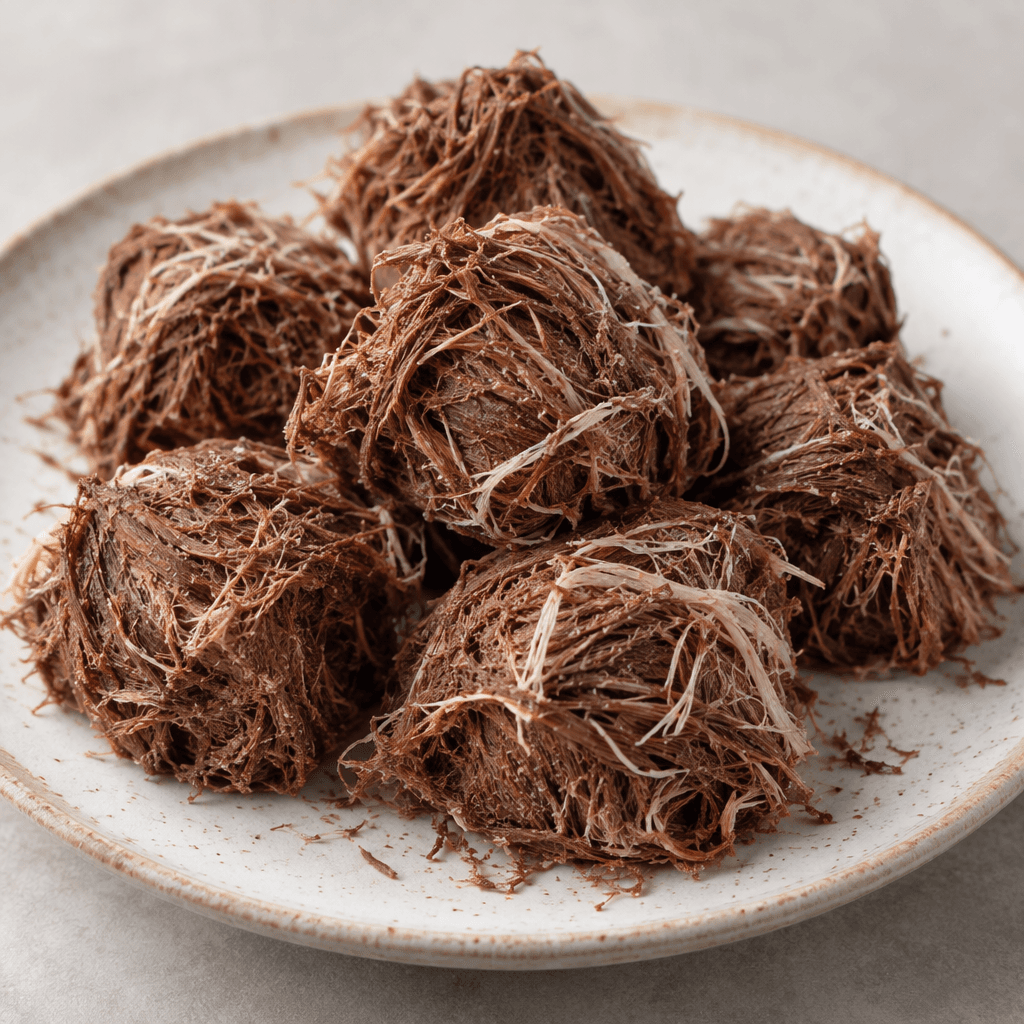
Chocolate pişmaniye Calories
Traditional Turkish floss halva with chocolate coating
In season: Spring · Summer · Autumn · Winter
CALORIES
GI
POTASSIUM
FIBER
Quick answer
1 piece (medium) of Chocolate pişmaniye (25 g) has 105 calories. That works out to 420 calories per 100 g. It contains 17 g of carbs, 1.1 g of protein, 3.8 g of fat and 0.5 g of fiber. Its glycemic index is 65 (high), so it raises blood sugar quickly.
What is Chocolate pişmaniye?
Chocolate pişmaniye is a chocolate-coated version of pişmaniye, the Turkish sweet traditionally associated with İzmit in Kocaeli. It is made from fine, pulled strands of a sugar-and-flour mixture worked with fat, gathered into soft, wispy bundles; chocolate adds a deeper flavour and a richer finish.
The delicate threads almost melt apart as you eat them, while the chocolate brings a firm sweetness. In Turkey, it is commonly offered in small pieces with tea, shared during visits or served alongside coffee. For English-speaking readers elsewhere, it works well as a distinctive after-dinner sweet or a treat to share. It is mainly a carbohydrate-rich confection, with some fat; a small piece is often satisfying, and unsweetened tea or coffee balances its sweetness.
Chocolate pişmaniye Nutrition Facts
Selected: 100 g
420
KCAL / 100G
Carbs
68g
· 25% DV
Protein
4.2g
· 8% DV
Fat
15g
· 19% DV
Fiber
1.8g
· 6% DV
DV is the share of the daily value covered, on a 2,000 kcal reference diet.
Calories come from: Carbs 64% · Protein 4% · Fat 32%
Chocolate pişmaniye Vitamins & Minerals
Vitamins
B1
0.03mg · 3% DV
B2
0.04mg · 3% DV
B5
0.15mg · 3% DV
Biotin
1µg · 3% DV
Minerals
Zinc
1mg · 9% DV
Phosphorus
48mg · 7% DV
Calcium
55mg · 6% DV
Iron
1mg · 6% DV
How Nutritious Is Chocolate pişmaniye?
Nutrient density
Low
How many vitamins, minerals and how much fiber this food carries per calorie. A high score means a lot of nutrition for few calories.
Satiety score
Low
An EatBetter score computed from fiber, protein and calorie density. A high score means staying full longer on the same calories.
Both scores are calculated per 100 g and do not change with the selected portion. The satiety score is EatBetter's own calculation, not a clinical measure.
Chocolate pişmaniye Glycemic Index
GLYCEMIC INDEX
GLYCEMIC LOAD
Accounts for portion size — a more realistic measure than GI alone.
How to Burn Off Chocolate pişmaniye
To burn the 420 calories in 100 g:
🚶
Walking (5 km/h)
🏃
Running (8 km/h)
🚴
Cycling
🏊
Swimming
Times are calculated with the MET equation for a 70 kg adult. Actual burn varies with your weight, age and pace.
Is Chocolate pişmaniye Processed?
NOVA 3
Processed
1. Unprocessed
2. Minimally Processed
3. Processed
4. Ultra-Processed
NOVA classifies foods into 4 groups by industrial processing. NOVA 1 (unprocessed) is the healthiest.
Does Chocolate pişmaniye Contain Allergens?
Contains these allergens:
Which Diets Is Chocolate pişmaniye Good For?
Vegan
— Not suitable
Vegetarian
✓ Suitable
Gluten-Free
— Not suitable
Dairy-Free
— Not suitable
Mediterranean
— Not suitable
Paleo
— Not suitable
Whole30
— Not suitable
DASH
— Not suitable
Keto
— Not suitable
Low FODMAP
— Not suitable
Chocolate pişmaniye Fat Profile
SATURATED
6.5g
MONOUNSATURATED
4.2g
POLYUNSATURATED
2.3g
Omega 6:3 ratio 210:1
Above the ideal 4:1 (210:1).
Compare Chocolate pişmaniye
Foods Similar to Chocolate pişmaniye
Frequently Asked Questions About Chocolate pişmaniye
What is Chocolate pişmaniye?
Chocolate pişmaniye is a chocolate-flavoured variation of Turkish pişmaniye, a traditional sweet made from very fine, pulled sugar-and-flour threads. Its loose, floss-like texture contrasts with the richer cocoa taste of its chocolate coating or chocolate mixed through the strands.
Where does Chocolate pişmaniye come from?
Chocolate pişmaniye is a modern variation of pişmaniye, the Turkish floss halva traditionally associated with İzmit in Kocaeli province. The chocolate version keeps the familiar fine strands but adds chocolate; recipes and shapes can differ between makers.
What does Chocolate pişmaniye taste like?
Chocolate pişmaniye tastes sweet and cocoa-rich, with a delicate, floury melt-in-the-mouth texture from its fine strands. The chocolate can make it taste more intense than plain pişmaniye, while the exact balance depends on how much chocolate the maker uses.
Why is Chocolate pişmaniye made of thin strands?
Chocolate pişmaniye has thin strands because its sugar mixture is repeatedly stretched and folded into fine threads during production. Those threads create pişmaniye’s characteristic fluffy texture; pressing or handling the sweet roughly can crush them into smaller pieces.
How is Chocolate pişmaniye traditionally eaten?
Chocolate pişmaniye is eaten as a small sweet, often served with tea or coffee. Break off a modest piece rather than pressing it into a ball, since the delicate strands can crumble; keep the rest covered between servings.
How should you store Chocolate pişmaniye after opening?
Store Chocolate pişmaniye in a tightly closed, dry container away from sunlight and heat. Humidity can make its fine strands clump, while warmth can soften the chocolate. Reseal the package promptly after taking a portion.
Can you freeze Chocolate pişmaniye?
Freezing Chocolate pişmaniye is not recommended if you want to preserve its fluffy texture. Moisture during thawing can make the strands stick together, and temperature changes may affect the chocolate coating. Keep it sealed in a cool, dry place instead.
Can you make Chocolate pişmaniye at home?
Yes, you can make Chocolate pişmaniye at home, but creating the traditional fine strands is difficult because the cooked sugar mixture must be stretched and folded carefully. A simpler version coats purchased pişmaniye with chocolate, though its texture will differ from a traditionally made one.
Is Chocolate pişmaniye different from chocolate cotton candy?
Yes, Chocolate pişmaniye is different from chocolate cotton candy. Pişmaniye is made by pulling a sugar-and-flour mixture into fine strands, giving it a delicate, slightly floury texture; cotton candy is spun sugar without that same flour-based structure.
Can people with diabetes eat Chocolate pişmaniye?
People with diabetes should account for Chocolate pişmaniye as a sweet containing sugar and refined carbohydrates. Whether and how much fits their eating plan depends on individual blood-glucose management, so ask a doctor or dietitian for personal guidance.
Have another question about Chocolate pişmaniye?
Ask the AI nutrition coach — calories, portions, alternatives and more, answered in seconds in the app.

Scan calories with your camera
Instant AI nutrition analysis

Nutrition data compiled from USDA FoodData Central and scientific sources.