

Ready & Packaged Foods
All →Vegetables & Legumes
All →Desserts & Confectionery
All →Meat & Protein
All →Grains & Bakery
All →Beverages
All →Milk & Dairy
All →

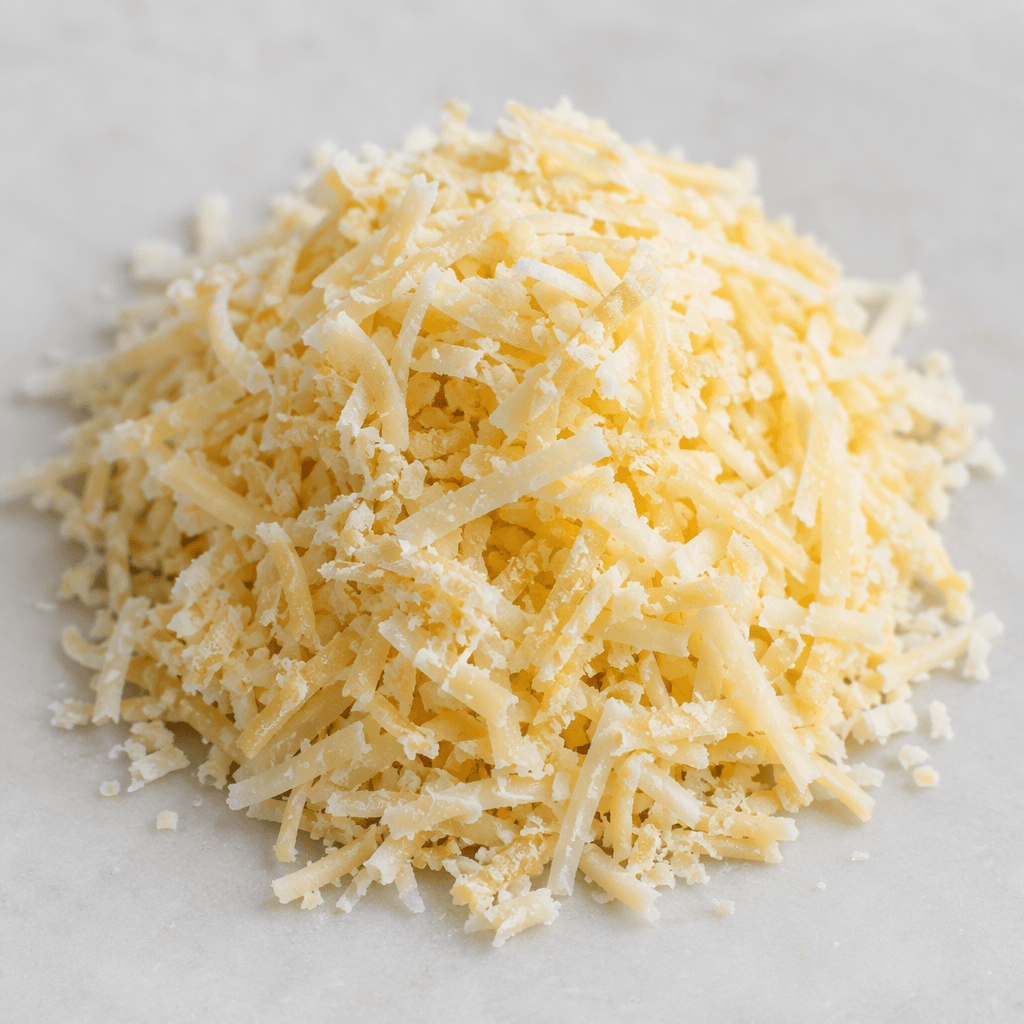
Grated Cheese Calories
Finely shredded cheese, commonly used as a topping or ingredient.
In season: Spring · Summer · Autumn · Winter
CALORIES
GI
POTASSIUM
FIBER
Quick answer
2 tablespoon (medium) of Grated Cheese (15 g) has 56 calories. That works out to 370 calories per 100 g. It contains 0.4 g of carbs, 3.8 g of protein, 4.4 g of fat and 0 g of fiber. Its 79.5 mg of Phosphorus covers 11% of the Daily Value. Its glycemic index is 0 (low), so it raises blood sugar slowly.
What is Grated Cheese?
Grated Cheese is finely shredded cheese, usually made from a firm or semi-firm variety. Its colour, flavour and melting quality depend on the cheese used, so the name describes its form rather than one specific kind of cheese.
It is commonly scattered over pasta, soups, salads and baked dishes, or stirred into fillings and sauces. In Turkey, grated kaşar is also used on toast and in oven-baked meals; elsewhere, the cheese may vary with local cooking traditions. It brings a savoury, milky flavour and melts readily. Grated cheese is relatively rich in protein and fat, so a small sprinkle can add plenty of flavour. For a lighter dish, use it as a finishing touch rather than mixing in a large amount.
Grated Cheese Nutrition Facts
Selected: 100 g
370
KCAL / 100G
Carbs
2.5g
· 1% DV
Protein
25g
· 50% DV
Fat
29g
· 37% DV
Fiber
0g
· 0% DV
DV is the share of the daily value covered, on a 2,000 kcal reference diet.
Calories come from: Carbs 3% · Protein 27% · Fat 70%

Log this food in EatBetter
100,000+ people use it
- Get your daily calorie target
- Snap your meal, log it in seconds
- See every vitamin and mineral

📸 Scan the code to get the app free.

Grated Cheese Vitamins & Minerals
Vitamins
B12
1.5µg · 63% DV
Vitamin A
260µg · 29% DV
B2
0.35mg · 27% DV
Biotin
2.5µg · 8% DV
Minerals
Phosphorus
530mg · 76% DV
Calcium
720mg · 72% DV
Sodium
670mg · 29% DV
Zinc
3mg · 27% DV
Potassium ⭐
110mg · 3% DV
How Nutritious Is Grated Cheese?
Nutrient density
High
How many vitamins, minerals and how much fiber this food carries per calorie. A high score means a lot of nutrition for few calories.
Satiety score
Low
An EatBetter score computed from fiber, protein and calorie density. A high score means staying full longer on the same calories.
Both scores are calculated per 100 g and do not change with the selected portion. The satiety score is EatBetter's own calculation, not a clinical measure.
Grated Cheese Glycemic Index
GLYCEMIC INDEX
GLYCEMIC LOAD
Accounts for portion size — a more realistic measure than GI alone.
How to Burn Off Grated Cheese
To burn the 370 calories in 100 g:
🚶
Walking (5 km/h)
🏃
Running (8 km/h)
🚴
Cycling
🏊
Swimming
Times are calculated with the MET equation for a 70 kg adult. Actual burn varies with your weight, age and pace.
Is Grated Cheese Processed?
NOVA 3
Processed
1. Unprocessed
2. Minimally Processed
3. Processed
4. Ultra-Processed
NOVA classifies foods into 4 groups by industrial processing. NOVA 1 (unprocessed) is the healthiest.
Does Grated Cheese Contain Allergens?
Contains these allergens:
Which Diets Is Grated Cheese Good For?
Vegan
— Not suitable
Vegetarian
✓ Suitable
Gluten-Free
— Not suitable
Dairy-Free
— Not suitable
Mediterranean
✓ Suitable
Paleo
— Not suitable
Whole30
— Not suitable
DASH
— Not suitable
Keto
— Not suitable
Low FODMAP
— Not suitable
Grated Cheese Fat Profile
SATURATED
18.5g
MONOUNSATURATED
7.5g
POLYUNSATURATED
0.5g
Omega 6:3 ratio 3.8:1
Below the ideal 4:1 — a good omega balance.
Compare Grated Cheese
Foods Similar to Grated Cheese
Frequently Asked Questions About Grated Cheese
Does grated cheese need to be refrigerated?
Yes, grated cheese should be refrigerated, including after opening. Keep it in a tightly sealed container so it stays dry and does not absorb odours from other foods; follow the package’s storage directions if they differ.
Can you freeze grated cheese?
Yes, grated cheese can be frozen in an airtight bag or container. It may become slightly crumbly after thawing, but that change is usually less noticeable when you use it in cooked dishes.
What is the best cheese for grated cheese toppings?
Hard or semi-hard cheeses, such as Parmesan or cheddar, work well as grated cheese toppings. Parmesan gives a sharper, savoury finish, while cheddar has a fuller flavour and melts readily on hot food.
Why does grated cheese sometimes not melt smoothly?
Grated cheese may melt unevenly if it is very dry, added to a dish that is not hot enough, or heated too quickly. Add it gradually over moderate heat; freshly grated cheese often melts more smoothly than very dry packaged cheese.
Is grated cheese the same as shredded cheese?
Not always; grated cheese usually has finer, shorter pieces than shredded cheese. The terms can overlap on product labels, so check the texture if the size of the cheese matters for a recipe.
Does packaged grated cheese contain anything besides cheese?
Some packaged grated cheese includes a small amount of starch or cellulose to keep the shreds from sticking together. Ingredients vary by product, and these additions are not necessary when you grate cheese at home.
Can you use grated cheese on pizza?
Yes, grated cheese works well on pizza because it spreads evenly and melts over the toppings. Choose a cheese that melts well, and add it in an even layer to avoid patches that brown too quickly.
How can you stop grated cheese from sticking to the grater?
Chill the cheese before grating it. Firmer, cold cheese is less likely to smear or clog the grater, and wiping the grater clean soon after use makes any remaining cheese easier to remove.
Can grated cheese replace Parmesan in a recipe?
Sometimes, but the result depends on what kind of grated cheese you have. A mild cheese will not provide Parmesan’s sharp, savoury flavour, so it works better as a melting topping than as a flavour-for-flavour substitute.
How can you tell if grated cheese has gone bad?
Discard grated cheese if you see mold, notice a sour or unpleasant smell, or find that it has become unusually wet or discoloured. Do not taste it to check; mold can spread through the fine shreds.
Have another question about Grated Cheese?
Ask the AI nutrition coach — calories, portions, alternatives and more, answered in seconds in the app.

Scan calories with your camera
Instant AI nutrition analysis

Nutrition data compiled from USDA FoodData Central and scientific sources.