

Ready & Packaged Foods
All →Vegetables & Legumes
All →Desserts & Confectionery
All →Meat & Protein
All →Grains & Bakery
All →Beverages
All →Milk & Dairy
All →

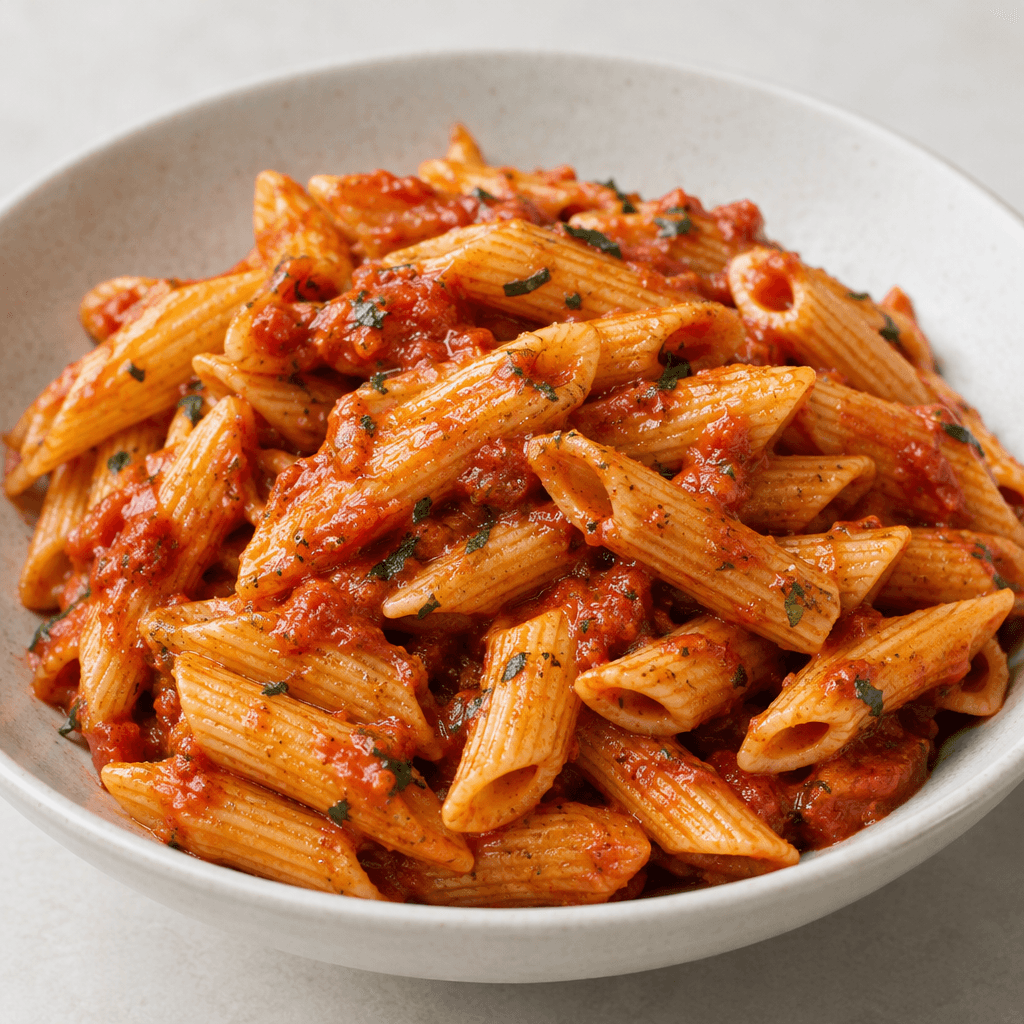
Penne Pasta with Tomato Sauce Calories
Classic Italian pasta with tomato sauce
In season: Spring · Summer · Autumn · Winter
CALORIES
GI
POTASSIUM
FIBER
Quick answer
1 cup (medium) of Penne Pasta with Tomato Sauce (150 g) has 180 calories. That works out to 120 calories per 100 g. It contains 33.8 g of carbs, 6.1 g of protein, 1.8 g of fat and 3.3 g of fiber. Its 0.1 mg of Copper covers 13% of the Daily Value. Its glycemic index is 55 (medium), so it raises blood sugar at a moderate pace.
What is Penne Pasta with Tomato Sauce?
Penne Pasta with Tomato Sauce pairs short, ridged tubes of pasta—cut on the diagonal—with a glossy tomato sauce. It draws on a familiar Italian style of pasta cooking, where the grooves and hollow centres help hold the sauce. The flavour is gently tangy and savoury, with tender pasta that still has a pleasant bite when cooked well.
In Italy and in kitchens around the world, it’s an easy lunch or supper, served on its own or alongside a salad. Its energy comes mainly from carbohydrates, with some protein and fibre. Add vegetables such as spinach or peppers for a more substantial plate, or keep the portion lighter with a simple side salad.
Penne Pasta with Tomato Sauce Nutrition Facts
Selected: 100 g
120
KCAL / 100G
Carbs
22.5g
· 8% DV
Protein
4.1g
· 8% DV
Fat
1.2g
· 2% DV
Fiber
2.2g
· 8% DV
DV is the share of the daily value covered, on a 2,000 kcal reference diet.
Calories come from: Carbs 77% · Protein 14% · Fat 9%
Penne Pasta with Tomato Sauce Vitamins & Minerals
Vitamins
Vitamin C
7mg · 8% DV
B1
0.07mg · 6% DV
Vitamin A
35µg · 4% DV
B3
0.7mg · 4% DV
Minerals
Iron
1mg · 6% DV
Phosphorus
40mg · 6% DV
Sodium
110mg · 5% DV
Selenium
2.1µg · 4% DV
How Nutritious Is Penne Pasta with Tomato Sauce?
Nutrient density
Medium
How many vitamins, minerals and how much fiber this food carries per calorie. A high score means a lot of nutrition for few calories.
Satiety score
Medium
An EatBetter score computed from fiber, protein and calorie density. A high score means staying full longer on the same calories.
Both scores are calculated per 100 g and do not change with the selected portion. The satiety score is EatBetter's own calculation, not a clinical measure.
Penne Pasta with Tomato Sauce Glycemic Index
GLYCEMIC INDEX
GLYCEMIC LOAD
Accounts for portion size — a more realistic measure than GI alone.
How to Burn Off Penne Pasta with Tomato Sauce
To burn the 120 calories in 100 g:
🚶
Walking (5 km/h)
🏃
Running (8 km/h)
🚴
Cycling
🏊
Swimming
Times are calculated with the MET equation for a 70 kg adult. Actual burn varies with your weight, age and pace.
Is Penne Pasta with Tomato Sauce Processed?
NOVA 3
Processed
1. Unprocessed
2. Minimally Processed
3. Processed
4. Ultra-Processed
NOVA classifies foods into 4 groups by industrial processing. NOVA 1 (unprocessed) is the healthiest.
Does Penne Pasta with Tomato Sauce Contain Allergens?
Contains these allergens:
Which Diets Is Penne Pasta with Tomato Sauce Good For?
Vegan
— Not suitable
Vegetarian
✓ Suitable
Gluten-Free
— Not suitable
Dairy-Free
— Not suitable
Mediterranean
— Not suitable
Paleo
— Not suitable
Whole30
— Not suitable
DASH
— Not suitable
Keto
— Not suitable
Low FODMAP
— Not suitable
Penne Pasta with Tomato Sauce Fat Profile
SATURATED
0.2g
MONOUNSATURATED
0.2g
POLYUNSATURATED
0.3g
Omega 6:3 ratio 5:1
Above the ideal 4:1 (5:1).
Compare Penne Pasta with Tomato Sauce
Foods Similar to Penne Pasta with Tomato Sauce
Frequently Asked Questions About Penne Pasta with Tomato Sauce
How do you make Penne Pasta with Tomato Sauce from scratch?
Penne Pasta with Tomato Sauce is easy to make by cooking penne until just tender and simmering tomatoes with olive oil, garlic, and herbs. Toss the drained pasta with the sauce and a splash of pasta water so it coats the ridged tubes.
Is Penne Pasta with Tomato Sauce the same as arrabbiata?
No, Penne Pasta with Tomato Sauce is not necessarily arrabbiata. Arrabbiata is a spicy tomato sauce, usually made with chilli and garlic; a basic tomato sauce can be mild and may include herbs or onion instead.
What does the penne shape add to Penne Pasta with Tomato Sauce?
Penne's short, hollow tubes and ridged surface help hold tomato sauce both inside and around the pasta. That makes Penne Pasta with Tomato Sauce a practical choice for a thick or chunky sauce.
Can you make Penne Pasta with Tomato Sauce with fresh tomatoes?
Yes, ripe fresh tomatoes work well in Penne Pasta with Tomato Sauce. Chop them and simmer until their juices reduce and the sauce thickens; peeling is optional, though removing the skins gives a smoother texture.
What vegetables can you add to Penne Pasta with Tomato Sauce?
Penne Pasta with Tomato Sauce pairs well with vegetables such as zucchini, spinach, mushrooms, or roasted peppers. Cook firmer vegetables before adding the sauce, and stir leafy greens in near the end so they do not overcook.
How can you make Penne Pasta with Tomato Sauce less acidic?
To soften an overly sharp tomato sauce in Penne Pasta with Tomato Sauce, simmer it longer or add a little olive oil or finely grated carrot. Taste as you go; too much sugar can make the sauce cloying.
How do you reheat Penne Pasta with Tomato Sauce without drying it out?
Reheat Penne Pasta with Tomato Sauce gently on the stovetop with a splash of water, stirring until hot. In a microwave, cover the dish and heat in short intervals, stirring between them so the edges do not dry out.
Can you freeze Penne Pasta with Tomato Sauce?
Yes, Penne Pasta with Tomato Sauce can be frozen in an airtight container once cooled. The pasta may soften after thawing, so freeze it slightly firm if preparing ahead; add a little water or sauce when reheating.
What cheese goes best with Penne Pasta with Tomato Sauce?
Parmesan is a classic topping for Penne Pasta with Tomato Sauce because its savoury flavour complements the tomatoes. Pecorino gives a sharper, saltier finish, while mozzarella makes the dish softer and stretchier.
Can you add meat to Penne Pasta with Tomato Sauce?
Yes, browned ground beef or Italian sausage can turn Penne Pasta with Tomato Sauce into a heartier meal. Cook the meat fully before adding the tomatoes, then simmer the sauce so the flavours combine.
Have another question about Penne Pasta with Tomato Sauce?
Ask the AI nutrition coach — calories, portions, alternatives and more, answered in seconds in the app.

Scan calories with your camera
Instant AI nutrition analysis

Nutrition data compiled from USDA FoodData Central and scientific sources.