

Ready & Packaged Foods
All →Vegetables & Legumes
All →Desserts & Confectionery
All →Meat & Protein
All →Grains & Bakery
All →Beverages
All →Milk & Dairy
All →

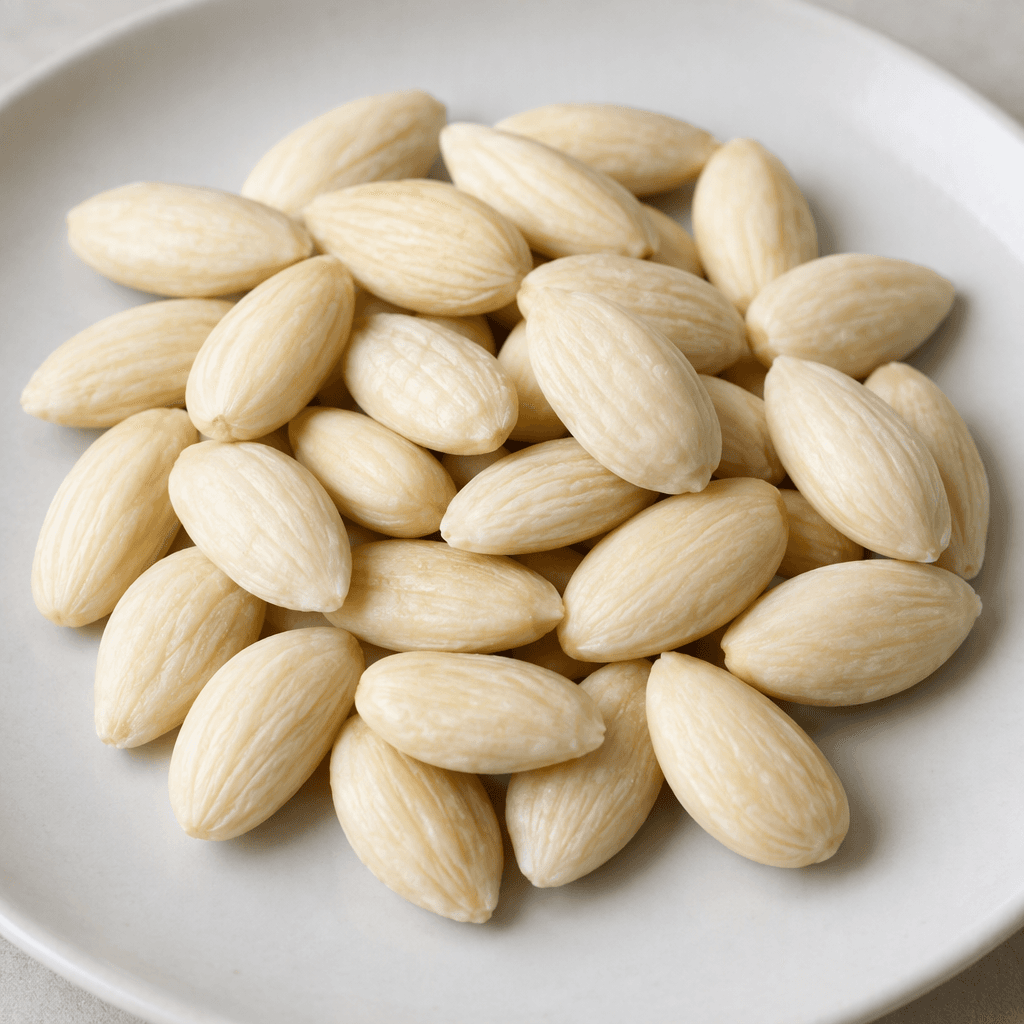
Almond (peeled) Calories
High in vitamin E, healthy fats, source of magnesium
In season: Spring · Summer · Autumn · Winter
CALORIES
GI
POTASSIUM
FIBER
Quick answer
1 ounce (medium) of Almond (peeled) (28 g) has 161 calories. That works out to 575 calories per 100 g. It contains 5.5 g of carbs, 5.9 g of protein, 13.8 g of fat and 3.5 g of fiber. Its 7.2 mg of Vitamin E covers 48% of the Daily Value. Its glycemic index is 15 (low), so it raises blood sugar slowly.
What is Almond (peeled)?
Peeled almonds are almond kernels with their thin brown skins removed. They are used whole, chopped or ground in sweets, baked goods and savoury dishes, and are also eaten as a snack. In places where almonds are grown and commonly used, they appear in everything from pastries to sauces; elsewhere, they are an easy addition to breakfast bowls and homemade baking.
Without the skin, they have a smooth bite and a mild, slightly sweet flavour. Enjoy them plain, stirred into porridge or yoghurt, or chopped over a salad. They are rich in unsaturated fats and fibre, with vitamin E too, so a small handful makes a filling snack; pair them with fruit for a simple, balanced bite.
Almond (peeled) Nutrition Facts
Selected: 100 g
575
KCAL / 100G
Carbs
19.7g
· 7% DV
Protein
21.2g
· 42% DV
Fat
49.4g
· 63% DV
Fiber
12.5g
· 45% DV
DV is the share of the daily value covered, on a 2,000 kcal reference diet.
Calories come from: Carbs 13% · Protein 14% · Fat 73%
Almond (peeled) Vitamins & Minerals
Vitamins
Vitamin E
25.6mg · 171% DV
B2
1.1mg · 85% DV
Biotin
17µg · 57% DV
B3
3.6mg · 23% DV
Minerals
Copper
1mg · 111% DV
Manganese
2mg · 87% DV
Phosphorus
484mg · 69% DV
Magnesium
268mg · 64% DV
How Nutritious Is Almond (peeled)?
Nutrient density
Very high
How many vitamins, minerals and how much fiber this food carries per calorie. A high score means a lot of nutrition for few calories.
Satiety score
High
An EatBetter score computed from fiber, protein and calorie density. A high score means staying full longer on the same calories.
Both scores are calculated per 100 g and do not change with the selected portion. The satiety score is EatBetter's own calculation, not a clinical measure.
Almond (peeled) Glycemic Index
GLYCEMIC INDEX
GLYCEMIC LOAD
Accounts for portion size — a more realistic measure than GI alone.
How to Burn Off Almond (peeled)
To burn the 575 calories in 100 g:
🚶
Walking (5 km/h)
🏃
Running (8 km/h)
🚴
Cycling
🏊
Swimming
Times are calculated with the MET equation for a 70 kg adult. Actual burn varies with your weight, age and pace.
Is Almond (peeled) Processed?
NOVA 2
Minimally Processed
1. Unprocessed
2. Minimally Processed
3. Processed
4. Ultra-Processed
NOVA classifies foods into 4 groups by industrial processing. NOVA 1 (unprocessed) is the healthiest.
Does Almond (peeled) Contain Allergens?
Contains these allergens:
Which Diets Is Almond (peeled) Good For?
Vegan
✓ Suitable
Vegetarian
✓ Suitable
Gluten-Free
✓ Suitable
Dairy-Free
— Not suitable
Mediterranean
✓ Suitable
Paleo
✓ Suitable
Whole30
— Not suitable
DASH
— Not suitable
Keto
— Not suitable
Low FODMAP
— Not suitable
Almond (peeled) Fat Profile
SATURATED
3.7g
MONOUNSATURATED
30.9g
POLYUNSATURATED
12.1g
Omega 6:3 ratio 1210:1
Above the ideal 4:1 (1210:1).
Compare Almond (peeled)
Foods Similar to Almond (peeled)
Frequently Asked Questions About Almond (peeled)
How do you blanch almonds to make peeled almonds?
To make peeled almonds, cover whole almonds briefly with boiling water, drain them, then squeeze each almond so the brown skin slips off. Dry the blanched almonds thoroughly before storing or using them in a recipe.
Do peeled almonds need to be soaked before eating?
No, peeled almonds do not need soaking before you eat them. Soaking softens their texture and can make them easier to blend into drinks or sauces, but it does not make them necessary to digest; refrigerate soaked almonds and use them promptly.
What is the best way to store peeled almonds?
Keep peeled almonds in an airtight container in a cool, dark, dry place. Their exposed oils can turn rancid faster in heat and light, so refrigerate or freeze them for longer storage; discard any that smell stale or paint-like.
Can you freeze peeled almonds?
Yes, peeled almonds freeze well. Seal them in an airtight freezer-safe container to protect them from moisture and odors, and take out only what you need; they can be used in recipes without thawing first.
Can peeled almonds be eaten raw?
Yes, peeled almonds can be eaten raw. Add them to cereal, salads, or smoothies, or eat them as a snack; avoid any that are moldy or have a rancid smell.
Are peeled almonds as nutritious as almonds with the skin on?
Peeled almonds retain much of the nut’s nutrients, but removing the brown skin also removes some fiber and plant compounds. Skin-on almonds therefore offer those extra components, while peeled almonds are useful when a smooth texture matters.
How do you roast peeled almonds without burning them?
Roast peeled almonds in a single layer in a dry pan over medium-low heat, stirring often until lightly golden and fragrant. They continue to cook briefly after you remove them, so transfer them off the hot pan promptly.
Can peeled almonds be used to make almond milk?
Yes, peeled almonds work well for homemade almond milk and make a smooth, pale drink. Soak them until soft, blend with fresh water, then strain through a fine cloth; use the leftover pulp in porridge or baking.
Can you make almond butter from peeled almonds?
Yes, you can make almond butter from peeled almonds. Blend them in a food processor, scraping down the sides as needed, until the nuts release their oils and turn creamy; the result will be paler than butter made with skin-on almonds.
Are peeled almonds good for weight loss?
Peeled almonds can fit into a weight-loss eating plan because their fiber and fat may help you feel satisfied, but they do not cause weight loss on their own. Portion them into a small serving instead of eating straight from the bag.
Have another question about Almond (peeled)?
Ask the AI nutrition coach — calories, portions, alternatives and more, answered in seconds in the app.

Scan calories with your camera
Instant AI nutrition analysis

Nutrition data compiled from USDA FoodData Central and scientific sources.