

Ready & Packaged Foods
All →Vegetables & Legumes
All →Desserts & Confectionery
All →Meat & Protein
All →Grains & Bakery
All →Beverages
All →Milk & Dairy
All →

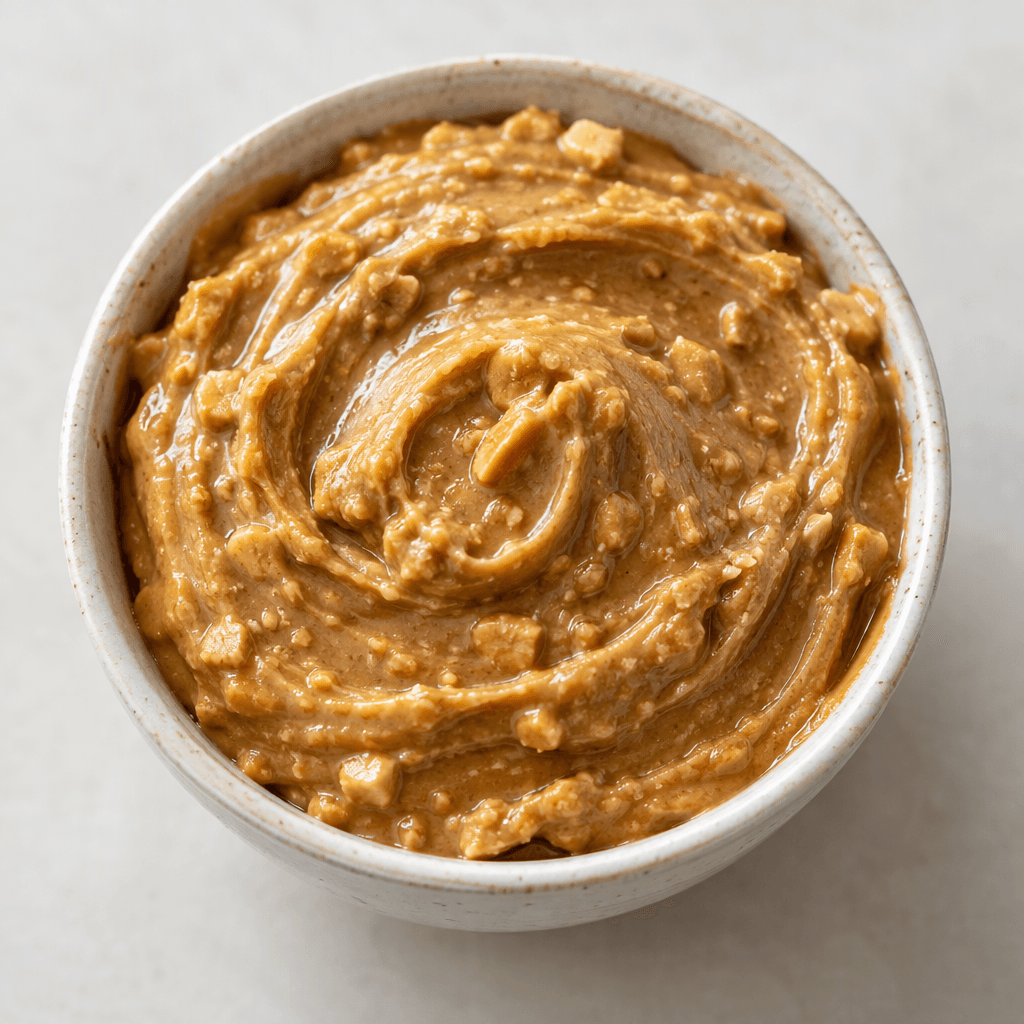
Peanut Butter (Züber Peanutzilla) Calories
High protein, healthy fats, no additives, fiber source
In season: Spring · Summer · Autumn · Winter
CALORIES · 100 G
GI
POTASSIUM · 100 G
FIBER · 100 G
Quick answer
1 tablespoon (medium) of Peanut Butter (Züber Peanutzilla) (20 g) has 122 calories. That works out to 610 calories per 100 g. It contains 3.6 g of carbs, 5.6 g of protein, 9.6 g of fat and 1.6 g of fiber. Its 0.2 mg of Copper covers 24% of the Daily Value. Its glycemic index is 14 (low), so it raises blood sugar slowly.
Peanut Butter (Züber Peanutzilla) Nutrition Facts
Selected: 1 tablespoon (medium) · 20 g
122
KCAL / 20G
Carbs
3.6g
· 1% DV
Protein
5.6g
· 11% DV
Fat
9.6g
· 12% DV
Fiber
1.6g
· 6% DV
DV is the share of the daily value covered, on a 2,000 kcal reference diet.
Calories come from: Carbs 12% · Protein 18% · Fat 70%
Peanut Butter (Züber Peanutzilla) nutrition facts table · 1 tablespoon (medium) (20 g)
| Nutrient | Amount | % DV |
|---|---|---|
| Calories | 122 kcal | |
| Total fat | 9.6 g | 12% |
| Saturated fat | 1.7 g | 9% |
| Trans fat | 0 g | |
| Sodium | 1 mg | 0% |
| Total carbohydrate | 3.6 g | 1% |
| Fiber | 1.6 g | 6% |
| Protein | 5.6 g | 11% |
Calories: Calories measure energy. Average daily need is 2,000 kcal. Excess calories are stored as fat, too few cause weight loss.
Carbs: Your body's primary energy source. The brain runs exclusively on carbs. Daily need: 275g.
Protein: Essential for muscle repair and cell growth. Daily need: 50g. Keeps you full and boosts metabolism.
Fat: Needed for hormone production and vitamin absorption. Daily need: 78g. Limit saturated fats, choose unsaturated.
Fiber: Critical for digestive health and satiety. Daily need: 28g. Stabilizes blood sugar, lowers cholesterol.

Log this food in EatBetter
100,000+ people use it
- Get your daily calorie target
- Snap your meal, log it in seconds
- See every vitamin and mineral

📸 Scan the code to get the app free.

How Many Calories in 1 Tablespoon of Peanut Butter (Züber Peanutzilla)?
| Serving | Amount | Calories |
|---|---|---|
| 1 tablespoon (medium) | 20 g | 122 kcal |
| 1 teaspoon (small) | 7 g | 43 kcal |
| 1 slice (thin) | 15 g | 92 kcal |
| 1 slice (thick) | 25 g | 153 kcal |
| 1 piece (medium) | 30 g | 183 kcal |
| 1 serving (medium) | 30 g | 183 kcal |
| 2 tablespoon (large) | 40 g | 244 kcal |
| 1 pack (mini) | 40 g | 244 kcal |
| 100 g | 100 g | 610 kcal |
| 1 pack (large) | 200 g | 1220 kcal |
Calculated from 610 calories per 100 g.
Frequently Asked Questions About Peanut Butter (Züber Peanutzilla)
Is Züber Peanutzilla peanut butter healthy?
It can be a nourishing choice: Züber Peanutzilla peanut butter provides protein, unsaturated fats and fibre, and it has no additives. Spread it on toast or pair it with fruit; it is still energy-dense, so large spoonfuls can add up.
Why does oil separate in Züber Peanutzilla peanut butter?
Oil separation is normal in Züber Peanutzilla peanut butter. Peanut oil can rise to the surface while the jar sits, and that alone does not mean the product is spoiled. Stir it thoroughly with a clean spoon before serving.
Does Züber Peanutzilla peanut butter need to be refrigerated after opening?
Usually, it can be stored tightly closed in a cool, dry cupboard away from sunlight. Refrigeration makes the spread firmer and harder to spread. Follow the storage directions on the jar if they specify otherwise.
Can you use Züber Peanutzilla peanut butter in baking?
Yes. Züber Peanutzilla peanut butter works in cookies, brownies and energy bites, and it can add a roasted peanut flavour to sauces. Its thick texture may change a recipe’s consistency, so mix it in gradually.
Is Züber Peanutzilla peanut butter good before a workout?
It can work as a pre-workout snack when paired with an easy-to-digest carbohydrate, such as toast or a banana. Its fat and protein make it more filling, so a large serving right before exercise may feel heavy.
Can babies eat Züber Peanutzilla peanut butter?
Babies can have smooth peanut butter when they are ready for complementary foods, but never offer a thick spoonful because it can be a choking hazard. Peanut is a common allergen; ask a clinician first if your baby has severe eczema or a known food allergy.
Can Züber Peanutzilla peanut butter be frozen?
Yes, it can be frozen in a tightly sealed, freezer-safe container. Leave a little room for expansion and thaw it in the refrigerator or at room temperature. The texture may separate after thawing, so stir it well before eating.
Can Züber Peanutzilla peanut butter replace butter in a recipe?
Not as a direct one-for-one substitute in most baking recipes. Züber Peanutzilla peanut butter has a stronger flavour and a different balance of fat and moisture, so replacing butter can change both the texture and structure of the finished bake.
What goes well with Züber Peanutzilla peanut butter in a sandwich?
Banana, sliced apple or jam all pair well with Züber Peanutzilla peanut butter. For a more savoury sandwich, try it with a little chilli sauce. Spread it thinly so the filling is easier to bite and swallow.
How can you tell if Züber Peanutzilla peanut butter has gone rancid?
A sharp, paint-like or stale-oil smell, or an unpleasant bitter taste, can signal rancidity. Normal oil separation is not the same thing. If the smell or taste has changed noticeably, discard the jar rather than trying to mask it.
Peanut Butter (Züber Peanutzilla) Vitamins & Minerals
Vitamins
B3
2.6mg · 16% DV
Biotin
4µg · 13% DV
B1
0.14mg · 12% DV
Vitamin E
1.3mg · 9% DV
Minerals
Copper
0.22mg · 24% DV
Manganese
0.36mg · 16% DV
Phosphorus
70mg · 10% DV
Magnesium
36mg · 9% DV
Potassium ⭐
136mg · 4% DV
Sodium
1mg · 0% DV
Peanut Butter (Züber Peanutzilla) Glycemic Index
GLYCEMIC INDEX
GLYCEMIC LOAD
Accounts for portion size — a more realistic measure than GI alone.
How to Burn Off Peanut Butter (Züber Peanutzilla)
To burn the 122 calories in 1 tablespoon (medium) (20 g):
🚶
Walking (5 km/h)
🏃
Running (8 km/h)
🚴
Cycling
🏊
Swimming
Times are calculated with the MET equation for a 70 kg adult. Actual burn varies with your weight, age and pace.
What is Peanut Butter (Züber Peanutzilla)?
Peanut butter (Züber Peanutzilla) is a spread made by grinding peanuts, with a dense, creamy texture and a rich roasted-nut flavour. It is popular in the United States, where it is often spread on toast or sandwiches, stirred into oatmeal, or paired with fruit; elsewhere, it works just as easily on breakfast toast or blended into a smoothie.
It provides protein, fibre and plenty of fat, making it filling but energy-dense; it contains 28 g of protein per 100 g. A thin spread on toast or a spoonful alongside banana makes a satisfying snack, while a measured portion can help keep the meal lighter.
How Nutritious Is Peanut Butter (Züber Peanutzilla)?
Nutrient density
High
How many vitamins, minerals and how much fiber this food carries per calorie. A high score means a lot of nutrition for few calories.
Satiety score
High
An EatBetter score computed from fiber, protein and calorie density. A high score means staying full longer on the same calories.
Both scores are calculated per 100 g and do not change with the selected portion. The satiety score is EatBetter's own calculation, not a clinical measure.
Is Peanut Butter (Züber Peanutzilla) Processed?
NOVA 2
Minimally Processed
1. Unprocessed
2. Minimally Processed
3. Processed
4. Ultra-Processed
NOVA classifies foods into 4 groups by industrial processing. NOVA 1 (unprocessed) is the healthiest.
Does Peanut Butter (Züber Peanutzilla) Contain Allergens?
Contains these allergens:
Which Diets Is Peanut Butter (Züber Peanutzilla) Good For?
Vegan
✓ Suitable
Vegetarian
✓ Suitable
Gluten-Free
✓ Suitable
Dairy-Free
— Not suitable
Mediterranean
✓ Suitable
Paleo
✓ Suitable
Whole30
— Not suitable
DASH
— Not suitable
Keto
— Not suitable
Low FODMAP
— Not suitable
Peanut Butter (Züber Peanutzilla) Fat Profile
SATURATED
1.7g
MONOUNSATURATED
5g
POLYUNSATURATED
2.8g
Compare Peanut Butter (Züber Peanutzilla)
Foods Similar to Peanut Butter (Züber Peanutzilla)
Have another question about Peanut Butter (Züber Peanutzilla)?
Ask the AI nutrition coach — calories, portions, alternatives and more, answered in seconds in the app.

Scan calories with your camera
Instant AI nutrition analysis

Nutrition data compiled from USDA FoodData Central and scientific sources.