

Ready & Packaged Foods
All →Vegetables & Legumes
All →Desserts & Confectionery
All →Meat & Protein
All →Grains & Bakery
All →Beverages
All →Milk & Dairy
All →

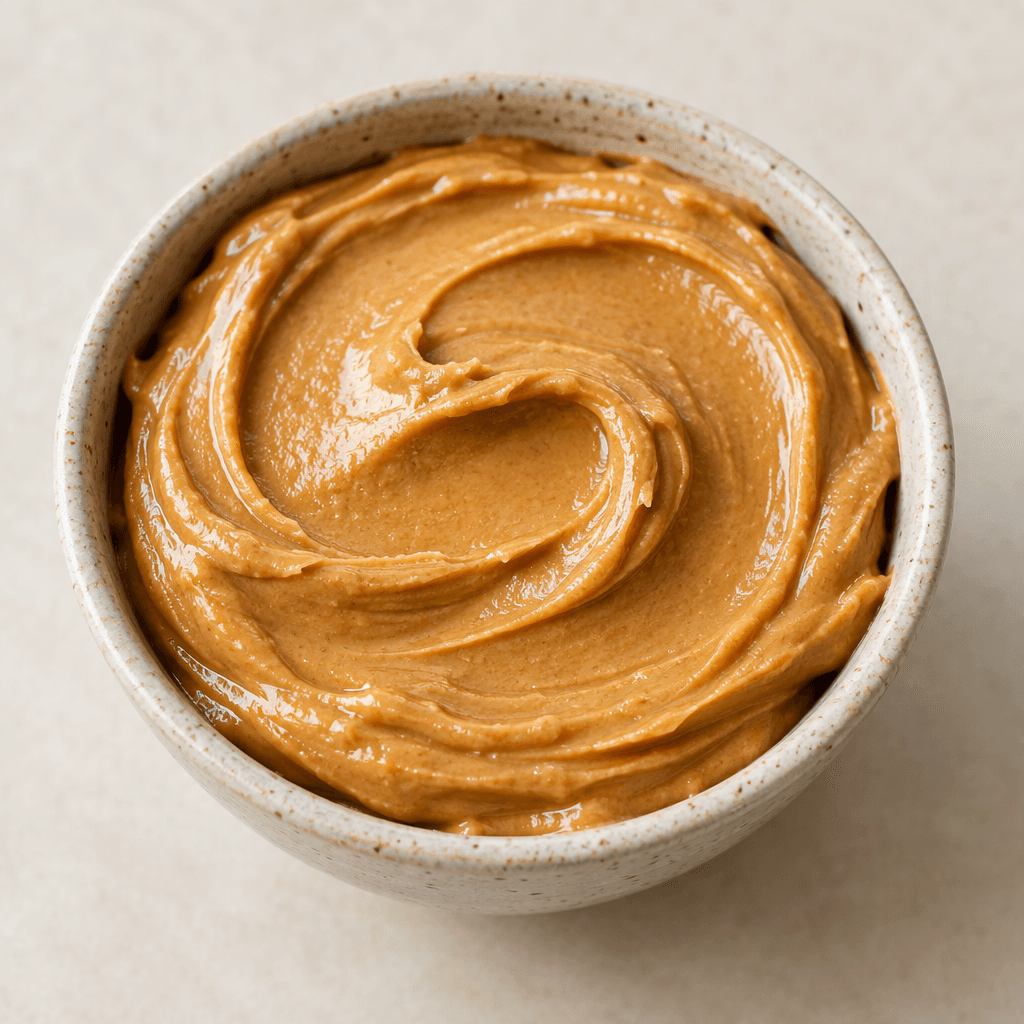
Peanut Butter (No Added Sugar) Calories
High protein, healthy fats, source of fiber, no added sugar
In season: Spring · Summer · Autumn · Winter
CALORIES
GI
POTASSIUM
FIBER
Quick answer
2 tablespoon (medium) of Peanut Butter (No Added Sugar) (32 g) has 189 calories. That works out to 590 calories per 100 g. It contains 5.9 g of carbs, 8.1 g of protein, 15.7 g of fat and 2.6 g of fiber. Its 0.4 mg of Copper covers 39% of the Daily Value. Its glycemic index is 14 (low), so it raises blood sugar slowly.
What is Peanut Butter (No Added Sugar)?
Peanut butter with no added sugar is made by grinding roasted peanuts into a smooth or slightly crunchy paste. Popularized in the United States, it is now a familiar pantry staple in many parts of the world. Without added sugar, its flavour is deeply nutty and roasted, with a natural hint of sweetness; a little oil may rise to the surface, so stir it back in.
Spread it on toast, pair it with banana or apple, or spoon it into porridge and smoothies. Its protein, unsaturated fat and fibre make it a substantial, filling ingredient, though it is energy-dense. Choose it when you want a simple spread without added sugar, and enjoy a modest spoonful with fruit or whole-grain bread.
Peanut Butter (No Added Sugar) Nutrition Facts
Selected: 100 g
590
KCAL / 100G
Carbs
18.5g
· 7% DV
Protein
25.2g
· 50% DV
Fat
49.2g
· 63% DV
Fiber
8g
· 29% DV
DV is the share of the daily value covered, on a 2,000 kcal reference diet.
Calories come from: Carbs 12% · Protein 16% · Fat 72%
Peanut Butter (No Added Sugar) Vitamins & Minerals
Vitamins
B3
13mg · 81% DV
Biotin
18µg · 60% DV
Vitamin E
8.3mg · 55% DV
B1
0.5mg · 42% DV
Minerals
Copper
1mg · 111% DV
Manganese
2mg · 87% DV
Phosphorus
390mg · 56% DV
Magnesium
170mg · 40% DV
How Nutritious Is Peanut Butter (No Added Sugar)?
Nutrient density
High
How many vitamins, minerals and how much fiber this food carries per calorie. A high score means a lot of nutrition for few calories.
Satiety score
High
An EatBetter score computed from fiber, protein and calorie density. A high score means staying full longer on the same calories.
Both scores are calculated per 100 g and do not change with the selected portion. The satiety score is EatBetter's own calculation, not a clinical measure.
Peanut Butter (No Added Sugar) Glycemic Index
GLYCEMIC INDEX
GLYCEMIC LOAD
Accounts for portion size — a more realistic measure than GI alone.
How to Burn Off Peanut Butter (No Added Sugar)
To burn the 590 calories in 100 g:
🚶
Walking (5 km/h)
🏃
Running (8 km/h)
🚴
Cycling
🏊
Swimming
Times are calculated with the MET equation for a 70 kg adult. Actual burn varies with your weight, age and pace.
Is Peanut Butter (No Added Sugar) Processed?
NOVA 2
Minimally Processed
1. Unprocessed
2. Minimally Processed
3. Processed
4. Ultra-Processed
NOVA classifies foods into 4 groups by industrial processing. NOVA 1 (unprocessed) is the healthiest.
Does Peanut Butter (No Added Sugar) Contain Allergens?
Contains these allergens:
Which Diets Is Peanut Butter (No Added Sugar) Good For?
Vegan
✓ Suitable
Vegetarian
✓ Suitable
Gluten-Free
✓ Suitable
Dairy-Free
— Not suitable
Mediterranean
✓ Suitable
Paleo
✓ Suitable
Whole30
— Not suitable
DASH
— Not suitable
Keto
✓ Suitable
Low FODMAP
— Not suitable
Peanut Butter (No Added Sugar) Fat Profile
SATURATED
9.5g
MONOUNSATURATED
24.5g
POLYUNSATURATED
14g
Omega 6:3 ratio 1350:1
Above the ideal 4:1 (1350:1).
Compare Peanut Butter (No Added Sugar)
Foods Similar to Peanut Butter (No Added Sugar)
Frequently Asked Questions About Peanut Butter (No Added Sugar)
Is peanut butter with no added sugar actually sugar-free?
No. Peanuts naturally contain a small amount of sugar, so “no added sugar” does not mean sugar-free. It means sugar has not been added as an ingredient; check the nutrition information if you need to count total sugars.
Why does peanut butter with no added sugar have oil on top?
Oil naturally separates and rises in peanut butter with no added sugar, especially when it contains no stabilizers. Stir it thoroughly from the bottom with a clean utensil. Refrigeration after stirring can slow the separation, though it makes the spread firmer.
Does peanut butter with no added sugar need to be refrigerated?
Usually, peanut butter with no added sugar can be kept in a cool, dry cupboard with the lid tightly closed. Refrigerating it can slow oil separation and help preserve freshness, but makes it harder to spread. Follow the storage directions on the jar.
Can you freeze peanut butter with no added sugar?
Yes, peanut butter with no added sugar can be frozen in an airtight, freezer-safe container. Leave a little room for expansion, then thaw it in the refrigerator and stir well, since freezing and thawing may change its texture.
Can dogs eat peanut butter with no added sugar?
Sometimes, in a small amount, if the peanut butter contains no xylitol, which is toxic to dogs. Read the ingredient list carefully before sharing it, and avoid giving a dog a large spoonful because the spread is rich and sticky.
Can peanut butter with no added sugar replace butter in baking?
No, not as a direct one-for-one replacement. Peanut butter with no added sugar contains much more protein and less water than dairy butter, so swapping it can make baked goods dense and dry. Use a recipe developed specifically for peanut butter.
Is peanut butter with no added sugar good for people with diabetes?
It can fit into a diabetes-friendly meal because it has no added sugar and contains protein and fat, but bread, fruit, and other foods eaten with it also affect the meal’s carbohydrate total. Ask your clinician for personal guidance if medication affects your meal planning.
Does peanut butter with no added sugar keep you full?
Yes, its protein, fat, and fiber can make peanut butter with no added sugar more filling than a sweet spread. Pairing a modest amount with fruit or whole-grain toast makes a more substantial snack than eating it by itself.
How do you make peanut butter with no added sugar at home?
Blend roasted, shelled peanuts in a food processor until they release their oils and turn smooth, stopping to scrape down the sides. The mixture may look crumbly before becoming creamy; add a little neutral oil only if needed for the texture.
Can peanut butter with no added sugar be used in savory recipes?
Yes, it works well in noodle sauces, marinades, and dips. Whisk peanut butter with no added sugar with lime or lemon juice, soy sauce, garlic, and warm water until smooth; add chili if you want heat.
Have another question about Peanut Butter (No Added Sugar)?
Ask the AI nutrition coach — calories, portions, alternatives and more, answered in seconds in the app.

Scan calories with your camera
Instant AI nutrition analysis

Nutrition data compiled from USDA FoodData Central and scientific sources.