

Ready & Packaged Foods
All →Vegetables & Legumes
All →Desserts & Confectionery
All →Meat & Protein
All →Grains & Bakery
All →Beverages
All →Milk & Dairy
All →

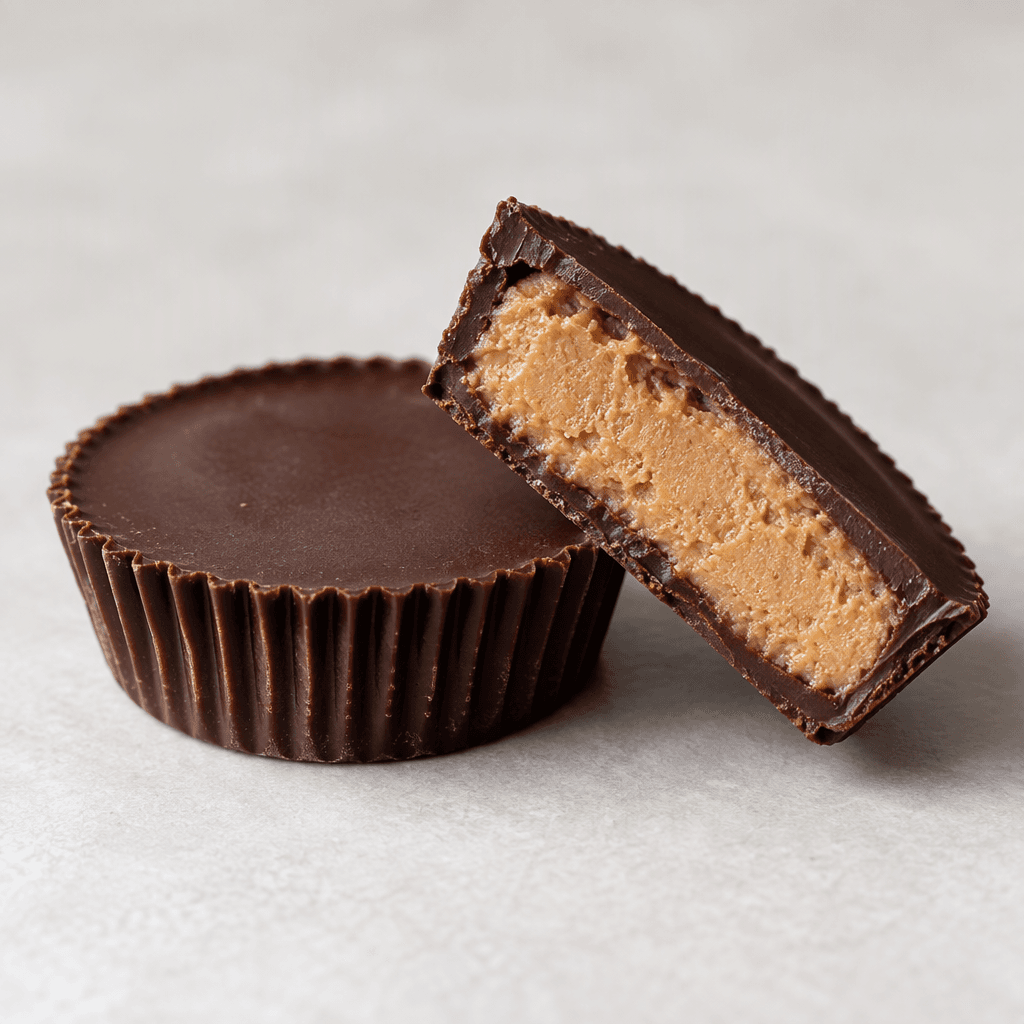
Peanut Butter Cup (Dark Chocolate) Calories
Combination of peanut butter and dark chocolate, contains protein and healthy fats, energy-dense treat.
CALORIES
GI
POTASSIUM
FIBER
Quick answer
1 piece (medium) of Peanut Butter Cup (Dark Chocolate) (20 g) has 108 calories. That works out to 540 calories per 100 g. It contains 8.8 g of carbs, 2 g of protein, 7.2 g of fat and 1.3 g of fiber. Its 0.1 mg of Copper covers 9% of the Daily Value. Its glycemic index is 35 (low), so it raises blood sugar slowly.
What is Peanut Butter Cup (Dark Chocolate)?
A Peanut Butter Cup (Dark Chocolate) is a small confection with a soft peanut-butter centre enclosed in a dark-chocolate shell. Peanut butter cups are especially associated with the United States, where they are a familiar shop-bought sweet. The filling is creamy, rich and often a little salty, while the chocolate adds a firmer snap and a bittersweet cocoa note.
It works as an occasional dessert or a small treat with coffee; in the US, it is also a common candy-counter and lunchbox sweet. Peanuts contribute protein and fats, but the combination is energy-dense: it provides 540 calories per 100 g. Enjoy one piece when you want something satisfying, or pair it with fresh fruit to balance its richness.
Peanut Butter Cup (Dark Chocolate) Nutrition Facts
Selected: 100 g
540
KCAL / 100G
Carbs
44g
· 16% DV
Protein
10g
· 20% DV
Fat
36g
· 46% DV
Fiber
6.5g
· 23% DV
DV is the share of the daily value covered, on a 2,000 kcal reference diet.
Calories come from: Carbs 33% · Protein 7% · Fat 60%
Peanut Butter Cup (Dark Chocolate) Vitamins & Minerals
Vitamins
B3
3.8mg · 24% DV
Biotin
7µg · 23% DV
Vitamin E
3.1mg · 21% DV
B1
0.12mg · 10% DV
Minerals
Manganese
1mg · 43% DV
Phosphorus
170mg · 24% DV
Magnesium
90mg · 21% DV
Iron
2mg · 11% DV
How Nutritious Is Peanut Butter Cup (Dark Chocolate)?
Nutrient density
Low
How many vitamins, minerals and how much fiber this food carries per calorie. A high score means a lot of nutrition for few calories.
Satiety score
Medium
An EatBetter score computed from fiber, protein and calorie density. A high score means staying full longer on the same calories.
Both scores are calculated per 100 g and do not change with the selected portion. The satiety score is EatBetter's own calculation, not a clinical measure.
Peanut Butter Cup (Dark Chocolate) Glycemic Index
GLYCEMIC INDEX
GLYCEMIC LOAD
Accounts for portion size — a more realistic measure than GI alone.
How to Burn Off Peanut Butter Cup (Dark Chocolate)
To burn the 540 calories in 100 g:
🚶
Walking (5 km/h)
🏃
Running (8 km/h)
🚴
Cycling
🏊
Swimming
Times are calculated with the MET equation for a 70 kg adult. Actual burn varies with your weight, age and pace.
Is Peanut Butter Cup (Dark Chocolate) Processed?
NOVA 4
Ultra-Processed
1. Unprocessed
2. Minimally Processed
3. Processed
4. Ultra-Processed
NOVA classifies foods into 4 groups by industrial processing. NOVA 1 (unprocessed) is the healthiest.
Does Peanut Butter Cup (Dark Chocolate) Contain Allergens?
Contains these allergens:
Which Diets Is Peanut Butter Cup (Dark Chocolate) Good For?
Vegan
— Not suitable
Vegetarian
✓ Suitable
Gluten-Free
— Not suitable
Dairy-Free
— Not suitable
Mediterranean
— Not suitable
Paleo
— Not suitable
Whole30
— Not suitable
DASH
— Not suitable
Keto
— Not suitable
Low FODMAP
— Not suitable
Peanut Butter Cup (Dark Chocolate) Fat Profile
SATURATED
10.5g
MONOUNSATURATED
16.8g
POLYUNSATURATED
7.5g
Omega 6:3 ratio 144:1
Above the ideal 4:1 (144:1).
Compare Peanut Butter Cup (Dark Chocolate)
Foods Similar to Peanut Butter Cup (Dark Chocolate)
Frequently Asked Questions About Peanut Butter Cup (Dark Chocolate)
What is inside a dark chocolate peanut butter cup?
A dark chocolate peanut butter cup has a shell of dark chocolate around a peanut butter filling. Some versions add salt or sweeteners to the filling, so its texture and sweetness can vary by recipe.
Is a dark chocolate peanut butter cup the same as a Reese’s cup?
They are similar, but not necessarily the same. Classic Reese’s cups are usually made with milk chocolate, while a dark chocolate peanut butter cup uses a more cocoa-forward coating; recipes and sweetness vary between products.
How do you make a dark chocolate peanut butter cup at home?
Make one by coating the bottom and sides of a small paper or silicone cup with melted dark chocolate, adding peanut butter, then sealing it with another layer of chocolate. Chill until firm.
Why does the peanut butter filling leak out of a dark chocolate peanut butter cup?
The filling can leak if the chocolate shell has gaps or is too thin, or if the cup gets warm and soft. When making them at home, let the base layer set and cover the filling completely.
How should you store a dark chocolate peanut butter cup?
Store a dark chocolate peanut butter cup sealed in a cool, dry place, away from sunlight and heat. Refrigerate it if your room is warm, keeping it covered so it does not absorb moisture or other food odors.
Can you freeze a dark chocolate peanut butter cup?
Yes, you can freeze a dark chocolate peanut butter cup in an airtight container. Let it come to room temperature while still covered before eating to reduce condensation on the chocolate.
Can you bake with a dark chocolate peanut butter cup?
Yes, you can chop a dark chocolate peanut butter cup into cookies or brownies, or add it as a topping. The chocolate and filling soften in the oven, so pieces may spread rather than keep their shape.
Is a dark chocolate peanut butter cup healthy?
It can fit as an occasional treat, but a dark chocolate peanut butter cup is still a rich sweet rather than a substitute for a balanced snack. Its peanut butter filling adds richness, while the chocolate coating contributes sweetness.
Can dogs eat a dark chocolate peanut butter cup?
No, do not give a dark chocolate peanut butter cup to dogs. Chocolate can be toxic to them, and some peanut butter products also contain xylitol, which is dangerous for dogs.
Can people with diabetes eat a dark chocolate peanut butter cup?
People with diabetes may be able to include one, but its sugars and carbohydrates can affect blood glucose. The amount and recipe matter, so ask your diabetes care team how to fit it into your eating plan.
Have another question about Peanut Butter Cup (Dark Chocolate)?
Ask the AI nutrition coach — calories, portions, alternatives and more, answered in seconds in the app.

Scan calories with your camera
Instant AI nutrition analysis

Nutrition data compiled from USDA FoodData Central and scientific sources.