

Ready & Packaged Foods
All →Vegetables & Legumes
All →Desserts & Confectionery
All →Meat & Protein
All →Grains & Bakery
All →Beverages
All →Milk & Dairy
All →

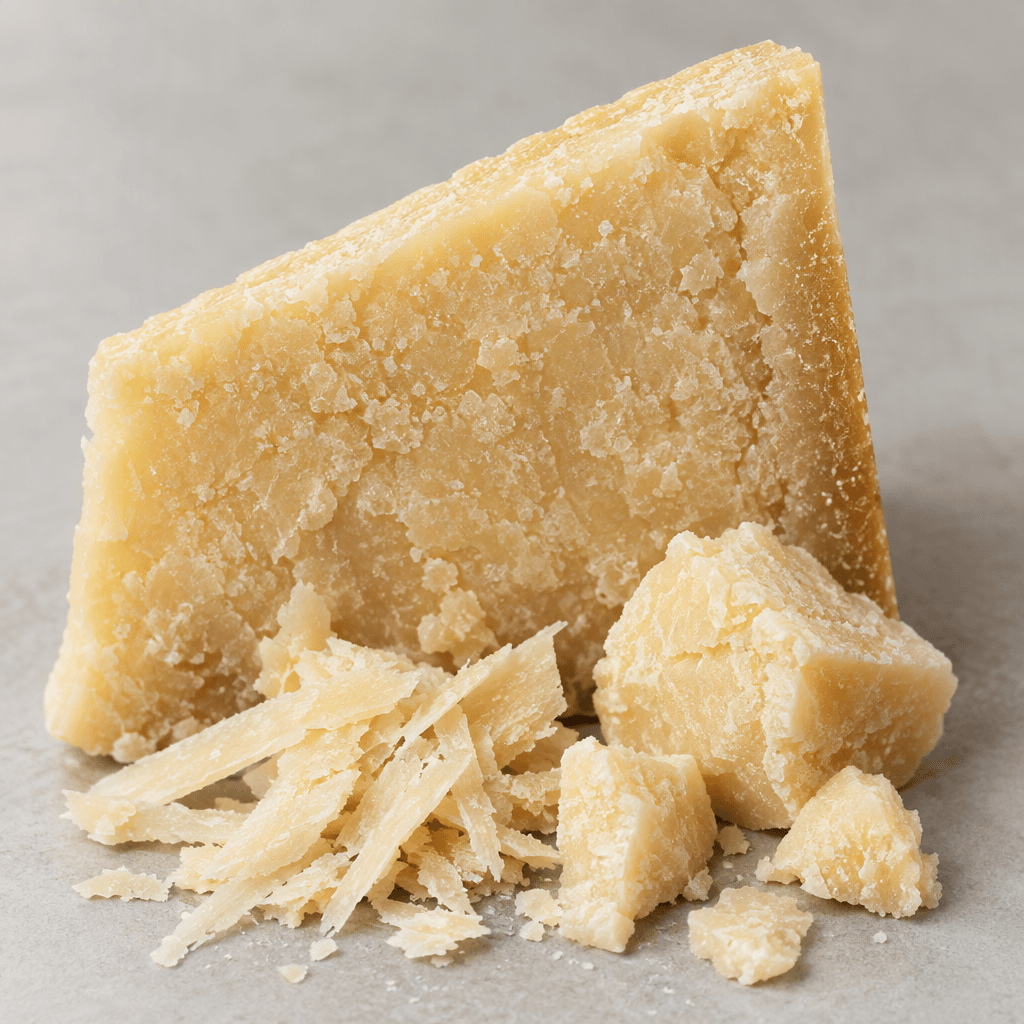
Parmesan Cheese Calories
Hard, salty, aged Italian cheese with rich umami flavor
In season: Spring · Summer · Autumn · Winter
CALORIES
GI
POTASSIUM
FIBER
Quick answer
2 tablespoon (grated) of Parmesan Cheese (10 g) has 43 calories. That works out to 431 calories per 100 g. It contains 0.4 g of carbs, 3.8 g of protein, 2.9 g of fat and 0 g of fiber. Its 118 mg of Calcium covers 12% of the Daily Value. Its glycemic index is 0 (low), so it raises blood sugar slowly.
What is Parmesan Cheese?
Parmesan Cheese is a hard, aged Italian cheese, known for its dry, crumbly texture and salty, savoury depth. It is usually sold as a wedge and grated over dishes or broken into small pieces. In Italy, it is a familiar finishing touch for pasta and risotto; elsewhere, it is also used in soups, salads and baked dishes, or served on a cheese board with bread and fruit.
Its flavour is concentrated, so a little goes a long way. Parmesan Cheese is protein-rich but also energy-dense, making it a flavourful addition rather than the main part of a meal. Grate it over a dish just before serving, and use a light hand if you want to keep the overall saltiness in check.
Parmesan Cheese Nutrition Facts
Selected: 100 g
431
KCAL / 100G
Carbs
4.1g
· 1% DV
Protein
38g
· 76% DV
Fat
29g
· 37% DV
Fiber
0g
· 0% DV
DV is the share of the daily value covered, on a 2,000 kcal reference diet.
Calories come from: Carbs 4% · Protein 35% · Fat 61%
Parmesan Cheese Vitamins & Minerals
Vitamins
B12
1.3µg · 54% DV
Vitamin A
270µg · 30% DV
B2
0.35mg · 27% DV
B5
0.5mg · 10% DV
Minerals
Calcium
1180mg · 118% DV
Phosphorus
680mg · 97% DV
Sodium
1800mg · 78% DV
Zinc
3mg · 27% DV
How Nutritious Is Parmesan Cheese?
Nutrient density
High
How many vitamins, minerals and how much fiber this food carries per calorie. A high score means a lot of nutrition for few calories.
Satiety score
Low
An EatBetter score computed from fiber, protein and calorie density. A high score means staying full longer on the same calories.
Both scores are calculated per 100 g and do not change with the selected portion. The satiety score is EatBetter's own calculation, not a clinical measure.
Parmesan Cheese Glycemic Index
GLYCEMIC INDEX
GLYCEMIC LOAD
Accounts for portion size — a more realistic measure than GI alone.
How to Burn Off Parmesan Cheese
To burn the 431 calories in 100 g:
🚶
Walking (5 km/h)
🏃
Running (8 km/h)
🚴
Cycling
🏊
Swimming
Times are calculated with the MET equation for a 70 kg adult. Actual burn varies with your weight, age and pace.
Is Parmesan Cheese Processed?
NOVA 3
Processed
1. Unprocessed
2. Minimally Processed
3. Processed
4. Ultra-Processed
NOVA classifies foods into 4 groups by industrial processing. NOVA 1 (unprocessed) is the healthiest.
Does Parmesan Cheese Contain Allergens?
Contains these allergens:
Which Diets Is Parmesan Cheese Good For?
Vegan
— Not suitable
Vegetarian
✓ Suitable
Gluten-Free
— Not suitable
Dairy-Free
— Not suitable
Mediterranean
✓ Suitable
Paleo
— Not suitable
Whole30
— Not suitable
DASH
— Not suitable
Keto
— Not suitable
Low FODMAP
— Not suitable
Parmesan Cheese Fat Profile
SATURATED
18.9g
MONOUNSATURATED
8.2g
POLYUNSATURATED
0.7g
Omega 6:3 ratio 4.2:1
Above the ideal 4:1 (4.2:1).
Compare Parmesan Cheese
Foods Similar to Parmesan Cheese
Frequently Asked Questions About Parmesan Cheese
What is Parmesan cheese?
Parmesan cheese is a firm, aged Italian cheese with a savory, nutty flavor and a crumbly texture. Parmigiano Reggiano is a protected, traditionally made type from designated Italian regions; Parmesan sold elsewhere may be made under different rules.
How do you use Parmesan cheese?
Parmesan cheese is commonly grated over pasta, risotto, soups, and salads. Its concentrated savory flavor means a little goes a long way; adding it near the end of cooking helps preserve its aroma.
Can you eat the rind of Parmesan cheese?
Yes, Parmesan cheese rind can be used in cooking, though it is too hard for most people to enjoy on its own. Simmer a clean piece in soup, sauce, or stew to add flavor, then remove it before serving.
Does Parmesan cheese melt?
Yes, Parmesan cheese softens and melts into hot dishes, but it does not become stretchy like mozzarella. Finely grated Parmesan blends well into sauces and risotto; cooked by itself over high heat, it can turn dry and crisp.
What can I use instead of Parmesan cheese?
Grana Padano is a close substitute for Parmesan cheese, with a similar firm texture and a milder flavor. Pecorino Romano also works, but it is sharper and saltier, so use less and adjust the dish’s seasoning.
How should you store Parmesan cheese?
Keep Parmesan cheese in the refrigerator, wrapped so it does not dry out or absorb other odors. Wrap a wedge in cheese paper or parchment and place it in an airtight container; grate it shortly before use for the best flavor.
Can you freeze Parmesan cheese?
Yes, Parmesan cheese freezes well, especially when grated or cut into small pieces. Its texture may become more crumbly after thawing, so use frozen Parmesan in cooked dishes rather than relying on it for neat slices.
What is the difference between Parmesan cheese and Pecorino Romano?
Parmesan cheese is made from cow’s milk and has a savory, nutty flavor, while Pecorino Romano is made from sheep’s milk and is typically sharper and saltier. Both grate well, but Pecorino can make a dish noticeably saltier.
Is Parmesan cheese lactose-free?
Aged Parmesan cheese contains very little lactose because most is removed or broken down during cheesemaking and aging. Many people with lactose intolerance tolerate a small serving, but Parmesan is still a dairy product and is not suitable for a milk-protein allergy.
Is Parmesan cheese healthy?
Parmesan cheese provides protein and calcium, but it is also salty and contains saturated fat. Using a small amount to flavor a meal can fit into a balanced eating pattern; people limiting sodium may need to keep portions modest.
Have another question about Parmesan Cheese?
Ask the AI nutrition coach — calories, portions, alternatives and more, answered in seconds in the app.

Scan calories with your camera
Instant AI nutrition analysis

Nutrition data compiled from USDA FoodData Central and scientific sources.