

Ready & Packaged Foods
All →Vegetables & Legumes
All →Desserts & Confectionery
All →Meat & Protein
All →Grains & Bakery
All →Beverages
All →Milk & Dairy
All →

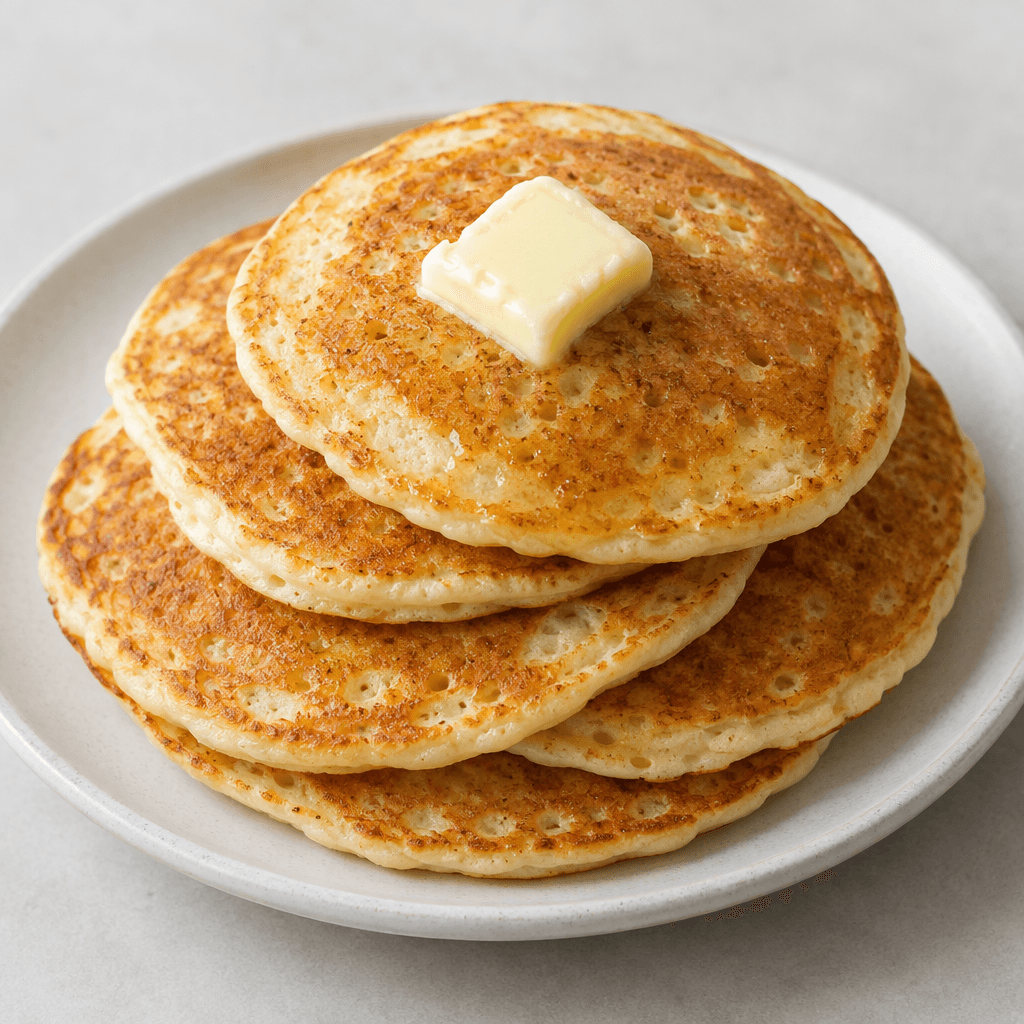
Pancake Calories
Breakfast, egg-based, flour, sweet
In season: Spring · Summer · Autumn · Winter
CALORIES
GI
POTASSIUM
FIBER
Quick answer
1 piece (medium) of Pancake (60 g) has 132 calories. That works out to 220 calories per 100 g. It contains 19.2 g of carbs, 3.7 g of protein, 4.3 g of fat and 0.7 g of fiber. Its 72 mg of Phosphorus covers 10% of the Daily Value. Its glycemic index is 67 (medium), so it raises blood sugar at a moderate pace.
What is Pancake?
Pancakes are small, round griddle cakes usually made from flour, eggs and milk, with a raising agent often added for a soft, puffy crumb. The pictured stack is the fluffy American-style kind, rather than the thin crêpes also called pancakes in some countries.
They taste gently sweet, with browned edges and a tender, porous centre. In the United States they are a familiar breakfast, often served in a stack with butter and syrup; elsewhere, toppings might include fruit, jam or yogurt. They are mainly a flour-based source of carbohydrates, with some protein from the eggs and milk. For a lighter topping, try fresh fruit and plain yogurt instead of a generous pour of syrup.
Pancake Nutrition Facts
Selected: 100 g
220
KCAL / 100G
Carbs
32g
· 12% DV
Protein
6.2g
· 12% DV
Fat
7.2g
· 9% DV
Fiber
1.1g
· 4% DV
DV is the share of the daily value covered, on a 2,000 kcal reference diet.
Calories come from: Carbs 59% · Protein 11% · Fat 30%
Pancake Vitamins & Minerals
Vitamins
B2
0.18mg · 14% DV
Biotin
3.5µg · 12% DV
B1
0.13mg · 11% DV
B5
0.45mg · 9% DV
Minerals
Phosphorus
120mg · 17% DV
Sodium
350mg · 15% DV
Selenium
7.5µg · 14% DV
Calcium
110mg · 11% DV
How Nutritious Is Pancake?
Nutrient density
Medium
How many vitamins, minerals and how much fiber this food carries per calorie. A high score means a lot of nutrition for few calories.
Satiety score
Low
An EatBetter score computed from fiber, protein and calorie density. A high score means staying full longer on the same calories.
Both scores are calculated per 100 g and do not change with the selected portion. The satiety score is EatBetter's own calculation, not a clinical measure.
Pancake Glycemic Index
GLYCEMIC INDEX
GLYCEMIC LOAD
Accounts for portion size — a more realistic measure than GI alone.
How to Burn Off Pancake
To burn the 220 calories in 100 g:
🚶
Walking (5 km/h)
🏃
Running (8 km/h)
🚴
Cycling
🏊
Swimming
Times are calculated with the MET equation for a 70 kg adult. Actual burn varies with your weight, age and pace.
Is Pancake Processed?
NOVA 3
Processed
1. Unprocessed
2. Minimally Processed
3. Processed
4. Ultra-Processed
NOVA classifies foods into 4 groups by industrial processing. NOVA 1 (unprocessed) is the healthiest.
Does Pancake Contain Allergens?
Contains these allergens:
Which Diets Is Pancake Good For?
Vegan
— Not suitable
Vegetarian
✓ Suitable
Gluten-Free
— Not suitable
Dairy-Free
— Not suitable
Mediterranean
— Not suitable
Paleo
— Not suitable
Whole30
— Not suitable
DASH
— Not suitable
Keto
— Not suitable
Low FODMAP
— Not suitable
Pancake Fat Profile
SATURATED
2.1g
MONOUNSATURATED
2.5g
POLYUNSATURATED
1g
Omega 6:3 ratio 16.3:1
Above the ideal 4:1 (16.3:1).
Compare Pancake
Foods Similar to Pancake
Frequently Asked Questions About Pancake
How do you make pancakes from scratch?
Pancakes are made by combining flour, egg, milk, and a raising agent into a batter, then cooking spoonfuls on a warm pan. Mix just until combined, pour onto a lightly greased surface, and flip when bubbles appear and the edges begin to set.
How do you make pancakes fluffy?
Pancakes turn out fluffy when the baking powder is fresh and the batter is not overmixed. Stir only until the dry ingredients are moistened; a few small lumps are fine. Cook over medium heat so the centers have time to rise without the outsides burning.
What is the difference between pancakes and crêpes?
Pancakes are thicker and rise with a raising agent, while crêpes are thin, flexible, and usually made without one. Pancakes are commonly stacked and topped; crêpes are often folded or rolled around sweet or savoury fillings.
Why are my pancakes flat?
Pancakes often come out flat if the baking powder is old, the batter has been overmixed, or it has sat too long. Check that the raising agent is fresh and cook the batter soon after mixing to retain its lift.
Why do pancakes stick to the pan?
Pancakes stick when the pan is not properly heated, its surface is worn, or the pancake is flipped too soon. Warm the pan over medium heat, add a thin film of oil or butter, and wait until the edges set before turning.
When should you flip a pancake?
Flip a pancake when bubbles form across the top and the edges look set rather than wet. Slide a thin spatula underneath and turn it once; pressing down on the pancake can make it dense.
Can you make pancake batter the night before?
You can prepare pancake batter ahead, but an overnight rest may weaken the lift from baking powder. Refrigerate it covered and cook it as soon as practical; for the fluffiest pancakes, mix the batter shortly before cooking.
Can you freeze pancakes and reheat them?
Yes, cooked pancakes freeze well. Let them cool completely, separate them with baking paper, and store them in an airtight freezer-safe container. Reheat from frozen in a toaster or pan until hot throughout.
What are the best toppings for pancakes?
Pancakes pair well with fresh berries, sliced banana, yogurt, nut butter, or a little syrup. For a less sweet breakfast, serve them with eggs or plain yogurt; toppings such as chocolate spread and syrup add sweetness quickly.
Are pancakes a good breakfast for weight loss?
Pancakes can fit into a weight-loss breakfast, but large portions and generous syrup or chocolate toppings can make the meal more filling in energy without adding much staying power. Pair a moderate serving with fruit and a protein-rich side such as yogurt or eggs.
Have another question about Pancake?
Ask the AI nutrition coach — calories, portions, alternatives and more, answered in seconds in the app.

Scan calories with your camera
Instant AI nutrition analysis

Nutrition data compiled from USDA FoodData Central and scientific sources.