

Ready & Packaged Foods
All →Vegetables & Legumes
All →Desserts & Confectionery
All →Meat & Protein
All →Grains & Bakery
All →Beverages
All →Milk & Dairy
All →

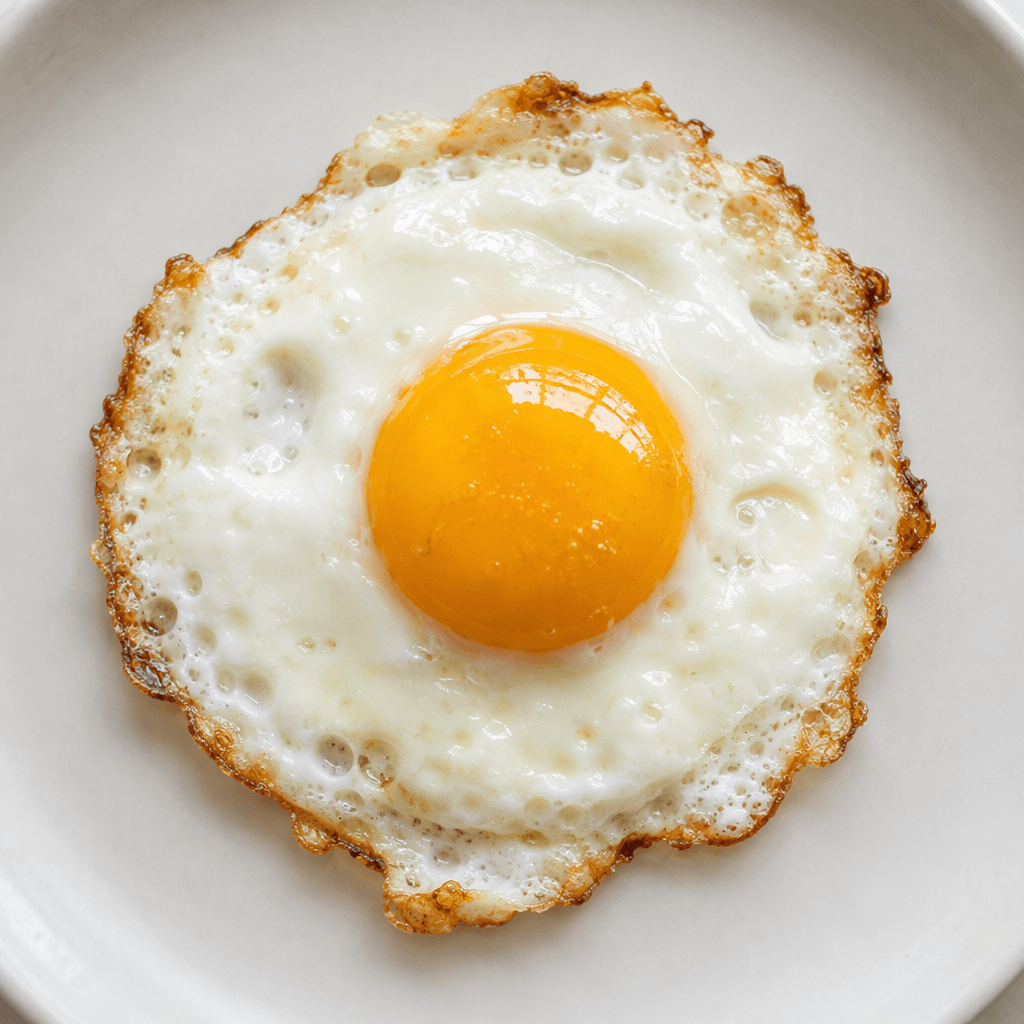
Pan-cooked egg Calories
High-quality protein, good fats, source of B12 and D vitamins
In season: Spring · Summer · Autumn · Winter
CALORIES
GI
POTASSIUM
FIBER
Quick answer
1 piece (medium) of Pan-cooked egg (50 g) has 72 calories. That works out to 143 calories per 100 g. It contains 0.6 g of carbs, 6.5 g of protein, 5 g of fat and 0 g of fiber. Its 10 µg of Biotin covers 33% of the Daily Value. Its glycemic index is 0 (low), so it raises blood sugar slowly.
What is Pan-cooked egg?
A pan-cooked egg is cracked into a hot pan and cooked until the white sets, often with the yolk left soft and whole. A little oil or butter may be used, and the edges can turn lightly crisp. It is a quick, familiar breakfast in many kitchens, though it also works as a simple addition to lunch or supper.
Serve it hot on toast, with vegetables, or alongside potatoes; in Turkey, it is often part of a breakfast spread. It provides substantial protein and fat while remaining very low in carbohydrates. For a lighter result, use a non-stick pan with just a little oil, or pair the egg with fresh vegetables and whole-grain bread.
Pan-cooked egg Nutrition Facts
Selected: 100 g
143
KCAL / 100G
Carbs
1.1g
· 0% DV
Protein
13g
· 26% DV
Fat
9.9g
· 13% DV
Fiber
0g
· 0% DV
DV is the share of the daily value covered, on a 2,000 kcal reference diet.
Calories come from: Carbs 3% · Protein 36% · Fat 61%
Pan-cooked egg Vitamins & Minerals
Vitamins
Biotin
20µg · 67% DV
B12
1.1µg · 46% DV
B2
0.5mg · 38% DV
B5
1.4mg · 28% DV
Minerals
Selenium
30µg · 55% DV
Iodine
47µg · 31% DV
Phosphorus
170mg · 24% DV
Zinc
1mg · 9% DV
How Nutritious Is Pan-cooked egg?
Nutrient density
Very high
How many vitamins, minerals and how much fiber this food carries per calorie. A high score means a lot of nutrition for few calories.
Satiety score
Medium
An EatBetter score computed from fiber, protein and calorie density. A high score means staying full longer on the same calories.
Both scores are calculated per 100 g and do not change with the selected portion. The satiety score is EatBetter's own calculation, not a clinical measure.
Pan-cooked egg Glycemic Index
GLYCEMIC INDEX
GLYCEMIC LOAD
Accounts for portion size — a more realistic measure than GI alone.
How to Burn Off Pan-cooked egg
To burn the 143 calories in 100 g:
🚶
Walking (5 km/h)
🏃
Running (8 km/h)
🚴
Cycling
🏊
Swimming
Times are calculated with the MET equation for a 70 kg adult. Actual burn varies with your weight, age and pace.
Is Pan-cooked egg Processed?
NOVA 2
Minimally Processed
1. Unprocessed
2. Minimally Processed
3. Processed
4. Ultra-Processed
NOVA classifies foods into 4 groups by industrial processing. NOVA 1 (unprocessed) is the healthiest.
Does Pan-cooked egg Contain Allergens?
Contains these allergens:
Which Diets Is Pan-cooked egg Good For?
Vegan
— Not suitable
Vegetarian
✓ Suitable
Gluten-Free
✓ Suitable
Dairy-Free
— Not suitable
Mediterranean
✓ Suitable
Paleo
✓ Suitable
Whole30
— Not suitable
DASH
— Not suitable
Keto
✓ Suitable
Low FODMAP
— Not suitable
Pan-cooked egg Fat Profile
SATURATED
3.1g
MONOUNSATURATED
3.7g
POLYUNSATURATED
1.4g
Omega 6:3 ratio 26:1
Above the ideal 4:1 (26:1).
Compare Pan-cooked egg
Foods Similar to Pan-cooked egg
Frequently Asked Questions About Pan-cooked egg
How do you cook a pan-cooked egg without overcooking the yolk?
Cook a pan-cooked egg over medium-low heat and take it off the heat once the white is set, if you want a runny yolk. A very hot pan or prolonged cooking can firm the yolk before the white is done.
How do you keep a pan-cooked egg from sticking to the pan?
To keep a pan-cooked egg from sticking, warm the pan first and coat its surface with a thin layer of cooking fat. Use a well-seasoned or nonstick pan, and wait until the white has set before easing the egg loose.
Can you make a pan-cooked egg without oil?
Yes, you can make a pan-cooked egg without oil in a good nonstick pan, though it may be harder to release from a regular pan. A small amount of water and a lid can help cook the white without adding fat.
Should you cover a pan-cooked egg while it cooks?
Covering a pan-cooked egg is optional. The trapped steam cooks the top of the white without flipping, which is useful if you want a gently cooked top; uncover it as soon as the white is set to avoid cooking the yolk through.
How do you get crispy edges on a pan-cooked egg?
For crispy edges on a pan-cooked egg, crack it into a hot, lightly oiled pan and let the white sizzle at the edges. Keep the center from overcooking by lowering the heat once the edges start to brown.
Do you flip a pan-cooked egg?
You do not need to flip a pan-cooked egg. Leaving it intact keeps the yolk more exposed and runny; for a more cooked top, slide a thin spatula underneath, turn it gently, and cook the other side briefly.
What is the difference between a sunny-side-up egg and an over-easy pan-cooked egg?
A sunny-side-up pan-cooked egg is cooked on one side, leaving the yolk visible. An over-easy egg is flipped briefly, so its white cooks on both sides while the yolk generally remains runny.
Is a runny pan-cooked egg safe to eat?
A runny pan-cooked egg can carry a food-safety risk because the yolk is not fully cooked. People who are pregnant, very young, older, or immunocompromised should choose eggs cooked until both the white and yolk are firm.
How long can you keep a leftover pan-cooked egg in the fridge?
Keep a leftover pan-cooked egg in a covered container in the refrigerator and eat it promptly. Do not leave it sitting at room temperature for an extended time, and discard it if it has been stored or handled unsafely.
What is the best way to reheat a pan-cooked egg?
Reheat a pan-cooked egg gently in a covered pan over low heat until it is hot throughout. The microwave also works in short bursts, but it can make the white rubbery and may cause the yolk to burst.
Have another question about Pan-cooked egg?
Ask the AI nutrition coach — calories, portions, alternatives and more, answered in seconds in the app.

Scan calories with your camera
Instant AI nutrition analysis

Nutrition data compiled from USDA FoodData Central and scientific sources.