

Ready & Packaged Foods
All →Vegetables & Legumes
All →Desserts & Confectionery
All →Meat & Protein
All →Grains & Bakery
All →Beverages
All →Milk & Dairy
All →

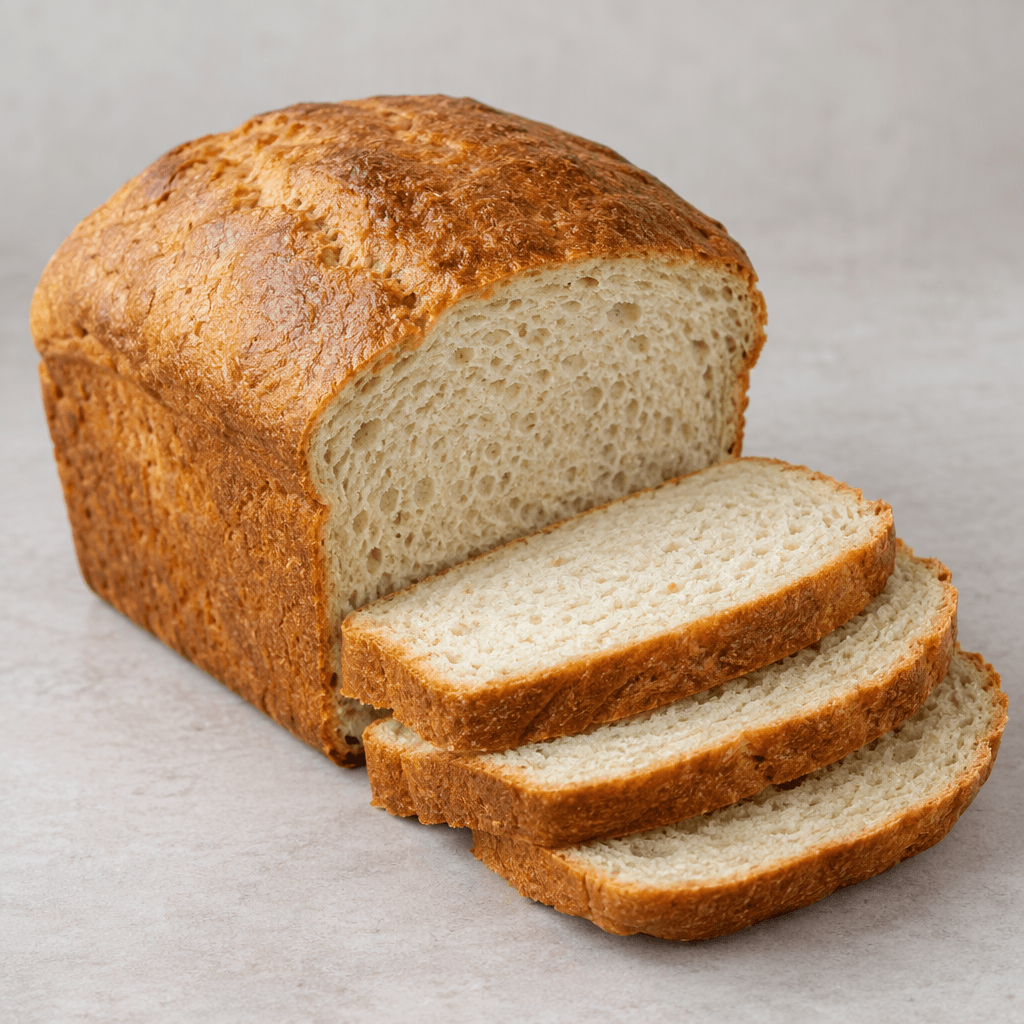
Loaf bread Calories
Staple daily bread, source of carbohydrates
In season: Spring · Summer · Autumn · Winter
CALORIES · 100 G
GI
POTASSIUM · 100 G
FIBER · 100 G
Quick answer
1 slice (medium) of Loaf bread (30 g) has 78 calories. That works out to 260 calories per 100 g. It contains 15.3 g of carbs, 2.6 g of protein, 0.8 g of fat and 0.8 g of fiber. Its 3.9 µg of Selenium covers 7% of the Daily Value. Its glycemic index is 75 (high), so it raises blood sugar quickly.
Loaf bread Nutrition Facts
Selected: 1 slice (medium) · 30 g
78
KCAL / 30G
Carbs
15.3g
· 6% DV
Protein
2.6g
· 5% DV
Fat
0.8g
· 1% DV
Fiber
0.8g
· 3% DV
DV is the share of the daily value covered, on a 2,000 kcal reference diet.
Calories come from: Carbs 78% · Protein 13% · Fat 9%
Loaf bread nutrition facts table · 1 slice (medium) (30 g)
| Nutrient | Amount | % DV |
|---|---|---|
| Calories | 78 kcal | |
| Total fat | 0.8 g | 1% |
| Saturated fat | 0.21 g | 1% |
| Trans fat | 0 g | |
| Sodium | 144 mg | 6% |
| Total carbohydrate | 15.3 g | 6% |
| Fiber | 0.8 g | 3% |
| Protein | 2.6 g | 5% |
Calories: Calories measure energy. Average daily need is 2,000 kcal. Excess calories are stored as fat, too few cause weight loss.
Carbs: Your body's primary energy source. The brain runs exclusively on carbs. Daily need: 275g.
Protein: Essential for muscle repair and cell growth. Daily need: 50g. Keeps you full and boosts metabolism.
Fat: Needed for hormone production and vitamin absorption. Daily need: 78g. Limit saturated fats, choose unsaturated.
Fiber: Critical for digestive health and satiety. Daily need: 28g. Stabilizes blood sugar, lowers cholesterol.

Log this food in EatBetter
100,000+ people use it
- Get your daily calorie target
- Snap your meal, log it in seconds
- See every vitamin and mineral

📸 Scan the code to get the app free.

How Many Calories in 1 Slice of Loaf bread?
| Serving | Amount | Calories |
|---|---|---|
| 1 slice (medium) | 30 g | 78 kcal |
| 1 slice (extra small) | 15 g | 39 kcal |
| 1 slice (thin) | 25 g | 65 kcal |
| 1 slice (thick) | 40 g | 104 kcal |
| 1 serving (medium) | 50 g | 130 kcal |
| 2 slice (medium) | 60 g | 156 kcal |
| 1 piece (small) | 80 g | 208 kcal |
| 100 g | 100 g | 260 kcal |
| 1 serving (large) | 100 g | 260 kcal |
| 1 piece (large) | 120 g | 312 kcal |
Calculated from 260 calories per 100 g.
Frequently Asked Questions About Loaf bread
How should you store loaf bread to keep it fresh?
Store loaf bread at room temperature in a bread box or a closed bag, away from heat and sunlight. Refrigeration can make bread stale faster. If you will not use it soon, freeze it in portions and thaw only what you need.
Can you freeze loaf bread?
Yes, loaf bread freezes well. Slice it first and seal the slices in a freezer-safe bag so you can take out just what you need. Thaw slices at room temperature or toast them straight from frozen.
Why does loaf bread go stale so quickly?
Loaf bread goes stale as moisture shifts and the starch in the crumb changes structure over time. A closed container helps slow the process, while refrigeration can speed it up; freezing is a better option for longer storage.
How do you soften stale loaf bread?
Lightly moisten stale loaf bread and warm it briefly in the oven. The heat softens the inside and can crisp the crust again, but the effect is temporary. Eat it soon after warming for the best texture.
What is loaf bread usually made from?
Loaf bread is usually made from flour, water, yeast, and salt. Recipes vary, and some include ingredients such as oil or sugar for a softer crumb; the exact recipe depends on the bakery or home baker.
How do you get a soft crust on homemade loaf bread?
For a soft crust, let homemade loaf bread cool under a clean tea towel rather than leaving it uncovered. Keeping the loaf covered traps some moisture and softens the crust as it cools.
Why does homemade loaf bread collapse in the middle?
Homemade loaf bread often collapses when the dough is over-proofed, too wet, or underbaked. Let it rise until appropriately expanded rather than waiting for it to collapse, and make sure the center is fully baked before removing the loaf.
Can you use loaf bread to make French toast?
Yes, loaf bread works well for French toast. Slightly stale slices tend to absorb the egg-and-milk mixture without falling apart as easily as very fresh bread; cook them until both sides are set and browned.
What is the difference between loaf bread and artisan bread?
Loaf bread is generally baked in a pan for evenly shaped slices and a soft, regular crumb. Artisan loaves are often shaped by hand and baked for a thicker crust and more irregular interior, though recipes vary.
Does loaf bread raise blood sugar quickly?
Yes, loaf bread can raise blood sugar, particularly when eaten by itself because it is rich in carbohydrate. Pairing it with protein, healthy fats, or fibre-rich foods can slow the meal’s overall digestion; people with diabetes may need individualized guidance.
Loaf bread Vitamins & Minerals
Vitamins
B1
0.07mg · 6% DV
B3
0.66mg · 4% DV
Folate
10.5µg · 3% DV
B2
0.03mg · 2% DV
Minerals
Selenium
3.9µg · 7% DV
Manganese
0.15mg · 7% DV
Sodium
144mg · 6% DV
Iron
0.81mg · 5% DV
Potassium ⭐
36mg · 1% DV
Loaf bread Glycemic Index
GLYCEMIC INDEX
GLYCEMIC LOAD
Accounts for portion size — a more realistic measure than GI alone.
How to Burn Off Loaf bread
To burn the 78 calories in 1 slice (medium) (30 g):
🚶
Walking (5 km/h)
🏃
Running (8 km/h)
🚴
Cycling
🏊
Swimming
Times are calculated with the MET equation for a 70 kg adult. Actual burn varies with your weight, age and pace.
What is Loaf bread?
Loaf bread here refers to Turkish somun ekmek, an everyday wheat bread commonly bought fresh from neighbourhood bakeries. It is usually shaped as a rounded or oblong loaf, with a browned crust and a soft, airy interior; the exact shape and crust vary between bakeries and regions.
In Turkey, it is served at breakfast and alongside soups, stews and other meals, and often appears on the table at iftar. Its nutritional character is mainly that of a carbohydrate staple, with 51 g of carbohydrates per 100 g. For a more filling plate, pair a slice with eggs, beans, cheese or vegetables, and choose a portion that fits the rest of your meal.
How Nutritious Is Loaf bread?
Nutrient density
Low
How many vitamins, minerals and how much fiber this food carries per calorie. A high score means a lot of nutrition for few calories.
Satiety score
Medium
An EatBetter score computed from fiber, protein and calorie density. A high score means staying full longer on the same calories.
Both scores are calculated per 100 g and do not change with the selected portion. The satiety score is EatBetter's own calculation, not a clinical measure.
Is Loaf bread Processed?
NOVA 3
Processed
1. Unprocessed
2. Minimally Processed
3. Processed
4. Ultra-Processed
NOVA classifies foods into 4 groups by industrial processing. NOVA 1 (unprocessed) is the healthiest.
Does Loaf bread Contain Allergens?
Contains these allergens:
Which Diets Is Loaf bread Good For?
Vegan
— Not suitable
Vegetarian
✓ Suitable
Gluten-Free
— Not suitable
Dairy-Free
— Not suitable
Mediterranean
— Not suitable
Paleo
— Not suitable
Whole30
— Not suitable
DASH
— Not suitable
Keto
— Not suitable
Low FODMAP
— Not suitable
Loaf bread Fat Profile
SATURATED
0.21g
MONOUNSATURATED
0.18g
POLYUNSATURATED
0.12g
Omega 6:3 ratio 11:1
Above the ideal 4:1 (11:1).
Compare Loaf bread
Foods Similar to Loaf bread
Have another question about Loaf bread?
Ask the AI nutrition coach — calories, portions, alternatives and more, answered in seconds in the app.

Scan calories with your camera
Instant AI nutrition analysis

Nutrition data compiled from USDA FoodData Central and scientific sources.