

Ready & Packaged Foods
All →Vegetables & Legumes
All →Desserts & Confectionery
All →Meat & Protein
All →Grains & Bakery
All →Beverages
All →Milk & Dairy
All →

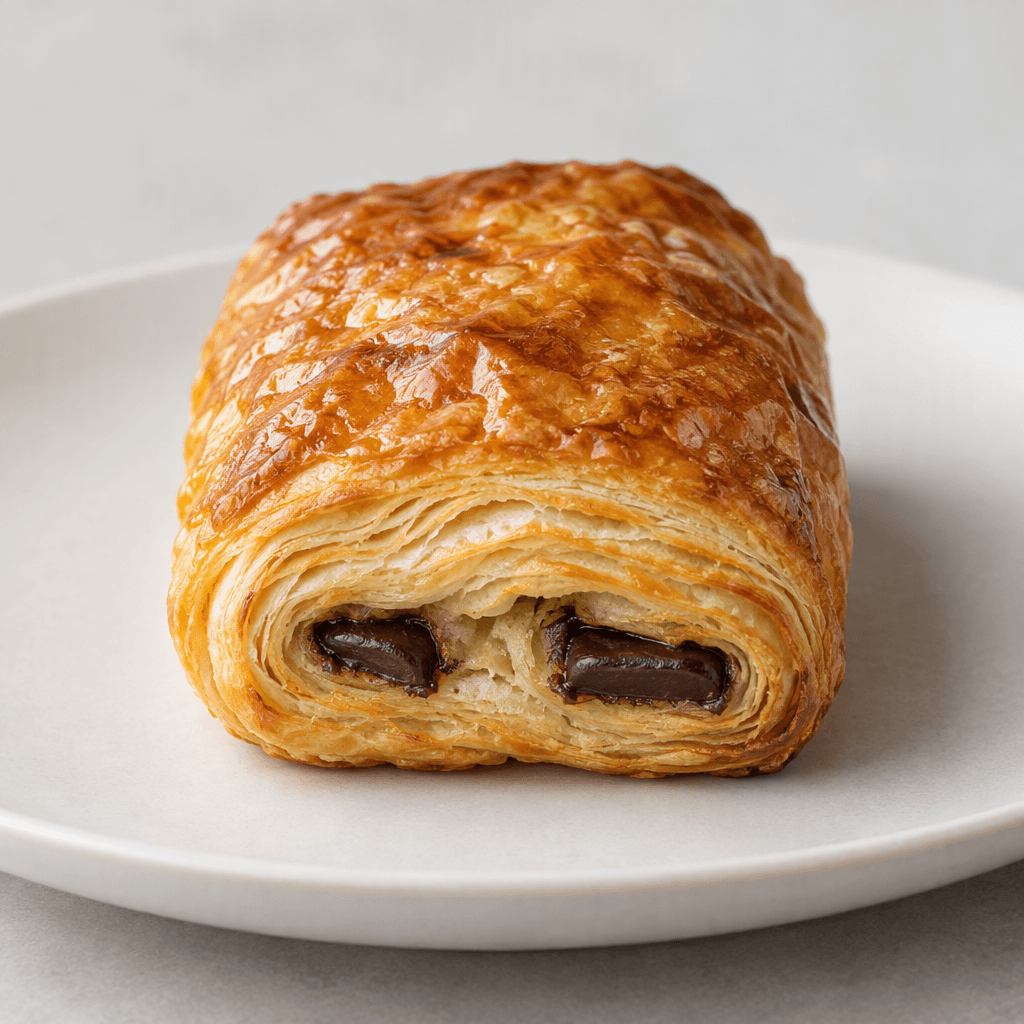
Pain au chocolat Calories
French pastry, chocolate croissant
In season: Spring · Summer · Autumn · Winter
CALORIES
GI
POTASSIUM
FIBER
Quick answer
1 piece (medium) of Pain au chocolat (55 g) has 226 calories. That works out to 410 calories per 100 g. It contains 24.2 g of carbs, 4 g of protein, 12.1 g of fat and 1.4 g of fiber. Its 5.5 µg of Selenium covers 10% of the Daily Value. Its glycemic index is 65 (medium), so it raises blood sugar at a moderate pace.
What is Pain au chocolat?
Pain au chocolat is a French pastry made by enclosing slim bars of chocolate in layers of laminated dough, then baking it until puffed and golden. Its exterior is crisp and flaky, while the centre is soft, buttery and lightly sweet, with distinct chocolate through the middle.
In France, it is a familiar breakfast bakery item, often enjoyed with coffee; elsewhere, it works just as well as a café snack or an occasional breakfast treat. The pastry is mainly a source of energy from flour and fat, with comparatively little fibre. Pair it with fruit or plain yoghurt for a more rounded breakfast, or enjoy it on its own with coffee when you want something small and sweet.
Pain au chocolat Nutrition Facts
Selected: 100 g
410
KCAL / 100G
Carbs
44g
· 16% DV
Protein
7.2g
· 14% DV
Fat
22g
· 28% DV
Fiber
2.6g
· 9% DV
DV is the share of the daily value covered, on a 2,000 kcal reference diet.
Calories come from: Carbs 44% · Protein 7% · Fat 49%
Pain au chocolat Vitamins & Minerals
Vitamins
B2
0.22mg · 17% DV
B1
0.18mg · 15% DV
Vitamin A
120µg · 13% DV
B5
0.6mg · 12% DV
Minerals
Selenium
10µg · 18% DV
Phosphorus
110mg · 16% DV
Sodium
340mg · 15% DV
Iron
2mg · 11% DV
How Nutritious Is Pain au chocolat?
Nutrient density
Low
How many vitamins, minerals and how much fiber this food carries per calorie. A high score means a lot of nutrition for few calories.
Satiety score
Low
An EatBetter score computed from fiber, protein and calorie density. A high score means staying full longer on the same calories.
Both scores are calculated per 100 g and do not change with the selected portion. The satiety score is EatBetter's own calculation, not a clinical measure.
Pain au chocolat Glycemic Index
GLYCEMIC INDEX
GLYCEMIC LOAD
Accounts for portion size — a more realistic measure than GI alone.
How to Burn Off Pain au chocolat
To burn the 410 calories in 100 g:
🚶
Walking (5 km/h)
🏃
Running (8 km/h)
🚴
Cycling
🏊
Swimming
Times are calculated with the MET equation for a 70 kg adult. Actual burn varies with your weight, age and pace.
Is Pain au chocolat Processed?
NOVA 3
Processed
1. Unprocessed
2. Minimally Processed
3. Processed
4. Ultra-Processed
NOVA classifies foods into 4 groups by industrial processing. NOVA 1 (unprocessed) is the healthiest.
Does Pain au chocolat Contain Allergens?
Contains these allergens:
Which Diets Is Pain au chocolat Good For?
Vegan
— Not suitable
Vegetarian
— Not suitable
Gluten-Free
— Not suitable
Dairy-Free
— Not suitable
Mediterranean
✓ Suitable
Paleo
— Not suitable
Whole30
— Not suitable
DASH
— Not suitable
Keto
— Not suitable
Low FODMAP
— Not suitable
Pain au chocolat Fat Profile
SATURATED
13g
MONOUNSATURATED
6.5g
POLYUNSATURATED
1.2g
Omega 6:3 ratio 14:1
Above the ideal 4:1 (14:1).
Compare Pain au chocolat
Foods Similar to Pain au chocolat
Frequently Asked Questions About Pain au chocolat
What is pain au chocolat?
Pain au chocolat is a French laminated pastry made from buttery, yeasted dough wrapped around chocolate batons. It bakes into crisp, flaky layers with soft chocolate inside and is commonly eaten for breakfast or with coffee.
Is pain au chocolat the same as a chocolate croissant?
They are very similar, and “chocolate croissant” is a common English name for pain au chocolat. The classic French pastry is usually rectangular and contains chocolate batons, while a plain croissant is crescent-shaped and has no chocolate filling.
Is pain au chocolat called chocolatine in some parts of France?
Yes. Chocolatine is the regional name used for pain au chocolat in parts of southwestern France. The names generally refer to the same chocolate-filled pastry, rather than two different recipes.
How do you pronounce pain au chocolat?
Pain au chocolat is roughly pronounced “pan oh shoh-koh-lah” in French, with the final “t” silent. English speakers often adapt the sounds, but keeping the French phrase recognizable is enough when ordering it.
What chocolate is inside pain au chocolat?
Pain au chocolat traditionally contains narrow bars of baking chocolate, often dark chocolate, rather than a spreadable filling. The bars soften in the oven but usually keep their shape, giving the pastry distinct strips of chocolate.
How is pain au chocolat traditionally served?
Pain au chocolat is usually served at room temperature or slightly warm, especially at breakfast or alongside coffee. Warming it briefly makes the chocolate softer and brings back some crispness in the pastry layers.
How do you reheat pain au chocolat without making it soggy?
Reheat pain au chocolat in an oven until it is just warm; dry oven heat helps restore its flaky exterior. Avoid heating it for too long, since the chocolate can become runny and the delicate pastry can overbrown.
Can pain au chocolat be stored at room temperature?
Yes. Once completely cool, keep pain au chocolat in an airtight container at room temperature to help preserve its texture. Refrigeration can make the pastry less crisp, so warm it briefly in the oven if the layers soften.
Can you freeze pain au chocolat?
Yes, pain au chocolat freezes well when wrapped tightly after cooling. Thaw it before serving, then warm it in the oven to revive the flaky layers; the chocolate may soften more quickly than the pastry during reheating.
How is pain au chocolat made from scratch?
Pain au chocolat is made by folding butter into yeasted dough through repeated rolling and folding, then wrapping the dough around chocolate batons. After shaping and proofing, the pastries are baked until puffed and deeply golden.
Have another question about Pain au chocolat?
Ask the AI nutrition coach — calories, portions, alternatives and more, answered in seconds in the app.

Scan calories with your camera
Instant AI nutrition analysis

Nutrition data compiled from USDA FoodData Central and scientific sources.