

Ready & Packaged Foods
All →Vegetables & Legumes
All →Desserts & Confectionery
All →Meat & Protein
All →Grains & Bakery
All →Beverages
All →Milk & Dairy
All →

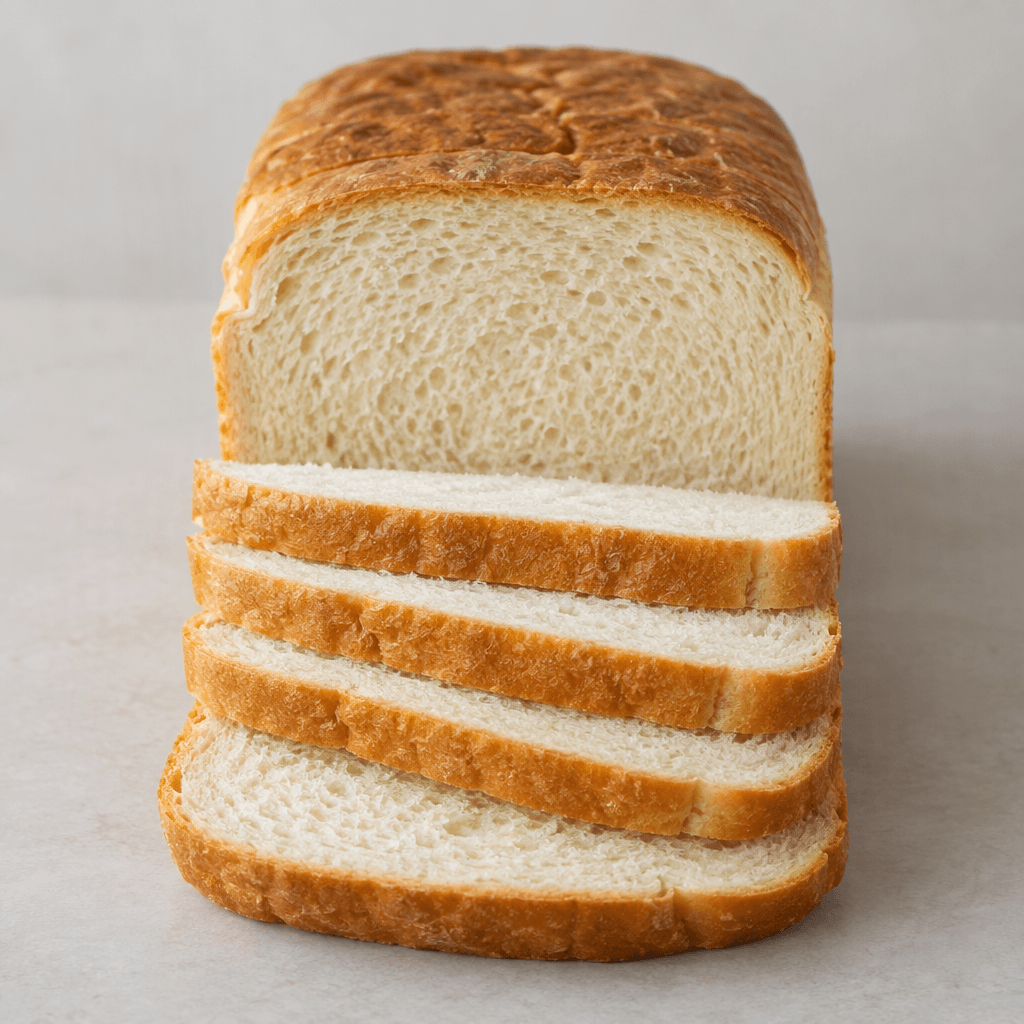
Pack Bread Calories
Commercially packaged white or whole wheat bread
In season: Spring · Summer · Autumn · Winter
CALORIES
GI
POTASSIUM
FIBER
Quick answer
1 slice (medium) of Pack Bread (25 g) has 63 calories. That works out to 250 calories per 100 g. It contains 11.8 g of carbs, 2.1 g of protein, 0.8 g of fat and 0.7 g of fiber. Its 0.1 mg of B1 covers 7% of the Daily Value. Its glycemic index is 75 (high), so it raises blood sugar quickly.
What is Pack Bread?
Pack bread is a commercially made loaf, sold sliced and wrapped for convenience. It is commonly available as white bread or whole-wheat bread, with a soft, even crumb and a thin crust that makes it easy to use straight from the bag.
Across many English-speaking households, it is a go-to choice for toast, sandwiches and simple sides with soup. Its nutrition is mainly carbohydrate, with some protein and fibre; it provides 47 g of carbohydrate per 100 g. Choose a whole-wheat version when you want more fibre, and pair slices with eggs, beans or vegetables for a more substantial meal.
Pack Bread Nutrition Facts
Selected: 100 g
250
KCAL / 100G
Carbs
47g
· 17% DV
Protein
8.5g
· 17% DV
Fat
3.2g
· 4% DV
Fiber
2.7g
· 10% DV
DV is the share of the daily value covered, on a 2,000 kcal reference diet.
Calories come from: Carbs 75% · Protein 14% · Fat 11%
Pack Bread Vitamins & Minerals
Vitamins
B1
0.35mg · 29% DV
B3
3.2mg · 20% DV
Folate
45µg · 11% DV
B2
0.12mg · 9% DV
Minerals
Selenium
16µg · 29% DV
Sodium
430mg · 19% DV
Iron
3mg · 17% DV
Calcium
110mg · 11% DV
How Nutritious Is Pack Bread?
Nutrient density
Low
How many vitamins, minerals and how much fiber this food carries per calorie. A high score means a lot of nutrition for few calories.
Satiety score
Medium
An EatBetter score computed from fiber, protein and calorie density. A high score means staying full longer on the same calories.
Both scores are calculated per 100 g and do not change with the selected portion. The satiety score is EatBetter's own calculation, not a clinical measure.
Pack Bread Glycemic Index
GLYCEMIC INDEX
GLYCEMIC LOAD
Accounts for portion size — a more realistic measure than GI alone.
How to Burn Off Pack Bread
To burn the 250 calories in 100 g:
🚶
Walking (5 km/h)
🏃
Running (8 km/h)
🚴
Cycling
🏊
Swimming
Times are calculated with the MET equation for a 70 kg adult. Actual burn varies with your weight, age and pace.
Is Pack Bread Processed?
NOVA 3
Processed
1. Unprocessed
2. Minimally Processed
3. Processed
4. Ultra-Processed
NOVA classifies foods into 4 groups by industrial processing. NOVA 1 (unprocessed) is the healthiest.
Does Pack Bread Contain Allergens?
Contains these allergens:
Which Diets Is Pack Bread Good For?
Vegan
— Not suitable
Vegetarian
✓ Suitable
Gluten-Free
— Not suitable
Dairy-Free
— Not suitable
Mediterranean
— Not suitable
Paleo
— Not suitable
Whole30
— Not suitable
DASH
— Not suitable
Keto
— Not suitable
Low FODMAP
— Not suitable
Pack Bread Fat Profile
SATURATED
0.7g
MONOUNSATURATED
0.7g
POLYUNSATURATED
1.2g
Omega 6:3 ratio 15:1
Above the ideal 4:1 (15:1).
Compare Pack Bread
Foods Similar to Pack Bread
Frequently Asked Questions About Pack Bread
How long does pack bread last after opening?
Pack bread does not have one fixed shelf life after opening; warmth, moisture, and the package date all matter. Keep it sealed, and discard it if you see mold or notice an unusual smell or texture.
Can you freeze pack bread?
Yes, pack bread freezes well. Separate slices or portions in a tightly sealed freezer bag so you can take out only what you need; thaw at room temperature or toast slices straight from frozen.
Should pack bread be kept in the refrigerator?
Usually not. Refrigeration can make pack bread go stale faster, even though it may slow mold in some conditions. Keep it sealed in a cool, dry cupboard for short-term storage, or freeze it for longer storage.
Can you eat the rest of pack bread after removing a moldy slice?
No. Discard the whole loaf of pack bread if you find mold, rather than cutting away the spot or throwing out just one slice. Mold can spread through porous bread beyond the part you can see.
Why does pack bread stay soft for so long?
Pack bread stays soft partly because sealed packaging limits exposure to air and drying. Some recipes also use ingredients that help retain moisture; a soft texture alone does not mean the bread is fresh or safe.
Can pack bread be used for toast?
Yes, pack bread works well in a toaster or under a grill. Start with a short setting because thin slices can brown quickly; toasting makes bread crisp but does not make moldy bread safe to eat.
What is the best way to store pack bread once the bag is open?
Close the original bag tightly or transfer pack bread to an airtight bread bag, then store it away from heat and moisture. Avoid leaving slices exposed on the counter, where they dry out faster.
Is whole-wheat pack bread better than white pack bread?
Whole-wheat pack bread is generally a more fibre-rich choice than white pack bread, provided whole-wheat flour is the main flour used. Check the ingredient list, since a brown colour alone does not prove it is whole grain.
Does toasting pack bread make it lower in carbohydrates?
No, toasting pack bread does not meaningfully remove its carbohydrates. It mainly removes moisture and changes the texture, so a slice may weigh less after toasting but still contains essentially the same bread.
Can stale pack bread be used instead of throwing it away?
Yes, if it is simply dry and has no mold or off smell, stale pack bread can be turned into croutons, breadcrumbs, or bread pudding. Do not use bread that is damp, moldy, or otherwise spoiled.
Have another question about Pack Bread?
Ask the AI nutrition coach — calories, portions, alternatives and more, answered in seconds in the app.

Scan calories with your camera
Instant AI nutrition analysis

Nutrition data compiled from USDA FoodData Central and scientific sources.