

Ready & Packaged Foods
All →Vegetables & Legumes
All →Desserts & Confectionery
All →Meat & Protein
All →Grains & Bakery
All →Beverages
All →Milk & Dairy
All →

Other Omega 3 fatty acids Calories
Includes EPA, DPA, SDA; beneficial for heart, brain, inflammation
In season: Spring · Summer · Autumn · Winter
CALORIES
GI
POTASSIUM
FIBER
Quick answer
1 tablespoon (medium) of Other Omega 3 fatty acids (14 g) has 122 calories. That works out to 900 calories per 100 g. It contains 0 g of carbs, 0 g of protein, 13.5 g of fat and 0 g of fiber. Its glycemic index is 0 (low), so it raises blood sugar slowly.
What is Other Omega 3 fatty acids?
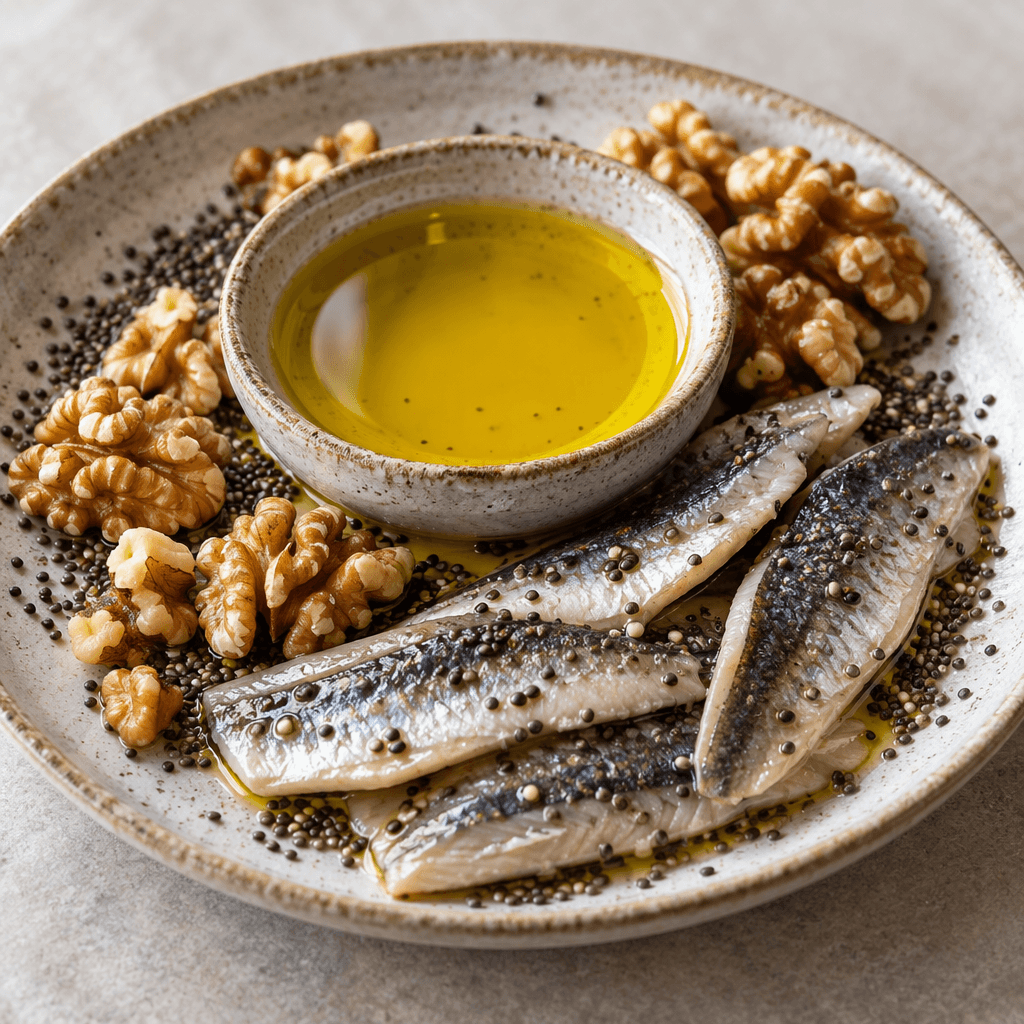
Other omega-3 fatty acids is a broad label for fats such as EPA, DPA and SDA, rather than a single food. EPA and DPA occur mainly in oily fish, while some omega-3 fats are also found in plant foods. Sardines, mackerel and salmon are familiar sources in many parts of the world; walnuts, flaxseed and chia are easy plant-based additions.
Oily fish is commonly grilled, baked or served alongside vegetables, while seeds and nuts can be stirred into porridge or sprinkled over salads. These fats provide energy rather than protein or carbohydrate; the table lists 100 g of fat per 100 g. For a lighter meal, bake or grill fish instead of frying it, and pair it with vegetables or whole grains.
Other Omega 3 fatty acids Nutrition Facts
Selected: 100 g
900
KCAL / 100G
Carbs
0g
· 0% DV
Protein
0g
· 0% DV
Fat
100g
· 128% DV
Fiber
0g
· 0% DV
DV is the share of the daily value covered, on a 2,000 kcal reference diet.
Calories come from: Carbs 0% · Protein 0% · Fat 100%
Other Omega 3 fatty acids Vitamins & Minerals
Vitamins
Vitamin E
2mg · 13% DV
Vitamin A
0µg · 0% DV
B1
0mg · 0% DV
B2
0mg · 0% DV
Minerals
Calcium
0mg · 0% DV
Iron
0mg · 0% DV
Magnesium
0mg · 0% DV
Zinc
0mg · 0% DV
How Nutritious Is Other Omega 3 fatty acids?
Nutrient density
High
How many vitamins, minerals and how much fiber this food carries per calorie. A high score means a lot of nutrition for few calories.
Satiety score
Low
An EatBetter score computed from fiber, protein and calorie density. A high score means staying full longer on the same calories.
Both scores are calculated per 100 g and do not change with the selected portion. The satiety score is EatBetter's own calculation, not a clinical measure.
Other Omega 3 fatty acids Glycemic Index
GLYCEMIC INDEX
GLYCEMIC LOAD
Accounts for portion size — a more realistic measure than GI alone.
How to Burn Off Other Omega 3 fatty acids
To burn the 900 calories in 100 g:
🚶
Walking (5 km/h)
🏃
Running (8 km/h)
🚴
Cycling
🏊
Swimming
Times are calculated with the MET equation for a 70 kg adult. Actual burn varies with your weight, age and pace.
Is Other Omega 3 fatty acids Processed?
NOVA 2
Minimally Processed
1. Unprocessed
2. Minimally Processed
3. Processed
4. Ultra-Processed
NOVA classifies foods into 4 groups by industrial processing. NOVA 1 (unprocessed) is the healthiest.
Does Other Omega 3 fatty acids Contain Allergens?
No known major allergens
Which Diets Is Other Omega 3 fatty acids Good For?
Vegan
✓ Suitable
Vegetarian
✓ Suitable
Gluten-Free
✓ Suitable
Dairy-Free
— Not suitable
Mediterranean
✓ Suitable
Paleo
✓ Suitable
Whole30
— Not suitable
DASH
— Not suitable
Keto
✓ Suitable
Low FODMAP
— Not suitable
Other Omega 3 fatty acids Fat Profile
SATURATED
10g
MONOUNSATURATED
20g
POLYUNSATURATED
68g
Omega 6:3 ratio 0:1
Below the ideal 4:1 — a good omega balance.
Compare Other Omega 3 fatty acids
Foods Similar to Other Omega 3 fatty acids
Frequently Asked Questions About Other Omega 3 fatty acids
What are other omega-3 fatty acids?
Other omega-3 fatty acids here refers to EPA, DPA and SDA. They are members of the omega-3 family, distinct from ALA and DHA in their structures and how the body uses or converts them.
What foods contain other omega-3 fatty acids?
Other omega-3 fatty acids occur mainly in oily fish and seafood; EPA and DPA are also present in some meat and dairy foods. SDA is found in certain plant oils, including hemp seed and blackcurrant seed oil.
What is the difference between EPA, DPA and SDA?
EPA, DPA and SDA are different omega-3 fatty acids. EPA and DPA are commonly obtained from fish and seafood, while SDA occurs in some plant oils and can be converted into EPA in the body.
Is SDA the same as ALA?
No, SDA and ALA are different omega-3 fatty acids. Both can come from plant sources, but SDA is further along the conversion pathway to EPA, so the body can convert it to EPA more readily than ALA.
Can other omega-3 fatty acids be converted into DHA?
Some conversion can occur, but it is limited. The body can convert SDA to EPA, and EPA can be converted onward to DHA; eating foods that already contain EPA or DHA provides these fatty acids directly.
Are other omega-3 fatty acids found in fish oil supplements?
Yes, many fish oil supplements contain EPA, and some also contain DPA. Formulas differ, so check the listed amounts of each fatty acid rather than assuming every product has the same composition.
Are other omega-3 fatty acids better than DHA?
No single omega-3 is universally better. EPA, DPA, SDA and DHA have different roles and sources, so the most relevant one depends on what you are trying to obtain from food or a supplement.
Do other omega-3 fatty acids lower triglycerides?
EPA can help lower elevated blood triglycerides when used in appropriate, medically supervised doses. Food sources contribute omega-3s, but they should not be treated as a substitute for prescribed triglyceride treatment.
Should other omega-3 fatty acid supplements be taken with food?
Yes, taking these supplements with a meal is usually more comfortable and may help absorption, particularly when the meal contains some fat. It can also reduce fishy aftertaste or stomach upset.
How should oils containing other omega-3 fatty acids be stored?
Store oils containing other omega-3 fatty acids tightly sealed and away from heat and light, following the product’s instructions after opening. Discard oil that smells rancid or tastes sharply bitter.
Have another question about Other Omega 3 fatty acids?
Ask the AI nutrition coach — calories, portions, alternatives and more, answered in seconds in the app.

Scan calories with your camera
Instant AI nutrition analysis

Nutrition data compiled from USDA FoodData Central and scientific sources.