

Ready & Packaged Foods
All →Vegetables & Legumes
All →Desserts & Confectionery
All →Meat & Protein
All →Grains & Bakery
All →Beverages
All →Milk & Dairy
All →

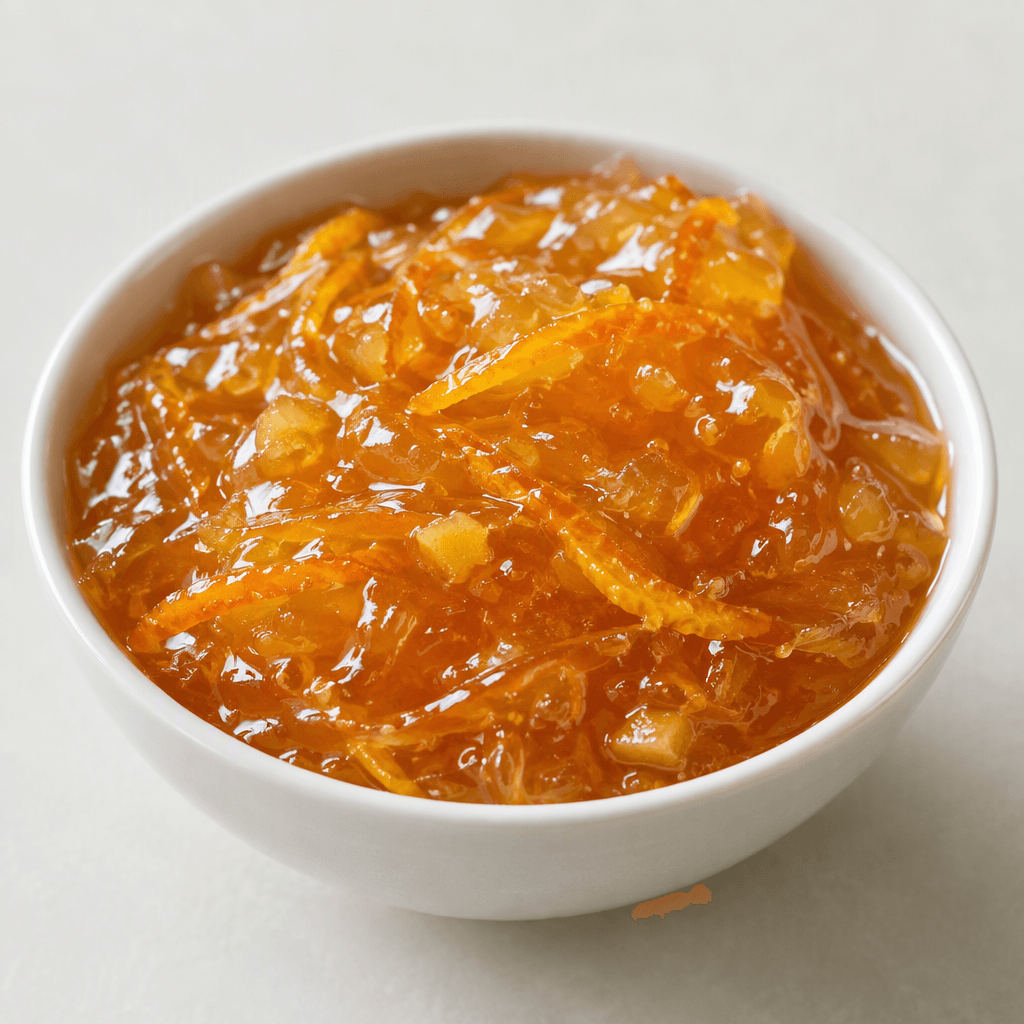
Orange jam Calories
Source of vitamin C, high sugar, breakfast spread
In season: Winter · Spring
CALORIES
GI
POTASSIUM
FIBER
Quick answer
1 tablespoon (medium) of Orange jam (20 g) has 52 calories. That works out to 260 calories per 100 g. It contains 13 g of carbs, 0.1 g of protein, 0 g of fat and 0.2 g of fiber. Its glycemic index is 65 (high), so it raises blood sugar quickly.
What is Orange jam?
Orange jam is a sweet preserve made by cooking oranges with sugar; Turkish versions may include strips of peel or small pieces of fruit in the glossy syrup. The exact balance of peel and pulp varies with the recipe, giving it a softly spreadable texture with a little bite.
It brings bright citrus flavour and pronounced sweetness to toast, pastries or a breakfast table, and can be served alongside tea. In Turkey, fruit preserves are a familiar breakfast accompaniment; elsewhere, orange jam also works as a filling for cakes or a topping for yoghurt. It is high in sugar and contributes little protein or fat, so a small spoonful is usually enough. Pair it with plain yoghurt or unsweetened porridge for a less-sweet breakfast.
Orange jam Nutrition Facts
Selected: 100 g
260
KCAL / 100G
Carbs
65g
· 24% DV
Protein
0.5g
· 1% DV
Fat
0.1g
· 0% DV
Fiber
1.2g
· 4% DV
DV is the share of the daily value covered, on a 2,000 kcal reference diet.
Calories come from: Carbs 99% · Protein 1% · Fat 0%
Orange jam Vitamins & Minerals
Vitamins
Vitamin C
18mg · 20% DV
B1
0.03mg · 3% DV
B5
0.15mg · 3% DV
Biotin
1µg · 3% DV
Minerals
Calcium
20mg · 2% DV
Magnesium
5mg · 1% DV
Iodine
1µg · 1% DV
Phosphorus
10mg · 1% DV
How Nutritious Is Orange jam?
Nutrient density
Low
How many vitamins, minerals and how much fiber this food carries per calorie. A high score means a lot of nutrition for few calories.
Satiety score
Low
An EatBetter score computed from fiber, protein and calorie density. A high score means staying full longer on the same calories.
Both scores are calculated per 100 g and do not change with the selected portion. The satiety score is EatBetter's own calculation, not a clinical measure.
Orange jam Glycemic Index
GLYCEMIC INDEX
GLYCEMIC LOAD
Accounts for portion size — a more realistic measure than GI alone.
How to Burn Off Orange jam
To burn the 260 calories in 100 g:
🚶
Walking (5 km/h)
🏃
Running (8 km/h)
🚴
Cycling
🏊
Swimming
Times are calculated with the MET equation for a 70 kg adult. Actual burn varies with your weight, age and pace.
Is Orange jam Processed?
NOVA 3
Processed
1. Unprocessed
2. Minimally Processed
3. Processed
4. Ultra-Processed
NOVA classifies foods into 4 groups by industrial processing. NOVA 1 (unprocessed) is the healthiest.
Does Orange jam Contain Allergens?
No known major allergens
Which Diets Is Orange jam Good For?
Vegan
✓ Suitable
Vegetarian
✓ Suitable
Gluten-Free
✓ Suitable
Dairy-Free
— Not suitable
Mediterranean
✓ Suitable
Paleo
— Not suitable
Whole30
— Not suitable
DASH
— Not suitable
Keto
— Not suitable
Low FODMAP
— Not suitable
Orange jam Fat Profile
SATURATED
0.01g
MONOUNSATURATED
0.02g
POLYUNSATURATED
0.03g
Omega 6:3 ratio 2:1
Below the ideal 4:1 — a good omega balance.
Compare Orange jam
Foods Similar to Orange jam
Frequently Asked Questions About Orange jam
Is orange jam the same as marmalade?
Not exactly: orange jam usually contains orange flesh and may include peel, while marmalade is traditionally defined by its citrus peel suspended in a clear jelly. The names are sometimes used interchangeably, so the fruit-to-peel texture is the most useful distinction.
How do you make orange jam?
Orange jam is made by simmering chopped oranges, sometimes with thin strips of peel, in sugar until the fruit softens and the mixture thickens. Removing excess white pith and preparing the peel first can help create a less bitter, more evenly textured jam.
Why does orange jam taste bitter?
Orange jam can taste bitter when too much white pith is left on the peel or the peel has not been softened and blanched enough. Removing some pith and boiling the peel before adding it to the jam usually produces a milder flavour.
Which oranges are best for orange jam?
Sweet, ripe oranges work well for a mellow orange jam, while bitter or Seville oranges make a sharper, more traditional marmalade-style preserve. Choose fruit with aromatic peel if you want a stronger citrus flavour, and prepare thicker peel before cooking.
Does orange jam need pectin?
No, orange jam does not always need added pectin. Citrus contains natural pectin, especially in the peel and pith, which can help the preserve set; the final texture also depends on the recipe and how far the fruit mixture is cooked.
How can you stop orange jam from crystallizing?
To reduce crystallization in orange jam, dissolve the sugar fully before the mixture boils and avoid stirring it heavily during cooking. Wiping sugar crystals from the sides of the pan and adding a little lemon juice can also help keep the syrup smooth.
What can you use orange jam for besides toast?
Orange jam works as a filling for cakes and pastries, a topping for plain yogurt, or a glaze for baked foods. Its citrus flavour also pairs well with chocolate and savoury cheeses, so a small spoonful can add brightness to either sweet or savoury dishes.
How should orange jam be stored after opening?
Store opened orange jam in the refrigerator in a tightly closed jar, and use a clean, dry spoon each time. Discard it if you see mould or notice an unusual smell or appearance; do not scrape mould off and eat the rest.
Can you freeze orange jam?
Yes, orange jam can be frozen in a freezer-safe container, leaving room for expansion. Its texture may become slightly looser or less uniform after thawing, so defrost it in the refrigerator and avoid refreezing it once thawed.
Can you make orange jam with less sugar?
Yes, orange jam can be made with less sugar, but the result may set differently and will not keep as long as a traditional high-sugar preserve. Use a recipe designed for reduced sugar, refrigerate the jam, and avoid treating it as shelf-stable.
Have another question about Orange jam?
Ask the AI nutrition coach — calories, portions, alternatives and more, answered in seconds in the app.

Scan calories with your camera
Instant AI nutrition analysis

Nutrition data compiled from USDA FoodData Central and scientific sources.