

Ready & Packaged Foods
All →Vegetables & Legumes
All →Desserts & Confectionery
All →Meat & Protein
All →Grains & Bakery
All →Beverages
All →Milk & Dairy
All →

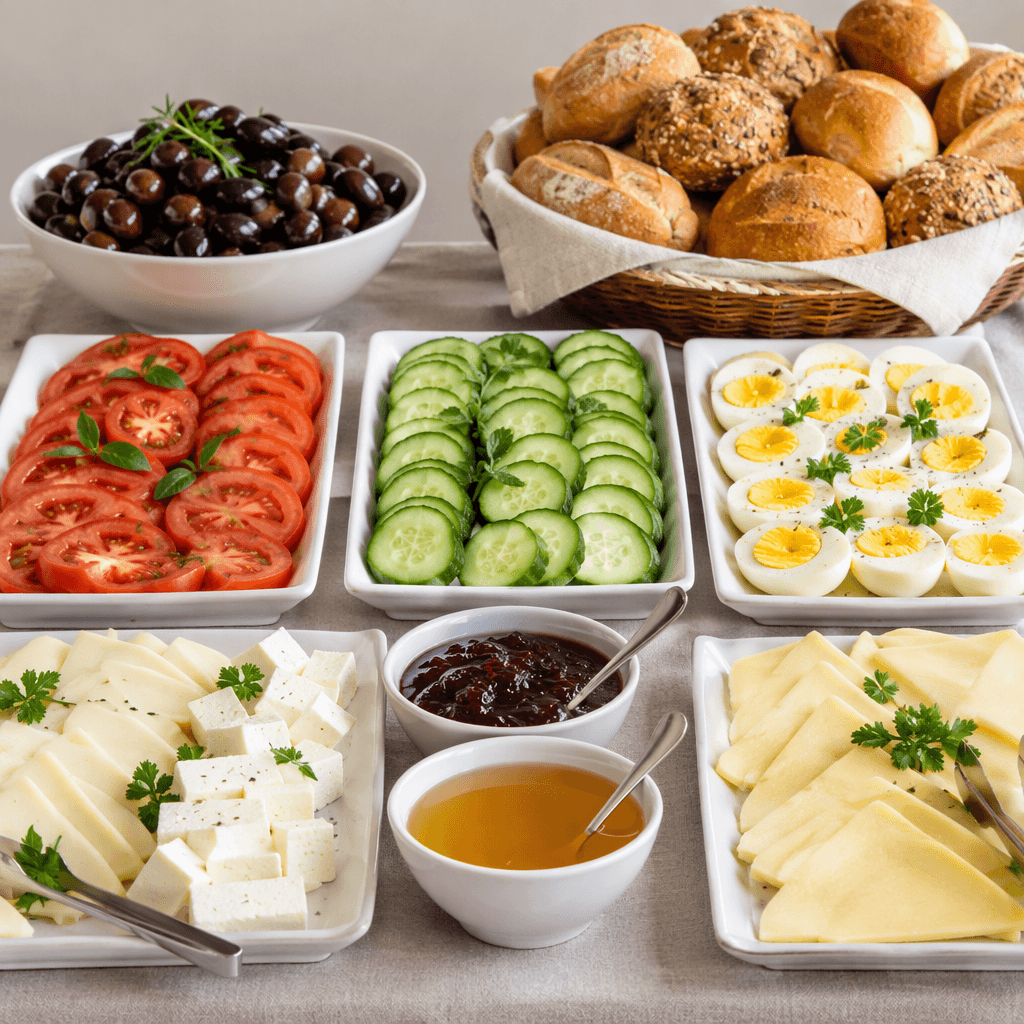
Open buffet breakfast Calories
Average mixed breakfast buffet selection; typically energy-dense and often high in sodium.
CALORIES
GI
POTASSIUM
FIBER
Quick answer
1 serving (medium) of Open buffet breakfast (350 g) has 774 calories. That works out to 221 calories per 100 g. It contains 78.4 g of carbs, 28.7 g of protein, 37.8 g of fat and 7.4 g of fiber. Its 42 µg of Selenium covers 76% of the Daily Value. Its glycemic index is 55 (medium), so it raises blood sugar at a moderate pace.
What is Open buffet breakfast?
Open buffet breakfast describes a style of serving rather than a fixed dish: a spread of choices such as bread, eggs, cheese, fruit, cereals and cooked items, commonly found in hotels and restaurants. What appears on the table varies by place, and may reflect local breakfast traditions.
You can build a plate around savoury or sweet foods, with textures ranging from soft eggs and yoghurt to crisp toast and fresh fruit. A mixed selection can be energy-dense and high in sodium; the provided average is 221 calories per 100 g. For a lighter meal, choose fruit or vegetables alongside eggs or yoghurt, and take smaller portions of pastries and fried foods.
Open buffet breakfast Nutrition Facts
Selected: 100 g
221
KCAL / 100G
Carbs
22.4g
· 8% DV
Protein
8.2g
· 16% DV
Fat
10.8g
· 14% DV
Fiber
2.1g
· 8% DV
DV is the share of the daily value covered, on a 2,000 kcal reference diet.
Calories come from: Carbs 41% · Protein 15% · Fat 44%
Open buffet breakfast Vitamins & Minerals
Vitamins
Biotin
6µg · 20% DV
B12
0.42µg · 18% DV
B2
0.21mg · 16% DV
B1
0.18mg · 15% DV
Minerals
Selenium
12µg · 22% DV
Phosphorus
138mg · 20% DV
Sodium
410mg · 18% DV
Iron
2mg · 11% DV
How Nutritious Is Open buffet breakfast?
Nutrient density
Medium
How many vitamins, minerals and how much fiber this food carries per calorie. A high score means a lot of nutrition for few calories.
Satiety score
Medium
An EatBetter score computed from fiber, protein and calorie density. A high score means staying full longer on the same calories.
Both scores are calculated per 100 g and do not change with the selected portion. The satiety score is EatBetter's own calculation, not a clinical measure.
Open buffet breakfast Glycemic Index
GLYCEMIC INDEX
GLYCEMIC LOAD
Accounts for portion size — a more realistic measure than GI alone.
How to Burn Off Open buffet breakfast
To burn the 221 calories in 100 g:
🚶
Walking (5 km/h)
🏃
Running (8 km/h)
🚴
Cycling
🏊
Swimming
Times are calculated with the MET equation for a 70 kg adult. Actual burn varies with your weight, age and pace.
Is Open buffet breakfast Processed?
NOVA 3
Processed
1. Unprocessed
2. Minimally Processed
3. Processed
4. Ultra-Processed
NOVA classifies foods into 4 groups by industrial processing. NOVA 1 (unprocessed) is the healthiest.
Does Open buffet breakfast Contain Allergens?
Contains these allergens:
Which Diets Is Open buffet breakfast Good For?
Vegan
— Not suitable
Vegetarian
✓ Suitable
Gluten-Free
— Not suitable
Dairy-Free
— Not suitable
Mediterranean
— Not suitable
Paleo
— Not suitable
Whole30
— Not suitable
DASH
— Not suitable
Keto
— Not suitable
Low FODMAP
— Not suitable
Open buffet breakfast Fat Profile
SATURATED
3.4g
MONOUNSATURATED
4.1g
POLYUNSATURATED
2.2g
Omega 6:3 ratio 23.8:1
Above the ideal 4:1 (23.8:1).
Compare Open buffet breakfast
Foods Similar to Open buffet breakfast
Frequently Asked Questions About Open buffet breakfast
What is usually included in an open buffet breakfast?
An open buffet breakfast usually offers a mix of breads, eggs, fruit, cereals, pastries, and hot or cold drinks. Hotel buffets may also include regional dishes, cooked-to-order items, and options for different tastes.
How does an open buffet breakfast work?
At an open buffet breakfast, you choose food from shared serving stations and take it to your table, often returning for more. Follow the venue’s serving instructions, use the utensils provided, and take only what you expect to eat.
How can you make an open buffet breakfast at home?
Set up an open buffet breakfast at home by arranging a few cold items, such as fruit, yogurt, bread, and cheese, alongside one or two hot dishes. Keep hot and cold foods separate and replenish them in small batches.
How can you eat healthily at an open buffet breakfast?
Build your open buffet breakfast around fruit or vegetables and filling choices such as eggs or yogurt, then add smaller portions of pastries or fried foods. Taking a first, modest plate makes it easier to choose what you really want.
How long can food at an open buffet breakfast safely sit out?
Food at an open buffet breakfast should be kept cold or hot, rather than left at room temperature. As a general food-safety rule, discard perishable items that have sat out for more than two hours, or sooner in hot conditions.
What is the difference between an open buffet breakfast and a continental breakfast?
An open buffet breakfast describes how food is served: guests select items themselves. A continental breakfast describes the style of food, commonly bread, pastries, fruit, and hot drinks; it may be served as a buffet or individually.
What is proper etiquette at an open buffet breakfast?
At an open buffet breakfast, use the serving utensil for each dish, avoid touching food you will not take, and let others reach the station. Take a clean plate if you go back for another serving.
Can you take leftovers from an open buffet breakfast home?
Usually, food left at the shared stations of an open buffet breakfast should not be taken home because it may have been exposed to unsafe temperatures or handling. Ask the venue about its policy for untouched food from your own plate.
Is an open buffet breakfast the same as brunch?
No. An open buffet breakfast is a self-service way of presenting food, while brunch is a late meal that combines breakfast and lunch. A brunch can be served buffet-style, but the terms do not mean the same thing.
How can you avoid overeating at an open buffet breakfast?
To avoid overeating at an open buffet breakfast, look over the choices before filling your plate and start with a small serving. Eat seated rather than while browsing, and pause before deciding whether you want seconds.
Have another question about Open buffet breakfast?
Ask the AI nutrition coach — calories, portions, alternatives and more, answered in seconds in the app.

Scan calories with your camera
Instant AI nutrition analysis

Nutrition data compiled from USDA FoodData Central and scientific sources.