

Ready & Packaged Foods
All →Vegetables & Legumes
All →Desserts & Confectionery
All →Meat & Protein
All →Grains & Bakery
All →Beverages
All →Milk & Dairy
All →

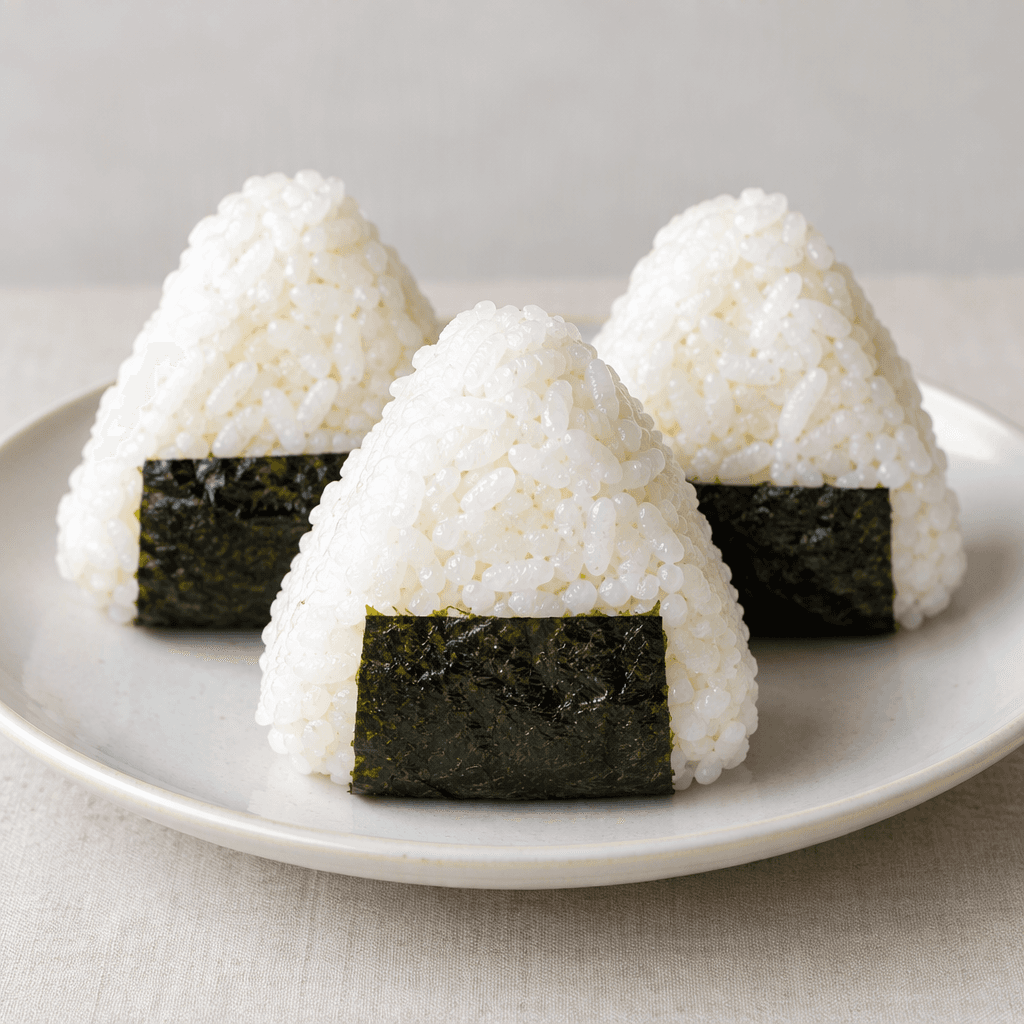
Onigiri Calories
Japanese rice ball, typically wrapped in nori and seasoned or filled.
In season: Spring · Summer · Autumn · Winter
CALORIES
GI
POTASSIUM
FIBER
Quick answer
1 piece (medium) of Onigiri (90 g) has 151 calories. That works out to 168 calories per 100 g. It contains 33.3 g of carbs, 2.7 g of protein, 0.3 g of fat and 1.1 g of fiber. Its 198 mg of Sodium covers 9% of the Daily Value. Its glycemic index is 72 (high), so it raises blood sugar quickly.
What is Onigiri?
Onigiri is a Japanese rice ball made by shaping cooked, usually short-grain rice by hand. It is often wrapped with a strip of nori and may be simply salted or filled with ingredients such as fish or vegetables. Triangular shapes are familiar, though rounded versions are common too.
The rice is soft and slightly sticky, while the seaweed adds a savoury, briny note. In Japan, onigiri is a familiar convenience-store snack, lunchbox staple or quick meal for a journey. Elsewhere, it works well as a portable lunch or light bite, served with miso soup, salad or pickled vegetables. It is mainly a source of carbohydrate and is low in fat, so a filling with fish, egg or beans can make it more substantial.
Onigiri Nutrition Facts
Selected: 100 g
168
KCAL / 100G
Carbs
37g
· 13% DV
Protein
3g
· 6% DV
Fat
0.3g
· 0% DV
Fiber
1.2g
· 4% DV
DV is the share of the daily value covered, on a 2,000 kcal reference diet.
Calories come from: Carbs 91% · Protein 7% · Fat 2%
Onigiri Vitamins & Minerals
Vitamins
B5
0.2mg · 4% DV
B1
0.03mg · 3% DV
B3
0.4mg · 3% DV
B6
0.05mg · 3% DV
Minerals
Sodium
220mg · 10% DV
Iodine
12µg · 8% DV
Phosphorus
35mg · 5% DV
Selenium
2µg · 4% DV
How Nutritious Is Onigiri?
Nutrient density
Low
How many vitamins, minerals and how much fiber this food carries per calorie. A high score means a lot of nutrition for few calories.
Satiety score
Low
An EatBetter score computed from fiber, protein and calorie density. A high score means staying full longer on the same calories.
Both scores are calculated per 100 g and do not change with the selected portion. The satiety score is EatBetter's own calculation, not a clinical measure.
Onigiri Glycemic Index
GLYCEMIC INDEX
GLYCEMIC LOAD
Accounts for portion size — a more realistic measure than GI alone.
How to Burn Off Onigiri
To burn the 168 calories in 100 g:
🚶
Walking (5 km/h)
🏃
Running (8 km/h)
🚴
Cycling
🏊
Swimming
Times are calculated with the MET equation for a 70 kg adult. Actual burn varies with your weight, age and pace.
Is Onigiri Processed?
NOVA 2
Minimally Processed
1. Unprocessed
2. Minimally Processed
3. Processed
4. Ultra-Processed
NOVA classifies foods into 4 groups by industrial processing. NOVA 1 (unprocessed) is the healthiest.
Does Onigiri Contain Allergens?
No known major allergens
Which Diets Is Onigiri Good For?
Vegan
✓ Suitable
Vegetarian
✓ Suitable
Gluten-Free
✓ Suitable
Dairy-Free
— Not suitable
Mediterranean
✓ Suitable
Paleo
— Not suitable
Whole30
— Not suitable
DASH
— Not suitable
Keto
— Not suitable
Low FODMAP
— Not suitable
Onigiri Fat Profile
SATURATED
0.08g
MONOUNSATURATED
0.07g
POLYUNSATURATED
0.09g
Omega 6:3 ratio 2:1
Below the ideal 4:1 — a good omega balance.
Compare Onigiri
Foods Similar to Onigiri
Frequently Asked Questions About Onigiri
What is onigiri?
Onigiri is a Japanese rice ball, usually shaped by hand and filled or seasoned with ingredients such as salted salmon or pickled plum. It is commonly wrapped partly in nori and eaten as a portable snack or light meal.
How do you eat onigiri?
Onigiri is usually eaten with your hands, not chopsticks. If it comes in a wrapper, follow the opening steps so the nori wraps around the rice; otherwise, simply pick it up and bite into it.
What rice is best for onigiri?
Japanese short-grain rice works best for onigiri because its sticky texture holds the shape. Long-grain rice tends to crumble when formed. The rice is usually not seasoned with sushi vinegar, though it may be lightly salted.
What are common onigiri fillings?
Common onigiri fillings include salted salmon, umeboshi (pickled plum), tuna mayonnaise, and kombu. Cooked vegetables can also work. Choose a filling that is not too wet, since excess moisture can make the rice ball difficult to shape and keep together.
What is the difference between onigiri and sushi?
Onigiri is a shaped rice ball, while sushi is made with rice seasoned with vinegar and comes in forms such as rolls or nigiri. Onigiri often has a savory filling and a nori strip, but it does not require raw fish.
Why does onigiri fall apart?
Onigiri usually falls apart when the rice is too dry, the grains are long and loose, or the ball is not pressed firmly enough. Shape freshly cooked short-grain rice while it is still warm, using damp, lightly salted hands.
Can you make onigiri ahead of time?
Yes, you can make onigiri ahead, but it tastes best the day it is made. Keep it covered and refrigerated if it will not be eaten soon, then let it lose its chill or warm it briefly; add nori just before serving.
How do you keep nori crispy on onigiri?
Keep the nori separate from the rice until just before eating. Rice releases moisture that softens the seaweed, so pack the nori separately or use an onigiri wrapper designed to keep it apart until opened.
Can you freeze onigiri?
Yes, onigiri can be frozen individually without the nori. Wrap each rice ball well, thaw and reheat it until hot throughout, then add fresh nori. Fillings containing mayonnaise or raw fish may not retain their texture as well.
Is onigiri eaten hot or cold?
Onigiri is commonly eaten at room temperature or cold, rather than served piping hot. You can warm refrigerated onigiri briefly if the rice has firmed up; keep the nori separate until after heating so it does not turn soggy.
Have another question about Onigiri?
Ask the AI nutrition coach — calories, portions, alternatives and more, answered in seconds in the app.

Scan calories with your camera
Instant AI nutrition analysis

Nutrition data compiled from USDA FoodData Central and scientific sources.