

Ready & Packaged Foods
All →Vegetables & Legumes
All →Desserts & Confectionery
All →Meat & Protein
All →Grains & Bakery
All →Beverages
All →Milk & Dairy
All →

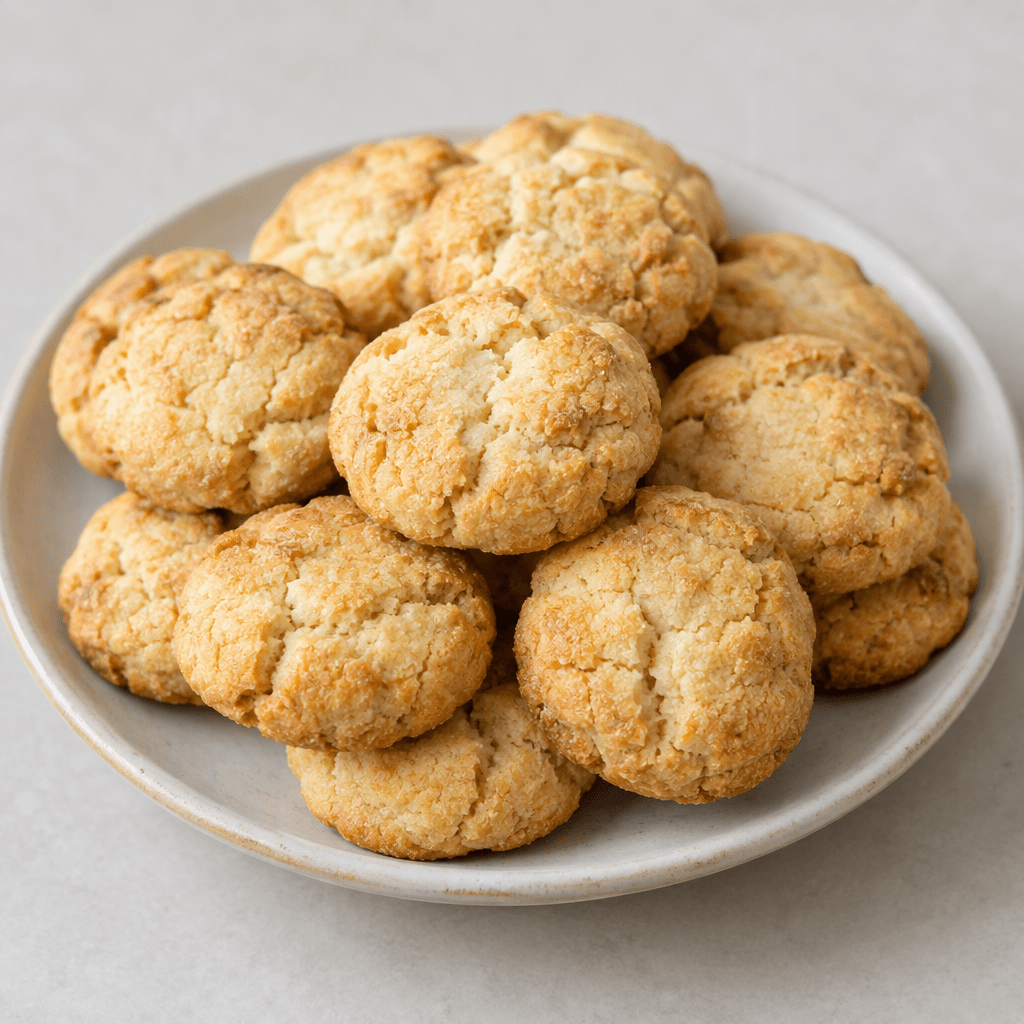
Olive oil cookie Calories
Homemade-style cookie made with olive oil
CALORIES
GI
POTASSIUM
FIBER
Quick answer
1 piece (medium) of Olive oil cookie (25 g) has 120 calories. That works out to 480 calories per 100 g. It contains 15.5 g of carbs, 1.3 g of protein, 5.8 g of fat and 0.6 g of fiber. Its glycemic index is 65 (high), so it raises blood sugar quickly.
What is Olive oil cookie?
An olive oil cookie is a simple home-baking style biscuit made with flour, olive oil and sugar; recipes may also include citrus zest or spices. It is not tied to one particular Turkish region, but fits the everyday tradition of homemade sweets. The olive oil gives the dough its characteristic richness without relying on butter.
These cookies are often lightly crisp at the edges and tender inside, with a flavour that depends on the oil used. In Turkey they are commonly served with tea; elsewhere, enjoy one with coffee or as a small afternoon treat. They are mainly a source of carbohydrates and fat, with comparatively little protein or fibre. For a lighter snack, keep the portion modest and pair it with fresh fruit.
Olive oil cookie Nutrition Facts
Selected: 100 g
480
KCAL / 100G
Carbs
62g
· 23% DV
Protein
5g
· 10% DV
Fat
23g
· 29% DV
Fiber
2.5g
· 9% DV
DV is the share of the daily value covered, on a 2,000 kcal reference diet.
Calories come from: Carbs 52% · Protein 4% · Fat 44%
Olive oil cookie Vitamins & Minerals
Vitamins
Vitamin E
2.2mg · 15% DV
B1
0.08mg · 7% DV
B2
0.05mg · 4% DV
B3
0.6mg · 4% DV
Minerals
Sodium
180mg · 8% DV
Phosphorus
55mg · 8% DV
Selenium
4µg · 7% DV
Iron
1mg · 6% DV
How Nutritious Is Olive oil cookie?
Nutrient density
Low
How many vitamins, minerals and how much fiber this food carries per calorie. A high score means a lot of nutrition for few calories.
Satiety score
Low
An EatBetter score computed from fiber, protein and calorie density. A high score means staying full longer on the same calories.
Both scores are calculated per 100 g and do not change with the selected portion. The satiety score is EatBetter's own calculation, not a clinical measure.
Olive oil cookie Glycemic Index
GLYCEMIC INDEX
GLYCEMIC LOAD
Accounts for portion size — a more realistic measure than GI alone.
How to Burn Off Olive oil cookie
To burn the 480 calories in 100 g:
🚶
Walking (5 km/h)
🏃
Running (8 km/h)
🚴
Cycling
🏊
Swimming
Times are calculated with the MET equation for a 70 kg adult. Actual burn varies with your weight, age and pace.
Is Olive oil cookie Processed?
NOVA 3
Processed
1. Unprocessed
2. Minimally Processed
3. Processed
4. Ultra-Processed
NOVA classifies foods into 4 groups by industrial processing. NOVA 1 (unprocessed) is the healthiest.
Does Olive oil cookie Contain Allergens?
Contains these allergens:
Which Diets Is Olive oil cookie Good For?
Vegan
— Not suitable
Vegetarian
✓ Suitable
Gluten-Free
— Not suitable
Dairy-Free
— Not suitable
Mediterranean
✓ Suitable
Paleo
— Not suitable
Whole30
— Not suitable
DASH
— Not suitable
Keto
— Not suitable
Low FODMAP
— Not suitable
Olive oil cookie Fat Profile
SATURATED
3.2g
MONOUNSATURATED
15.5g
POLYUNSATURATED
2.1g
Omega 6:3 ratio 34:1
Above the ideal 4:1 (34:1).
Compare Olive oil cookie
Foods Similar to Olive oil cookie
Frequently Asked Questions About Olive oil cookie
How do you make olive oil cookies?
Olive oil cookies are made by mixing olive oil with sugar and the recipe’s other wet ingredients, then adding flour and shaping the dough. Mix just until it comes together; overworking the dough can make the cookies tough.
Do olive oil cookies taste strongly of olive oil?
Olive oil cookies can have a noticeable fruity or peppery flavor, especially when made with a robust extra-virgin oil. Choose a mild-tasting oil if you want the cookie’s citrus, spice, or sweet notes to stand out more.
Can you use extra-virgin olive oil in olive oil cookies?
Yes, extra-virgin olive oil works in olive oil cookies and gives them a more pronounced, fruity aroma. If you are unsure how its flavor will come through, try a mild extra-virgin oil rather than a strongly peppery one.
Why did my olive oil cookies spread so much?
Olive oil cookies can spread when the dough is too warm or too soft, or when the baking sheet is still hot. Chill the shaped dough before baking and place it on a cool, lined sheet to help the cookies hold their shape.
Can olive oil replace butter in cookies?
Yes, olive oil can replace butter in many cookie recipes, but the result will not be identical. Butter is solid when cool and contains some water, while olive oil stays liquid, so the cookies may feel softer and have a different aroma.
How do you keep olive oil cookies from turning out dry?
To keep olive oil cookies from turning out dry, avoid adding too much flour and take them out before they become deeply browned. They may still feel slightly soft when hot; they firm up as they cool.
Can you make olive oil cookie dough ahead of time?
Yes, you can prepare olive oil cookie dough ahead and keep it covered in the refrigerator. Chilling can make soft dough easier to shape; let it sit briefly at room temperature if it becomes too firm to handle.
What flavors go well in olive oil cookies?
Citrus zest, rosemary, cinnamon, and chocolate all pair well with olive oil cookies. Lemon or orange highlights the oil’s fruity notes, while a little rosemary gives the cookies a savory edge.
How long do olive oil cookies stay fresh?
Olive oil cookies keep well for several days when fully cooled and stored in an airtight container in a cool, dry place. Avoid sealing them while warm, since trapped steam can soften their texture.
Can you freeze olive oil cookies?
Yes, baked olive oil cookies can be frozen in an airtight container once completely cool. Thaw them at room temperature before serving. You can also freeze portions of dough and bake them after thawing.
Have another question about Olive oil cookie?
Ask the AI nutrition coach — calories, portions, alternatives and more, answered in seconds in the app.

Scan calories with your camera
Instant AI nutrition analysis

Nutrition data compiled from USDA FoodData Central and scientific sources.