

Ready & Packaged Foods
All →Vegetables & Legumes
All →Desserts & Confectionery
All →Meat & Protein
All →Grains & Bakery
All →Beverages
All →Milk & Dairy
All →

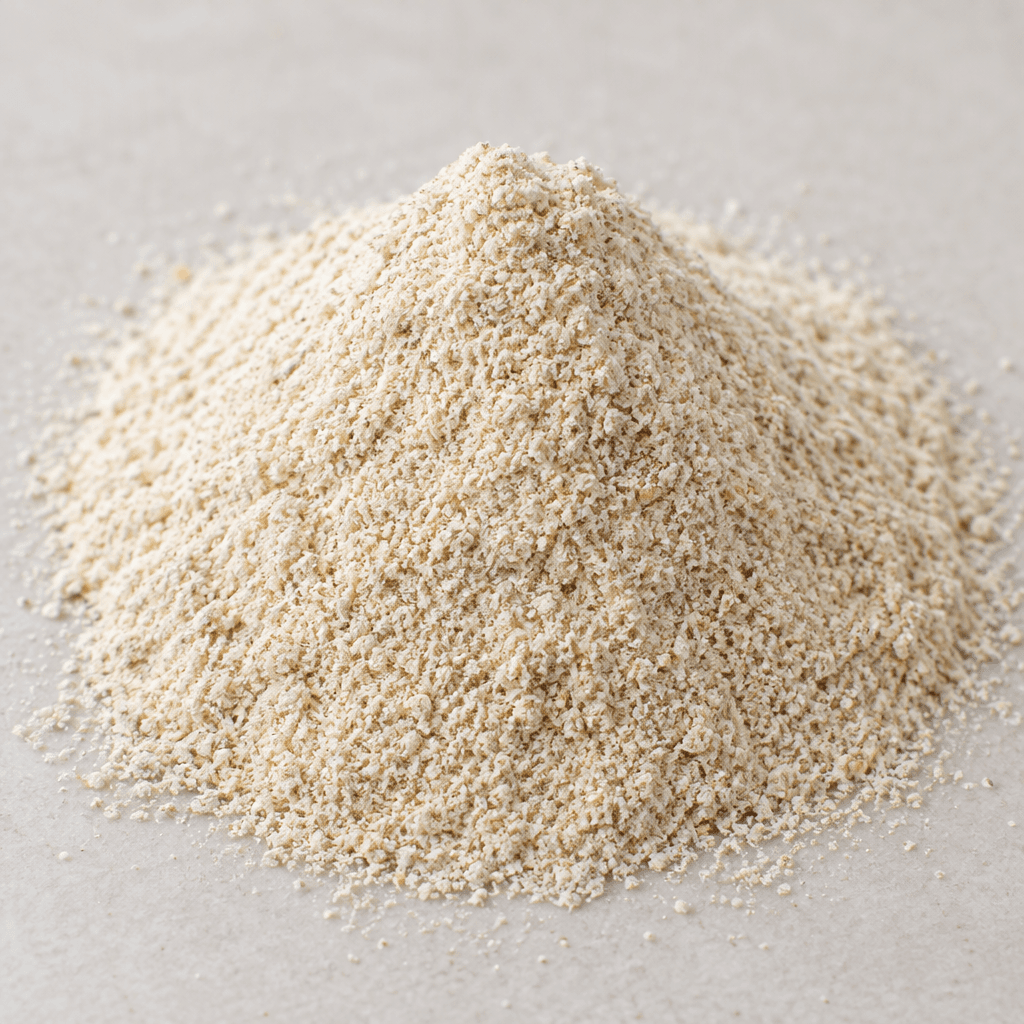
Finely ground oats Calories
High fiber, complex carbs, low sugar
In season: Spring · Summer · Autumn · Winter
CALORIES
GI
POTASSIUM
FIBER
Quick answer
1 cup (medium) of Finely ground oats (80 g) has 296 calories. That works out to 370 calories per 100 g. It contains 54.2 g of carbs, 10.6 g of protein, 5.5 g of fat and 8.1 g of fiber. Its 3.9 mg of Manganese covers 170% of the Daily Value. Its glycemic index is 55 (medium), so it raises blood sugar at a moderate pace.
What is Finely ground oats?
Finely ground oats are oat grains broken into small particles. They may be less powdery than oat flour, with a little texture still visible, and are easy to stir into batters or liquids. In many places, people cook them with milk or water for porridge, soak them overnight, or add them to smoothies, yoghurt and baking recipes.
Their flavour is mild and gently nutty; once mixed with liquid, they soften and thicken. They provide complex carbohydrates and fibre, with relatively little sugar—100 g contains 10.1 g of fibre. Pair them with fruit and yoghurt for a more substantial breakfast, or add extra liquid while cooking if you prefer a looser porridge.
Finely ground oats Nutrition Facts
Selected: 100 g
370
KCAL / 100G
Carbs
67.7g
· 25% DV
Protein
13.2g
· 26% DV
Fat
6.9g
· 9% DV
Fiber
10.1g
· 36% DV
DV is the share of the daily value covered, on a 2,000 kcal reference diet.
Calories come from: Carbs 70% · Protein 14% · Fat 16%
Finely ground oats Vitamins & Minerals
Vitamins
B1
0.46mg · 38% DV
B5
1.1mg · 22% DV
Biotin
6µg · 20% DV
B2
0.14mg · 11% DV
Minerals
Manganese
5mg · 217% DV
Phosphorus
410mg · 59% DV
Selenium
28µg · 51% DV
Magnesium
177mg · 42% DV
How Nutritious Is Finely ground oats?
Nutrient density
High
How many vitamins, minerals and how much fiber this food carries per calorie. A high score means a lot of nutrition for few calories.
Satiety score
Medium
An EatBetter score computed from fiber, protein and calorie density. A high score means staying full longer on the same calories.
Both scores are calculated per 100 g and do not change with the selected portion. The satiety score is EatBetter's own calculation, not a clinical measure.
Finely ground oats Glycemic Index
GLYCEMIC INDEX
GLYCEMIC LOAD
Accounts for portion size — a more realistic measure than GI alone.
How to Burn Off Finely ground oats
To burn the 370 calories in 100 g:
🚶
Walking (5 km/h)
🏃
Running (8 km/h)
🚴
Cycling
🏊
Swimming
Times are calculated with the MET equation for a 70 kg adult. Actual burn varies with your weight, age and pace.
Is Finely ground oats Processed?
NOVA 2
Minimally Processed
1. Unprocessed
2. Minimally Processed
3. Processed
4. Ultra-Processed
NOVA classifies foods into 4 groups by industrial processing. NOVA 1 (unprocessed) is the healthiest.
Does Finely ground oats Contain Allergens?
No known major allergens
Which Diets Is Finely ground oats Good For?
Vegan
✓ Suitable
Vegetarian
✓ Suitable
Gluten-Free
✓ Suitable
Dairy-Free
— Not suitable
Mediterranean
✓ Suitable
Paleo
✓ Suitable
Whole30
— Not suitable
DASH
— Not suitable
Keto
— Not suitable
Low FODMAP
— Not suitable
Finely ground oats Fat Profile
SATURATED
1.2g
MONOUNSATURATED
2.2g
POLYUNSATURATED
2.5g
Omega 6:3 ratio 20:1
Above the ideal 4:1 (20:1).
Compare Finely ground oats
Foods Similar to Finely ground oats
Frequently Asked Questions About Finely ground oats
Can finely ground oats replace all-purpose flour?
Finely ground oats can replace some or all of the flour in many recipes, but the result will be denser and more tender because oats lack wheat’s gluten. Start by replacing part of the flour, especially in cakes and breads.
Are finely ground oats the same as oat flour?
They are usually very similar: oat flour is simply oats ground into a flour-like powder. The fineness can vary between products, which may affect how quickly the mixture absorbs liquid and the texture of baked goods.
How do you make porridge with finely ground oats?
Stir finely ground oats into milk or water in a saucepan and cook over low heat, stirring until thick. They cook and thicken quickly, so add the liquid gradually and keep stirring to prevent lumps.
Can finely ground oats be used in pancakes?
Yes, finely ground oats work well in pancakes and give them a mild, oaty flavor. Mix them with the wet ingredients, then let the batter rest briefly so the oats absorb liquid before you adjust its thickness.
Can you eat finely ground oats without cooking them?
Yes, you can eat food-grade finely ground oats uncooked, for example stirred into yogurt or milk. Letting the mixture stand softens the oats and makes them less powdery.
How do you make finely ground oats at home?
Blend plain rolled oats in a food processor or blender until they become a fine, flour-like powder. Work in short bursts and scrape down the sides so the oats grind evenly.
Why does batter with finely ground oats become thick?
Finely ground oats absorb liquid, so batter often thickens as it sits. Add a little more liquid and stir before cooking or baking; a brief rest can also help the texture become more even.
Can finely ground oats be used to thicken soups?
Yes, finely ground oats can thicken soups and stews. Whisk a small amount into cool water first to make a smooth slurry, then stir it into the hot dish and simmer until the texture settles.
How should finely ground oats be stored?
Keep finely ground oats in a tightly sealed, dry container in a cool cupboard away from sunlight and moisture. Use a clean, dry spoon each time to help preserve their freshness.
Can you use finely ground oats for overnight oats?
Yes, finely ground oats can be mixed with milk or yogurt and chilled overnight. They absorb liquid more quickly than whole rolled oats, so the result will be soft and thick rather than chewy.
Have another question about Finely ground oats?
Ask the AI nutrition coach — calories, portions, alternatives and more, answered in seconds in the app.

Scan calories with your camera
Instant AI nutrition analysis

Nutrition data compiled from USDA FoodData Central and scientific sources.