

Ready & Packaged Foods
All →Vegetables & Legumes
All →Desserts & Confectionery
All →Meat & Protein
All →Grains & Bakery
All →Beverages
All →Milk & Dairy
All →

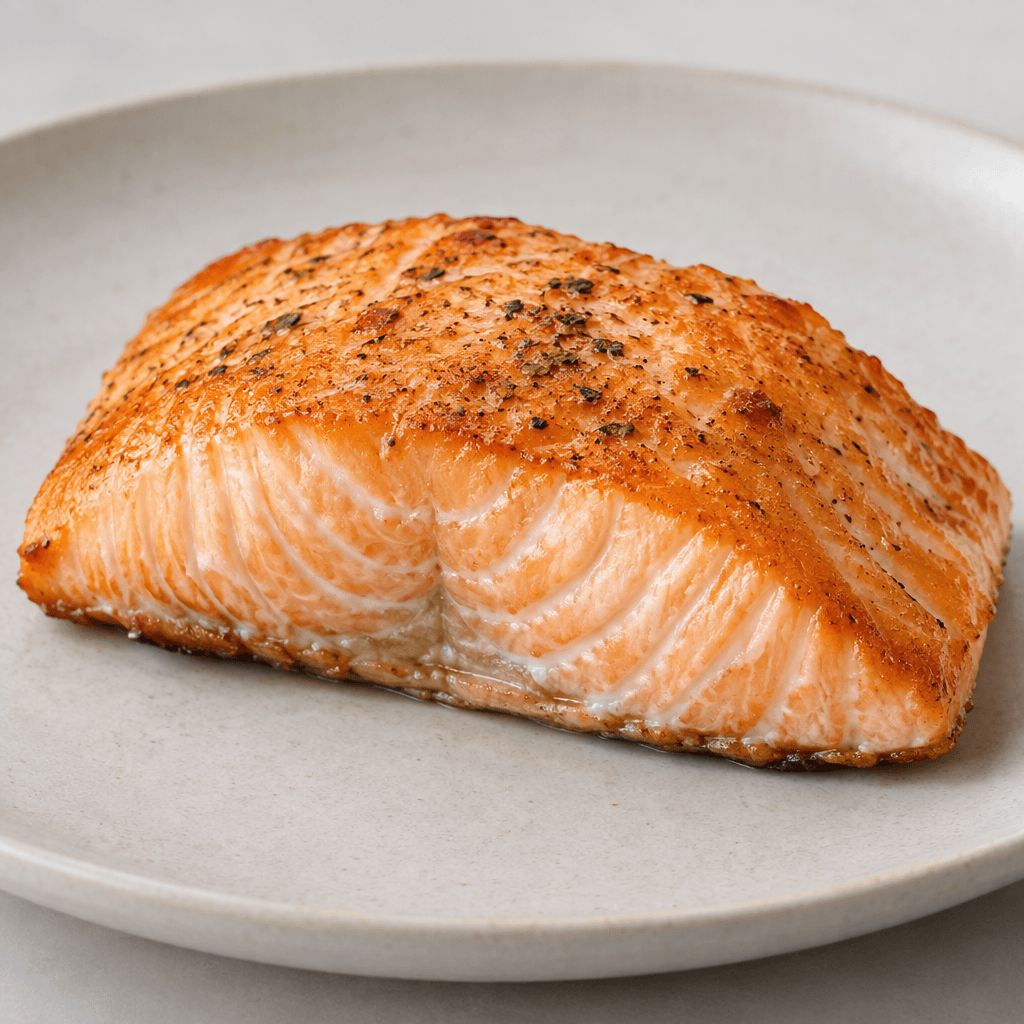
Norwegian Salmon (Baked) Calories
Rich in omega-3, high protein, baked
In season: Spring · Summer · Autumn · Winter
CALORIES
GI
POTASSIUM
FIBER
Quick answer
1 piece (medium) of Norwegian Salmon (Baked) (150 g) has 308 calories. That works out to 205 calories per 100 g. It contains 0 g of carbs, 33.2 g of protein, 19.8 g of fat and 0 g of fiber. Its 6.3 µg of B12 covers 263% of the Daily Value. Its glycemic index is 0 (low), so it raises blood sugar slowly.
What is Norwegian Salmon (Baked)?
Baked Norwegian salmon is a fillet of salmon from Norway cooked in the oven. The surface can turn lightly golden while the centre stays rosy, moist and easy to flake. Its rich, mildly savoury flavour needs little embellishment; lemon, herbs and a little pepper are common additions.
It works as a simple weeknight main with roasted vegetables, potatoes or a crisp salad, and can also be flaked into grain bowls or sandwiches. Salmon provides substantial protein and is rich in omega-3 fats, with no carbohydrates. For a lighter plate, keep added oil modest and serve it with plenty of vegetables.
Norwegian Salmon (Baked) Nutrition Facts
Selected: 100 g
205
KCAL / 100G
Carbs
0g
· 0% DV
Protein
22.1g
· 44% DV
Fat
13.2g
· 17% DV
Fiber
0g
· 0% DV
DV is the share of the daily value covered, on a 2,000 kcal reference diet.
Calories come from: Carbs 0% · Protein 43% · Fat 57%
Norwegian Salmon (Baked) Vitamins & Minerals
Vitamins
B12
4.2µg · 175% DV
Vitamin D
13µg · 65% DV
B6
0.85mg · 50% DV
B3
7.9mg · 49% DV
Minerals
Selenium
36µg · 65% DV
Phosphorus
230mg · 33% DV
Iodine
30µg · 20% DV
Potassium ⭐
340mg · 10% DV
How Nutritious Is Norwegian Salmon (Baked)?
Nutrient density
Very high
How many vitamins, minerals and how much fiber this food carries per calorie. A high score means a lot of nutrition for few calories.
Satiety score
Medium
An EatBetter score computed from fiber, protein and calorie density. A high score means staying full longer on the same calories.
Both scores are calculated per 100 g and do not change with the selected portion. The satiety score is EatBetter's own calculation, not a clinical measure.
Norwegian Salmon (Baked) Glycemic Index
GLYCEMIC INDEX
GLYCEMIC LOAD
Accounts for portion size — a more realistic measure than GI alone.
How to Burn Off Norwegian Salmon (Baked)
To burn the 205 calories in 100 g:
🚶
Walking (5 km/h)
🏃
Running (8 km/h)
🚴
Cycling
🏊
Swimming
Times are calculated with the MET equation for a 70 kg adult. Actual burn varies with your weight, age and pace.
Is Norwegian Salmon (Baked) Processed?
NOVA 2
Minimally Processed
1. Unprocessed
2. Minimally Processed
3. Processed
4. Ultra-Processed
NOVA classifies foods into 4 groups by industrial processing. NOVA 1 (unprocessed) is the healthiest.
Does Norwegian Salmon (Baked) Contain Allergens?
Contains these allergens:
Which Diets Is Norwegian Salmon (Baked) Good For?
Vegan
— Not suitable
Vegetarian
— Not suitable
Gluten-Free
✓ Suitable
Dairy-Free
— Not suitable
Mediterranean
✓ Suitable
Paleo
✓ Suitable
Whole30
— Not suitable
DASH
— Not suitable
Keto
✓ Suitable
Low FODMAP
— Not suitable
Norwegian Salmon (Baked) Fat Profile
SATURATED
2.8g
MONOUNSATURATED
5.2g
POLYUNSATURATED
3.1g
Omega 6:3 ratio 0.3:1
Below the ideal 4:1 — a good omega balance.
Compare Norwegian Salmon (Baked)
Foods Similar to Norwegian Salmon (Baked)
Frequently Asked Questions About Norwegian Salmon (Baked)
How do you bake Norwegian salmon?
Bake Norwegian salmon by seasoning the fillet, placing it in a lightly oiled dish, and cooking until the flesh turns opaque and flakes easily. Lemon, dill, garlic, and black pepper are classic additions; avoid leaving it in the oven after it is done.
How long does Norwegian salmon take to bake?
Baking time for Norwegian salmon depends on the fillet’s thickness and your oven. Begin checking thin pieces earlier; the salmon is ready when the centre is opaque and separates into moist flakes with a fork.
How can you keep baked Norwegian salmon from drying out?
Keep baked Norwegian salmon moist by avoiding overcooking and protecting it from intense dry heat. A light coating of oil and baking it covered can help; uncover it near the end if you want a more browned surface.
How can you tell when Norwegian salmon is done baking?
Norwegian salmon is done when its flesh is opaque and separates into moist flakes when gently pressed with a fork. If the centre still looks translucent and raw, continue baking briefly; dry, crumbly flesh usually means it has overcooked.
Should you bake Norwegian salmon with the skin on?
Yes, you can bake Norwegian salmon with the skin on. It helps shield the flesh from direct heat and makes the fillet easier to handle; place it skin-side down, and remove the skin after cooking if you prefer not to eat it.
Is Norwegian salmon farmed or wild?
Norwegian salmon sold in shops is usually farmed Atlantic salmon, not wild salmon. Farming is the main source of Norwegian salmon; check the product’s origin details if you need to confirm how a particular fillet was raised.
Can you bake frozen Norwegian salmon without thawing it first?
Yes, you can bake Norwegian salmon from frozen, but it will take longer and may cook less evenly than a thawed fillet. Thawing it in the refrigerator first usually gives more even results and lets seasonings adhere better.
Can you eat the skin on baked Norwegian salmon?
Yes, baked Norwegian salmon skin is edible when the fish has been properly handled and cooked. It is often more appealing when crisp; if the skin stays soft, you can simply lift the cooked flesh away from it.
How long does baked Norwegian salmon keep in the fridge?
Baked Norwegian salmon keeps for about 3 days in a covered container in the refrigerator. Refrigerate leftovers promptly rather than leaving them out, and reheat gently so the fish does not become dry.
Is Norwegian salmon safe to eat raw?
Norwegian salmon is not automatically safe to eat raw just because it is Norwegian. Raw preparations require fish handled and frozen appropriately for parasite control; cooking the salmon thoroughly is the safer choice when its raw-use status is unknown.
Have another question about Norwegian Salmon (Baked)?
Ask the AI nutrition coach — calories, portions, alternatives and more, answered in seconds in the app.

Scan calories with your camera
Instant AI nutrition analysis

Nutrition data compiled from USDA FoodData Central and scientific sources.