

Ready & Packaged Foods
All →Vegetables & Legumes
All →Desserts & Confectionery
All →Meat & Protein
All →Grains & Bakery
All →Beverages
All →Milk & Dairy
All →

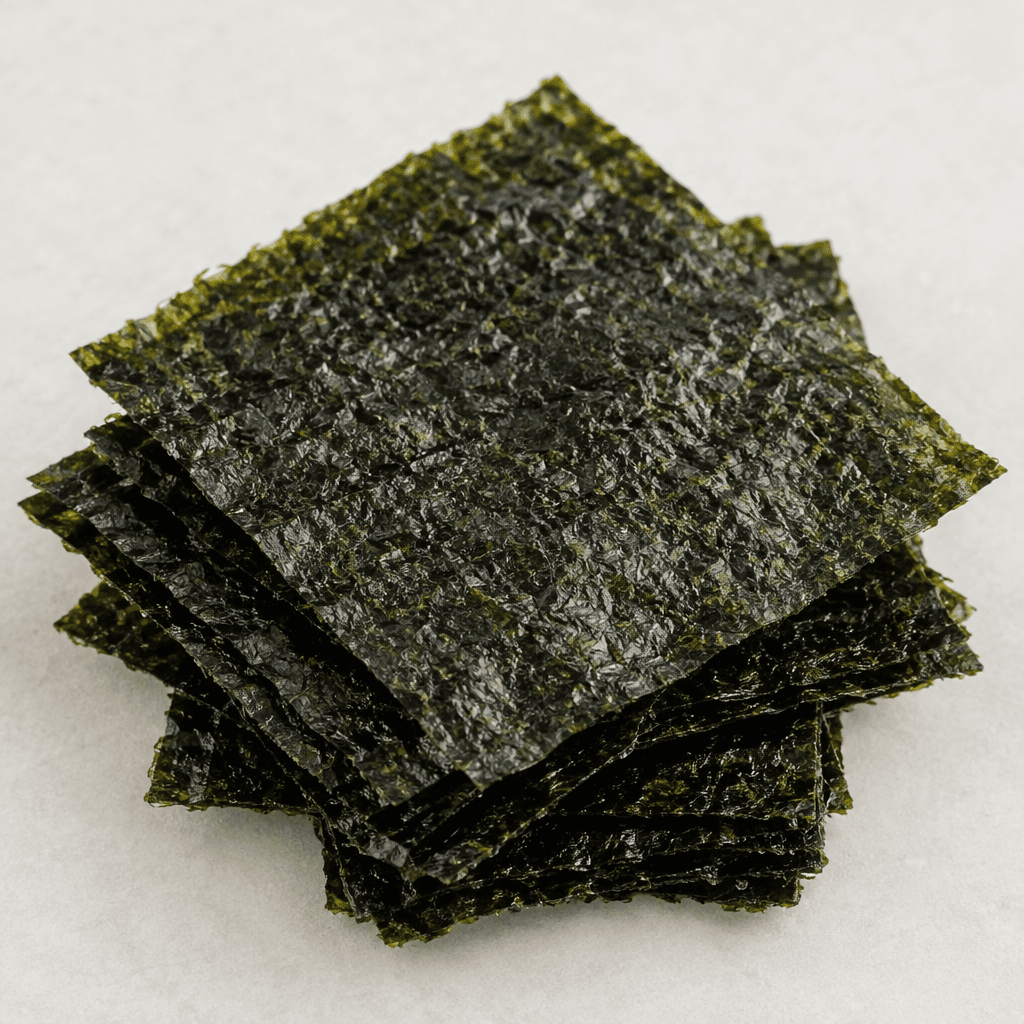
Nori (Seaweed) Calories
Very low calorie, rich in iodine and vitamins, vegan
In season: Spring · Summer · Autumn · Winter
CALORIES
GI
POTASSIUM
FIBER
Quick answer
1 piece (medium) of Nori (Seaweed) (3 g) has 1 calories. That works out to 35 calories per 100 g. It contains 0.2 g of carbs, 0.2 g of protein, 0 g of fat and 0 g of fiber. Its 70.5 µg of Iodine covers 47% of the Daily Value. Its glycemic index is 15 (low), so it raises blood sugar slowly.
What is Nori (Seaweed)?
Nori is a thin, dried seaweed used widely in Japanese cooking. The dark green, nearly black sheets are made pliable with moisture, while dry they have a delicate crispness and mild, savoury taste. In Japan, nori is best known for wrapping sushi rolls and onigiri; elsewhere, it is also sold as a ready-to-eat snack or seasoning.
Use a sheet to wrap rice and fillings, or crumble it over noodles, soup or a rice bowl just before serving so it retains some texture. Nori is very low in calories and offers iodine and vitamins, making it a flavourful plant-based addition rather than a substantial source of energy. It pairs especially well with rice, sesame and vegetables; if the sheets soften, briefly toast them to bring back their crispness.
Nori (Seaweed) Nutrition Facts
Selected: 100 g
35
KCAL / 100G
Carbs
5.1g
· 2% DV
Protein
5.8g
· 12% DV
Fat
0.3g
· 0% DV
Fiber
0.5g
· 2% DV
DV is the share of the daily value covered, on a 2,000 kcal reference diet.
Calories come from: Carbs 44% · Protein 50% · Fat 6%
Nori (Seaweed) Vitamins & Minerals
Vitamins
B12
2.2µg · 92% DV
Vitamin K
77µg · 64% DV
Vitamin C
39mg · 43% DV
Folate
146µg · 37% DV
Minerals
Iodine
2350µg · 1567% DV
Magnesium
240mg · 57% DV
Manganese
1mg · 43% DV
Phosphorus
120mg · 17% DV
How Nutritious Is Nori (Seaweed)?
Nutrient density
Very high
How many vitamins, minerals and how much fiber this food carries per calorie. A high score means a lot of nutrition for few calories.
Satiety score
Medium
An EatBetter score computed from fiber, protein and calorie density. A high score means staying full longer on the same calories.
Both scores are calculated per 100 g and do not change with the selected portion. The satiety score is EatBetter's own calculation, not a clinical measure.
Nori (Seaweed) Glycemic Index
GLYCEMIC INDEX
GLYCEMIC LOAD
Accounts for portion size — a more realistic measure than GI alone.
How to Burn Off Nori (Seaweed)
To burn the 35 calories in 100 g:
🚶
Walking (5 km/h)
🏃
Running (8 km/h)
🚴
Cycling
🏊
Swimming
Times are calculated with the MET equation for a 70 kg adult. Actual burn varies with your weight, age and pace.
Is Nori (Seaweed) Processed?
NOVA 2
Minimally Processed
1. Unprocessed
2. Minimally Processed
3. Processed
4. Ultra-Processed
NOVA classifies foods into 4 groups by industrial processing. NOVA 1 (unprocessed) is the healthiest.
Does Nori (Seaweed) Contain Allergens?
No known major allergens
Which Diets Is Nori (Seaweed) Good For?
Vegan
✓ Suitable
Vegetarian
✓ Suitable
Gluten-Free
✓ Suitable
Dairy-Free
— Not suitable
Mediterranean
✓ Suitable
Paleo
— Not suitable
Whole30
— Not suitable
DASH
— Not suitable
Keto
— Not suitable
Low FODMAP
— Not suitable
Nori (Seaweed) Fat Profile
SATURATED
0.08g
MONOUNSATURATED
0.04g
POLYUNSATURATED
0.16g
Omega 6:3 ratio 0.3:1
Below the ideal 4:1 — a good omega balance.
Compare Nori (Seaweed)
Foods Similar to Nori (Seaweed)
Frequently Asked Questions About Nori (Seaweed)
What is nori made from?
Nori is made from edible red seaweed that is pressed into thin sheets and dried, often with light roasting. The finished sheets are commonly used to wrap sushi, but they can also be crumbled over rice or noodles.
How do you use nori sheets for sushi?
Place a nori sheet shiny-side down on a sushi mat, spread rice over it, add fillings, then roll it tightly. Use slightly damp fingers to handle the rice, and serve the roll soon after assembling so the nori stays firm.
Can you eat nori without cooking it?
Yes, nori is ready to eat straight from the package and does not need cooking. Many sheets are already dried or lightly roasted; if yours has softened, briefly warming it in a dry pan can restore some crispness.
Is nori safe to eat every day?
Nori can be part of regular meals, but eating large amounts every day may add more iodine than intended. Iodine levels vary among seaweed products, so ask your clinician for individual advice if you have a thyroid condition or take iodine-related medication.
What can I use instead of nori for sushi?
Thin cucumber strips or soy paper can replace nori when making sushi rolls. Cucumber gives a fresh, crunchy wrap, while soy paper is closer to a flexible sheet; neither has nori’s distinctive seaweed flavour.
How should you store nori after opening?
Keep opened nori in an airtight container in a cool, dry, dark place. Moisture quickly makes the sheets limp, so close the package promptly and avoid handling the sheets with wet hands.
Why does nori get soggy in sushi?
Nori turns soggy when it absorbs moisture from sushi rice and fillings. For a crisper bite, assemble rolls shortly before serving, avoid adding wet fillings, and keep the nori sealed until you are ready to use it.
Can you roast nori at home?
Yes, you can warm nori briefly in a dry skillet or oven to make it crisp and bring out its toasted aroma. Watch it closely because the thin sheets can scorch quickly; you do not need to add oil.
Is nori the same as kelp?
No, nori and kelp are different seaweeds. Nori is usually sold as thin dried sheets for wrapping sushi, while kelp is a larger brown seaweed often used in broths and other dishes.
Can you put nori in soup?
Yes, crumble nori into soup for a savoury seaweed flavour, but add it near the end or just before serving. Long simmering softens the delicate sheets and can make them break down into the broth.
Have another question about Nori (Seaweed)?
Ask the AI nutrition coach — calories, portions, alternatives and more, answered in seconds in the app.

Scan calories with your camera
Instant AI nutrition analysis

Nutrition data compiled from USDA FoodData Central and scientific sources.