

Ready & Packaged Foods
All →Vegetables & Legumes
All →Desserts & Confectionery
All →Meat & Protein
All →Grains & Bakery
All →Beverages
All →Milk & Dairy
All →

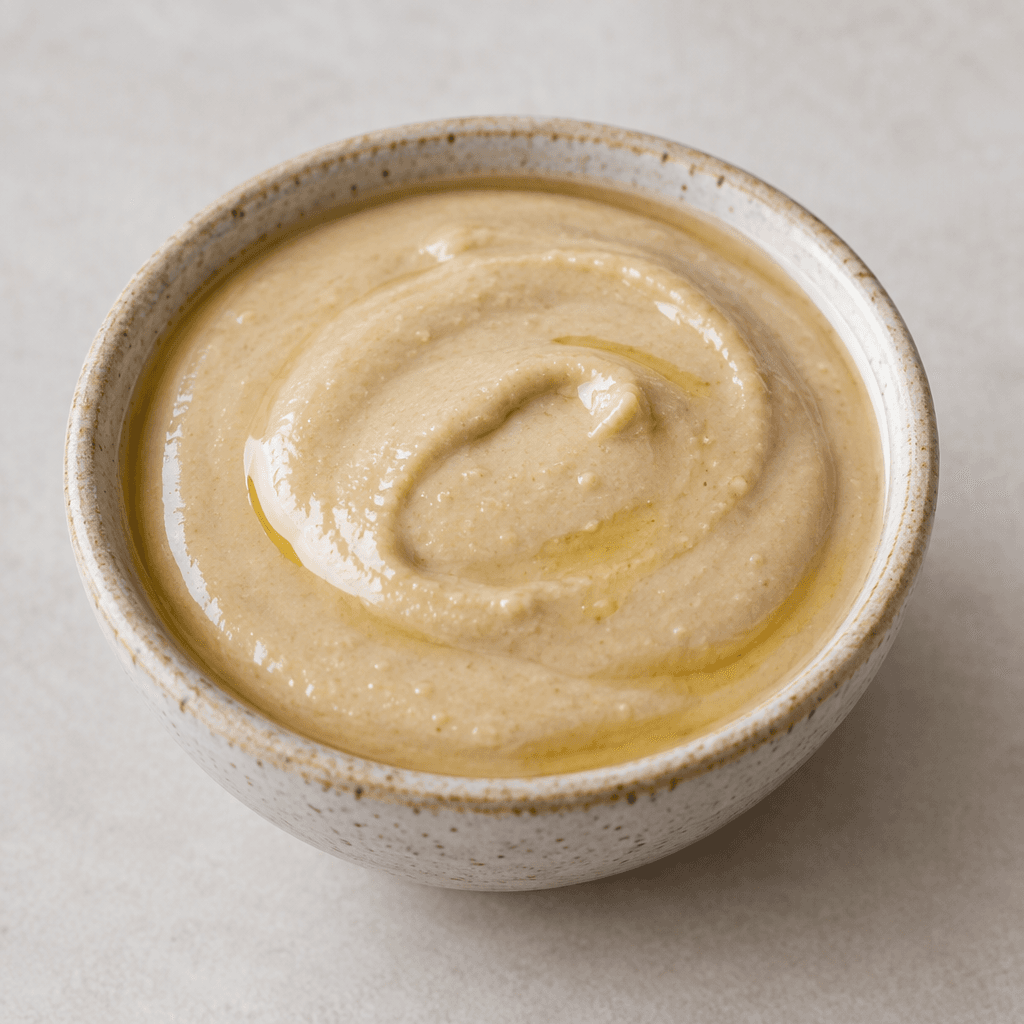
Natural Tahini Calories
Sesame paste, high in healthy fats and protein, rich in minerals and vitamins
In season: Spring · Summer · Autumn · Winter
CALORIES · 100 G
GI
POTASSIUM · 100 G
FIBER · 100 G
Quick answer
1 tablespoon (medium) of Natural Tahini (15 g) has 89 calories. That works out to 595 calories per 100 g. It contains 3.5 g of carbs, 2.6 g of protein, 8 g of fat and 1.4 g of fiber. Its 0.2 mg of Copper covers 25% of the Daily Value. Its glycemic index is 35 (low), so it raises blood sugar slowly.
Natural Tahini Nutrition Facts
Selected: 1 tablespoon (medium) · 15 g
89
KCAL / 15G
Carbs
3.5g
· 1% DV
Protein
2.6g
· 5% DV
Fat
8g
· 10% DV
Fiber
1.4g
· 5% DV
DV is the share of the daily value covered, on a 2,000 kcal reference diet.
Calories come from: Carbs 15% · Protein 11% · Fat 74%
Natural Tahini nutrition facts table · 1 tablespoon (medium) (15 g)
| Nutrient | Amount | % DV |
|---|---|---|
| Calories | 89 kcal | |
| Total fat | 8 g | 10% |
| Saturated fat | 1.13 g | 6% |
| Trans fat | 0 g | |
| Sodium | 2.4 mg | 0% |
| Total carbohydrate | 3.5 g | 1% |
| Fiber | 1.4 g | 5% |
| Protein | 2.6 g | 5% |
Calories: Calories measure energy. Average daily need is 2,000 kcal. Excess calories are stored as fat, too few cause weight loss.
Carbs: Your body's primary energy source. The brain runs exclusively on carbs. Daily need: 275g.
Protein: Essential for muscle repair and cell growth. Daily need: 50g. Keeps you full and boosts metabolism.
Fat: Needed for hormone production and vitamin absorption. Daily need: 78g. Limit saturated fats, choose unsaturated.
Fiber: Critical for digestive health and satiety. Daily need: 28g. Stabilizes blood sugar, lowers cholesterol.

Log this food in EatBetter
100,000+ people use it
- Get your daily calorie target
- Snap your meal, log it in seconds
- See every vitamin and mineral

📸 Scan the code to get the app free.

How Many Calories in 1 Tablespoon of Natural Tahini?
| Serving | Amount | Calories |
|---|---|---|
| 1 tablespoon (medium) | 15 g | 89 kcal |
| 1 teaspoon (small) | 5 g | 30 kcal |
| 1 piece (small) | 20 g | 119 kcal |
| 1 ounce (medium) | 28 g | 167 kcal |
| 2 tablespoon (large) | 30 g | 179 kcal |
| 1 serving (medium) | 30 g | 179 kcal |
| 1 pack (large) | 50 g | 298 kcal |
| 100 g | 100 g | 595 kcal |
| 1 cup (large) | 240 g | 1428 kcal |
Calculated from 595 calories per 100 g.
Frequently Asked Questions About Natural Tahini
What is natural tahini made of?
Natural tahini is sesame seeds ground into a smooth paste. Products may use hulled or unhulled sesame, so their color and flavor can differ; the word “natural” alone does not specify one fixed recipe.
How do you use natural tahini?
Natural tahini works in both savory and sweet dishes. Stir it into hummus, salad dressings, sauces, or baked goods, or spread it on toast; add a little water or lemon juice when you want a thinner consistency.
Why does oil separate in natural tahini?
Oil separating on top of natural tahini is normal: sesame oil rises out of the ground seeds during storage. Stir the paste thoroughly from the bottom of the jar before using it; separation alone does not mean it has spoiled.
How should you store natural tahini after opening?
Keep natural tahini tightly closed in a cool, dry place away from direct sunlight, and follow the storage directions on its label. Refrigeration can make it firmer, so stir it well or let it soften before serving.
Does natural tahini go bad?
Yes, natural tahini can go rancid as its sesame oils deteriorate. A sharp, stale, or paint-like smell or an unpleasant taste are warning signs; normal oil separation is not. Discard tahini if you see mold or an unusual change.
Why does natural tahini taste bitter?
Natural tahini can have a mild bitter edge because sesame variety and roasting affect its flavor. A strongly unpleasant bitterness or stale-oil smell can signal rancidity, so do not eat it if the taste seems spoiled.
How do you make natural tahini thinner?
Stir natural tahini first, then whisk in water, lemon juice, or another recipe liquid a little at a time. It may briefly thicken before becoming smooth, so keep whisking and add liquid gradually until it reaches the consistency you want.
Can you eat natural tahini straight from the jar?
Yes, natural tahini can be eaten straight from the jar, though its thick, rich texture is easier to enjoy when stirred first. You can also spread it on bread or mix it with honey or fruit for a quick snack.
What is the difference between natural tahini and sesame oil?
Natural tahini is a paste made from ground sesame seeds, while sesame oil is the oil extracted from sesame. Tahini retains the ground seed solids, so it is thick and spoonable rather than a pourable cooking oil.
How do you use natural tahini in hummus?
Natural tahini is blended with chickpeas, lemon juice, garlic, and other ingredients to make hummus. Add it while blending for a creamy texture, and thin the mixture with a little water if it is too thick.
Natural Tahini Vitamins & Minerals
Vitamins
B1
0.12mg · 10% DV
B3
0.69mg · 4% DV
B6
0.07mg · 4% DV
Folate
14.55µg · 4% DV
Minerals
Copper
0.22mg · 24% DV
Phosphorus
96mg · 14% DV
Manganese
0.17mg · 7% DV
Calcium
64mg · 6% DV
Potassium ⭐
62mg · 2% DV
Sodium
2.4mg · 0% DV
Natural Tahini Glycemic Index
GLYCEMIC INDEX
GLYCEMIC LOAD
Accounts for portion size — a more realistic measure than GI alone.
How to Burn Off Natural Tahini
To burn the 89 calories in 1 tablespoon (medium) (15 g):
🚶
Walking (5 km/h)
🏃
Running (8 km/h)
🚴
Cycling
🏊
Swimming
Times are calculated with the MET equation for a 70 kg adult. Actual burn varies with your weight, age and pace.
What is Natural Tahini?
Natural Tahini is a thick paste made by grinding sesame seeds. It has a rich, nutty flavour with a slight bitterness, and its dense texture loosens when stirred or mixed with liquid. Across the Middle East and Mediterranean, tahini is a familiar ingredient in hummus, dressings and sauces; it is also drizzled over roasted vegetables or spread on bread. In many English-speaking kitchens, it adds depth to dips, grain bowls and baking.
It is energy-dense, with most of its calories coming from fat, and also supplies plant protein and fibre. Stir it well before using, then thin it with lemon juice and water for a versatile dressing. A spoonful can also enrich porridge or yogurt, while pairing it with fresh, acidic flavours keeps its richness in balance.
How Nutritious Is Natural Tahini?
Nutrient density
High
How many vitamins, minerals and how much fiber this food carries per calorie. A high score means a lot of nutrition for few calories.
Satiety score
Medium
An EatBetter score computed from fiber, protein and calorie density. A high score means staying full longer on the same calories.
Both scores are calculated per 100 g and do not change with the selected portion. The satiety score is EatBetter's own calculation, not a clinical measure.
Is Natural Tahini Processed?
NOVA 2
Minimally Processed
1. Unprocessed
2. Minimally Processed
3. Processed
4. Ultra-Processed
NOVA classifies foods into 4 groups by industrial processing. NOVA 1 (unprocessed) is the healthiest.
Does Natural Tahini Contain Allergens?
Contains these allergens:
Which Diets Is Natural Tahini Good For?
Vegan
✓ Suitable
Vegetarian
✓ Suitable
Gluten-Free
✓ Suitable
Dairy-Free
— Not suitable
Mediterranean
✓ Suitable
Paleo
✓ Suitable
Whole30
— Not suitable
DASH
— Not suitable
Keto
✓ Suitable
Low FODMAP
— Not suitable
Natural Tahini Fat Profile
SATURATED
1.13g
MONOUNSATURATED
2.93g
POLYUNSATURATED
3.2g
Omega 6:3 ratio 63:1
Above the ideal 4:1 (63:1).
Compare Natural Tahini
Foods Similar to Natural Tahini
Have another question about Natural Tahini?
Ask the AI nutrition coach — calories, portions, alternatives and more, answered in seconds in the app.

Scan calories with your camera
Instant AI nutrition analysis

Nutrition data compiled from USDA FoodData Central and scientific sources.