

Ready & Packaged Foods
All →Vegetables & Legumes
All →Desserts & Confectionery
All →Meat & Protein
All →Grains & Bakery
All →Beverages
All →Milk & Dairy
All →

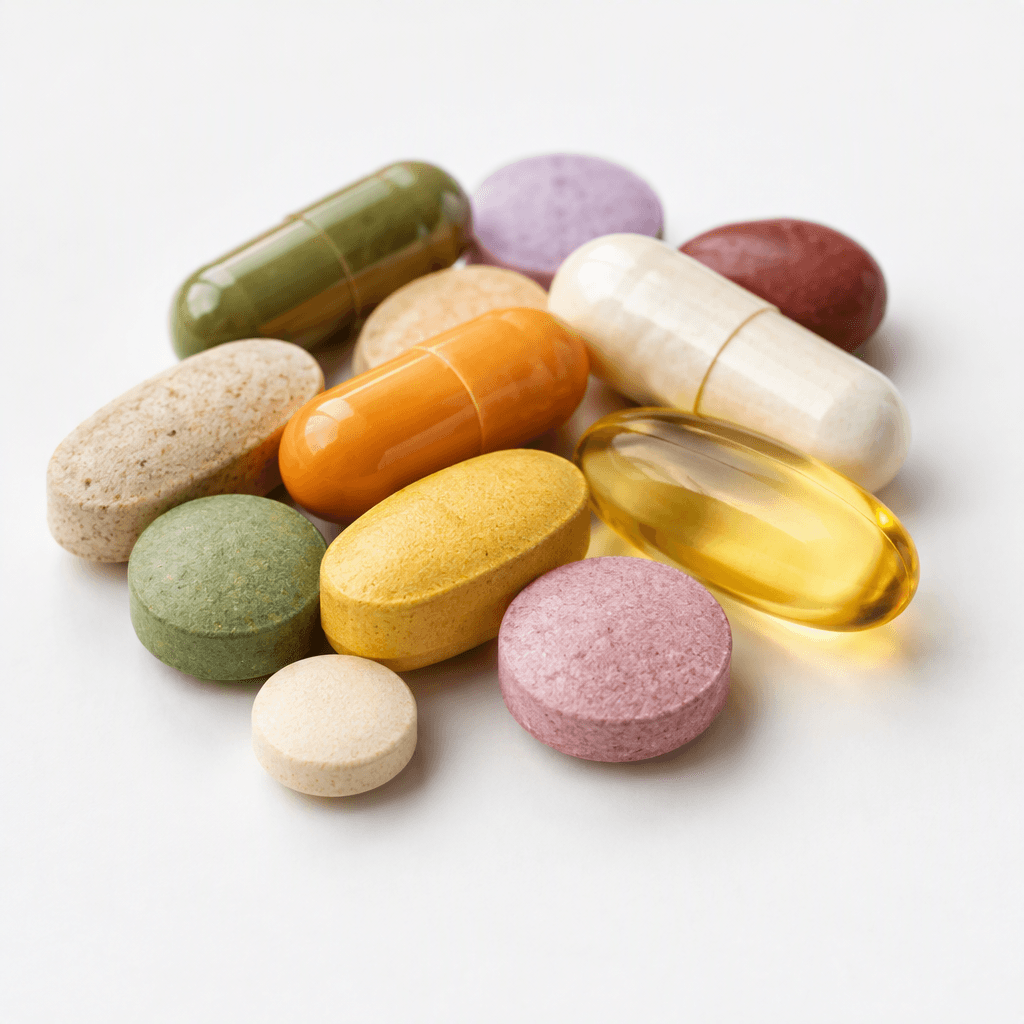
Multivitamin Supplement Calories
Balanced blend of essential vitamins and minerals
CALORIES
GI
POTASSIUM
FIBER
Quick answer
1 piece (small) of Multivitamin Supplement (1 g) has 4 calories. That works out to 350 calories per 100 g. It contains 1 g of carbs, 0 g of protein, 0 g of fat and 0 g of fiber. Its glycemic index is 60 (medium), so it raises blood sugar at a moderate pace.
What is Multivitamin Supplement?
A multivitamin supplement is a tablet or capsule formulated to provide a blend of vitamins and, depending on the product, minerals. It is not a single ingredient, and the formula and amounts can vary considerably between products, so check the label for what a particular one contains and how it is intended to be taken.
People often fit it into a daily routine with breakfast and a glass of water, though the directions may suggest taking it with a meal. It is not a snack or a source of meaningful protein or fibre; its nutritional role is the micronutrients in its formula, in a small serving. Follow the label rather than taking extra, and ask a pharmacist or healthcare professional if you are unsure whether it suits you.
Multivitamin Supplement Nutrition Facts
Selected: 100 g
350
KCAL / 100G
Carbs
85g
· 31% DV
Protein
0g
· 0% DV
Fat
0g
· 0% DV
Fiber
0g
· 0% DV
DV is the share of the daily value covered, on a 2,000 kcal reference diet.
Calories come from: Carbs 100% · Protein 0% · Fat 0%
Multivitamin Supplement Vitamins & Minerals
Vitamins
Biotin
50µg · 167% DV
B5
6mg · 120% DV
B2
1.4mg · 108% DV
B12
2.5µg · 104% DV
Minerals
Copper
1mg · 111% DV
Iodine
150µg · 100% DV
Selenium
55µg · 100% DV
Zinc
10mg · 91% DV
How Nutritious Is Multivitamin Supplement?
Nutrient density
Very high
How many vitamins, minerals and how much fiber this food carries per calorie. A high score means a lot of nutrition for few calories.
Satiety score
Low
An EatBetter score computed from fiber, protein and calorie density. A high score means staying full longer on the same calories.
Both scores are calculated per 100 g and do not change with the selected portion. The satiety score is EatBetter's own calculation, not a clinical measure.
Multivitamin Supplement Glycemic Index
GLYCEMIC INDEX
GLYCEMIC LOAD
Accounts for portion size — a more realistic measure than GI alone.
How to Burn Off Multivitamin Supplement
To burn the 350 calories in 100 g:
🚶
Walking (5 km/h)
🏃
Running (8 km/h)
🚴
Cycling
🏊
Swimming
Times are calculated with the MET equation for a 70 kg adult. Actual burn varies with your weight, age and pace.
Is Multivitamin Supplement Processed?
NOVA 3
Processed
1. Unprocessed
2. Minimally Processed
3. Processed
4. Ultra-Processed
NOVA classifies foods into 4 groups by industrial processing. NOVA 1 (unprocessed) is the healthiest.
Does Multivitamin Supplement Contain Allergens?
No known major allergens
Which Diets Is Multivitamin Supplement Good For?
Vegan
✓ Suitable
Vegetarian
✓ Suitable
Gluten-Free
✓ Suitable
Dairy-Free
— Not suitable
Mediterranean
✓ Suitable
Paleo
✓ Suitable
Whole30
— Not suitable
DASH
— Not suitable
Keto
✓ Suitable
Low FODMAP
— Not suitable
Multivitamin Supplement Fat Profile
SATURATED
0g
MONOUNSATURATED
0g
POLYUNSATURATED
0g
Compare Multivitamin Supplement
Foods Similar to Multivitamin Supplement
Frequently Asked Questions About Multivitamin Supplement
Do multivitamin supplements actually work?
Multivitamin supplements can help fill specific nutrient gaps, but they do not reliably prevent disease or improve health for everyone. Their usefulness is greatest when a person has a limited diet or a confirmed shortfall.
Can you take a multivitamin supplement at night?
Yes, you can take a multivitamin supplement at night if that suits your routine. Some people find certain formulas upsetting close to bedtime, so taking it with an evening meal may be more comfortable.
Should a multivitamin supplement be taken with food?
Taking a multivitamin supplement with food can reduce stomach discomfort, and dietary fat helps absorb vitamins A, D, E, and K. Follow the product’s directions if they specify a different way to take it.
Can a multivitamin supplement prevent colds?
No, a multivitamin supplement is not a reliable way to prevent colds. Correcting a vitamin deficiency supports normal immune function, but taking extra vitamins does not make a person immune to respiratory infections.
Can a multivitamin supplement cause nausea?
Yes, a multivitamin supplement can cause nausea, especially when taken on an empty stomach or when it contains iron. Taking it with a meal often helps; persistent symptoms are a reason to stop and review the product.
Why does a multivitamin supplement make urine bright yellow?
A multivitamin supplement can turn urine bright yellow because excess riboflavin, or vitamin B2, is excreted in urine. The color change is usually harmless and is not a sign that the supplement is improving hydration.
Can a multivitamin supplement interact with prescription medicines?
Yes, a multivitamin supplement can interact with medicines. Vitamin K may affect warfarin, while minerals such as calcium and iron can interfere with absorption of some drugs. Ask your doctor or pharmacist about timing if you take prescription medicine.
Can you take a regular multivitamin supplement during pregnancy?
A regular multivitamin supplement may not provide the right amounts for pregnancy and can contain unsuitable amounts of some nutrients. Pregnancy-specific supplements are formulated differently; ask your prenatal care professional which product is appropriate.
Do multivitamin supplements expire?
Yes, multivitamin supplements have an expiration date, and their potency may decline afterward. Keep them tightly closed in a cool, dry place, since heat and moisture can damage tablets or capsules sooner.
Should everyone take a multivitamin supplement?
No, a multivitamin supplement is not necessary for everyone. People who already meet their needs through food may gain little from routine use, while some groups have specific needs that call for a tailored supplement.
Have another question about Multivitamin Supplement?
Ask the AI nutrition coach — calories, portions, alternatives and more, answered in seconds in the app.

Scan calories with your camera
Instant AI nutrition analysis

Nutrition data compiled from USDA FoodData Central and scientific sources.