

Ready & Packaged Foods
All →Vegetables & Legumes
All →Desserts & Confectionery
All →Meat & Protein
All →Grains & Bakery
All →Beverages
All →Milk & Dairy
All →

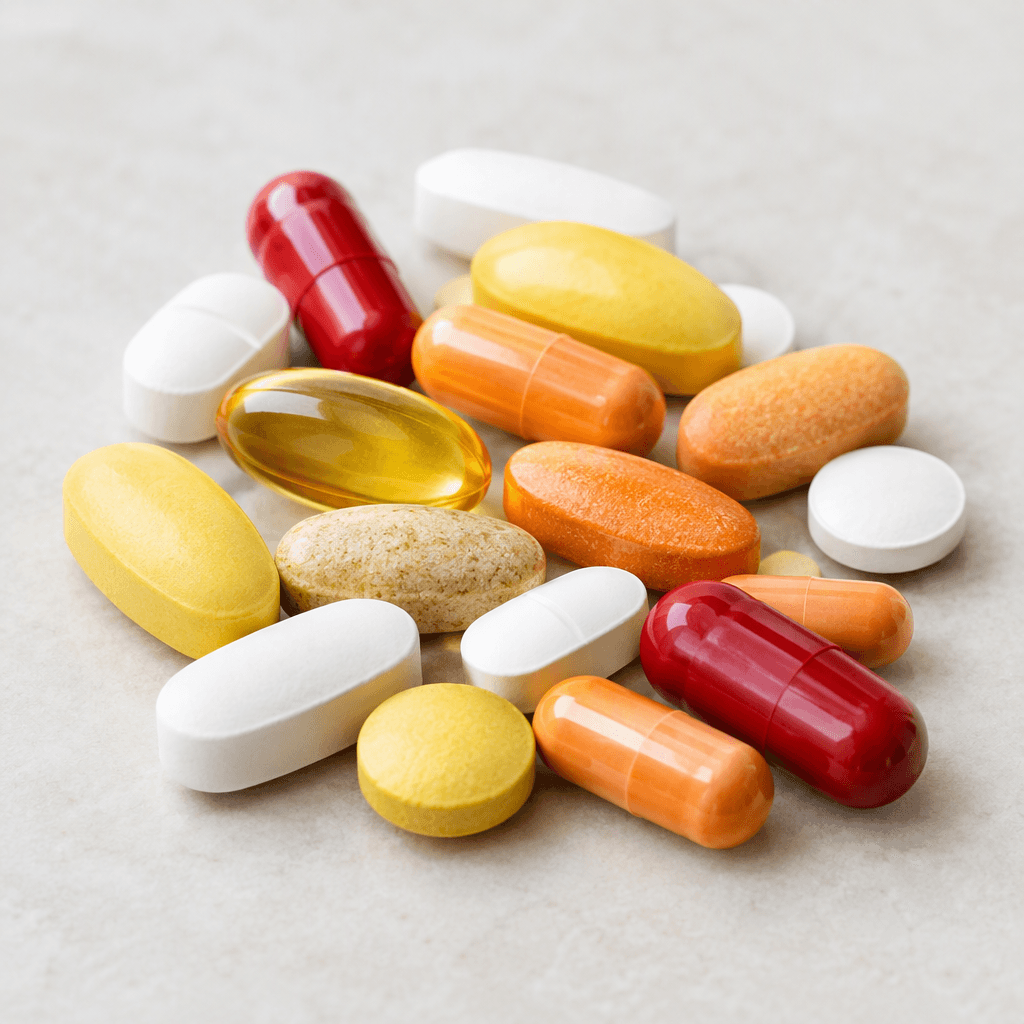
Multivitamin Calories
Comprehensive vitamin and mineral supplement
CALORIES
GI
POTASSIUM
FIBER
Quick answer
1 piece (medium) of Multivitamin (1 g) has 3 calories. That works out to 250 calories per 100 g. It contains 0.7 g of carbs, 0 g of protein, 0 g of fat and 0 g of fiber. Its glycemic index is 30 (low), so it raises blood sugar slowly.
What is Multivitamin?
A multivitamin is a packaged supplement that combines several vitamins, often alongside minerals, in a tablet, capsule or similar form. It is made from measured nutrient ingredients rather than being a food eaten as part of a meal.
Most people swallow it with water, often alongside breakfast or another meal as part of a daily routine; follow the directions on the specific product. The taste is usually less important than the tablet’s size and ease of swallowing. Nutritionally, it is intended as a source of vitamins and minerals, not as a meaningful source of protein or energy. Stick to the label’s serving directions, and don’t use it as a replacement for a varied diet.
Multivitamin Nutrition Facts
Selected: 100 g
250
KCAL / 100G
Carbs
60g
· 22% DV
Protein
0g
· 0% DV
Fat
0g
· 0% DV
Fiber
0g
· 0% DV
DV is the share of the daily value covered, on a 2,000 kcal reference diet.
Calories come from: Carbs 100% · Protein 0% · Fat 0%
Multivitamin Vitamins & Minerals
Vitamins
Biotin
50µg · 167% DV
B5
6mg · 120% DV
B2
1.4mg · 108% DV
B12
2.5µg · 104% DV
Minerals
Copper
1mg · 111% DV
Iodine
150µg · 100% DV
Selenium
55µg · 100% DV
Zinc
10mg · 91% DV
How Nutritious Is Multivitamin?
Nutrient density
Very high
How many vitamins, minerals and how much fiber this food carries per calorie. A high score means a lot of nutrition for few calories.
Satiety score
Low
An EatBetter score computed from fiber, protein and calorie density. A high score means staying full longer on the same calories.
Both scores are calculated per 100 g and do not change with the selected portion. The satiety score is EatBetter's own calculation, not a clinical measure.
Multivitamin Glycemic Index
GLYCEMIC INDEX
GLYCEMIC LOAD
Accounts for portion size — a more realistic measure than GI alone.
How to Burn Off Multivitamin
To burn the 250 calories in 100 g:
🚶
Walking (5 km/h)
🏃
Running (8 km/h)
🚴
Cycling
🏊
Swimming
Times are calculated with the MET equation for a 70 kg adult. Actual burn varies with your weight, age and pace.
Is Multivitamin Processed?
NOVA 3
Processed
1. Unprocessed
2. Minimally Processed
3. Processed
4. Ultra-Processed
NOVA classifies foods into 4 groups by industrial processing. NOVA 1 (unprocessed) is the healthiest.
Does Multivitamin Contain Allergens?
No known major allergens
Which Diets Is Multivitamin Good For?
Vegan
✓ Suitable
Vegetarian
✓ Suitable
Gluten-Free
✓ Suitable
Dairy-Free
— Not suitable
Mediterranean
✓ Suitable
Paleo
✓ Suitable
Whole30
— Not suitable
DASH
— Not suitable
Keto
✓ Suitable
Low FODMAP
— Not suitable
Multivitamin Fat Profile
SATURATED
0g
MONOUNSATURATED
0g
POLYUNSATURATED
0g
Compare Multivitamin
Foods Similar to Multivitamin
Frequently Asked Questions About Multivitamin
Do multivitamins actually do anything?
Yes, a multivitamin can help fill specific nutrient gaps, but it does not prevent illness or replace a varied diet. It is most useful when your food intake or a diagnosed need leaves you short of certain vitamins or minerals.
Should you take a multivitamin every day?
You can take a multivitamin daily if its directions say so, but daily use is not necessary for everyone. Avoid stacking it with other supplements that contain the same nutrients, since some vitamins and minerals can build up at excessive intakes.
What time of day should you take a multivitamin?
There is no universally best time to take a multivitamin. Choose a time you can stick to, and take it with a meal if it upsets your stomach; follow any timing instructions on the product.
Can a multivitamin make your pee bright yellow?
Yes, a multivitamin can turn urine bright yellow, often because the body excretes excess riboflavin, also called vitamin B2. The color change is usually harmless on its own and should fade as the supplement leaves your system.
Can multivitamins interact with prescription medicines?
Yes, minerals in some multivitamins can interfere with the absorption of medicines such as thyroid drugs and certain antibiotics; vitamin K can affect warfarin. Ask your pharmacist or prescriber about timing and suitability if you take regular medication.
Is it okay to take a multivitamin with coffee?
It is generally safe to take a multivitamin with coffee, but water is a better choice. Coffee may reduce absorption of iron in a supplement, so take an iron-containing multivitamin separately from coffee when possible.
Can you take too much multivitamin?
Yes, taking too much multivitamin can be harmful, particularly when several products add up to high amounts of vitamins A or D, iron, or other minerals. Stick to the label dose and keep supplements out of reach of children.
Do multivitamins need to be taken with food?
Not always, but taking a multivitamin with food can reduce nausea and help your body absorb fat-soluble vitamins. If the product causes stomach discomfort on an empty stomach, take it alongside a meal.
Should you take a multivitamin during pregnancy?
A standard multivitamin is not necessarily the right choice during pregnancy, because nutrient needs and safe amounts differ. Pregnancy supplements are formulated for this stage; ask your prenatal care provider which product and dose to use.
How should you store a multivitamin after opening?
Keep a multivitamin tightly closed in a cool, dry place, away from direct sunlight and moisture. Avoid storing it in a bathroom, and keep it out of children's reach; follow any specific storage directions on its packaging.
Have another question about Multivitamin?
Ask the AI nutrition coach — calories, portions, alternatives and more, answered in seconds in the app.

Scan calories with your camera
Instant AI nutrition analysis

Nutrition data compiled from USDA FoodData Central and scientific sources.