

Ready & Packaged Foods
All →Vegetables & Legumes
All →Desserts & Confectionery
All →Meat & Protein
All →Grains & Bakery
All →Beverages
All →Milk & Dairy
All →

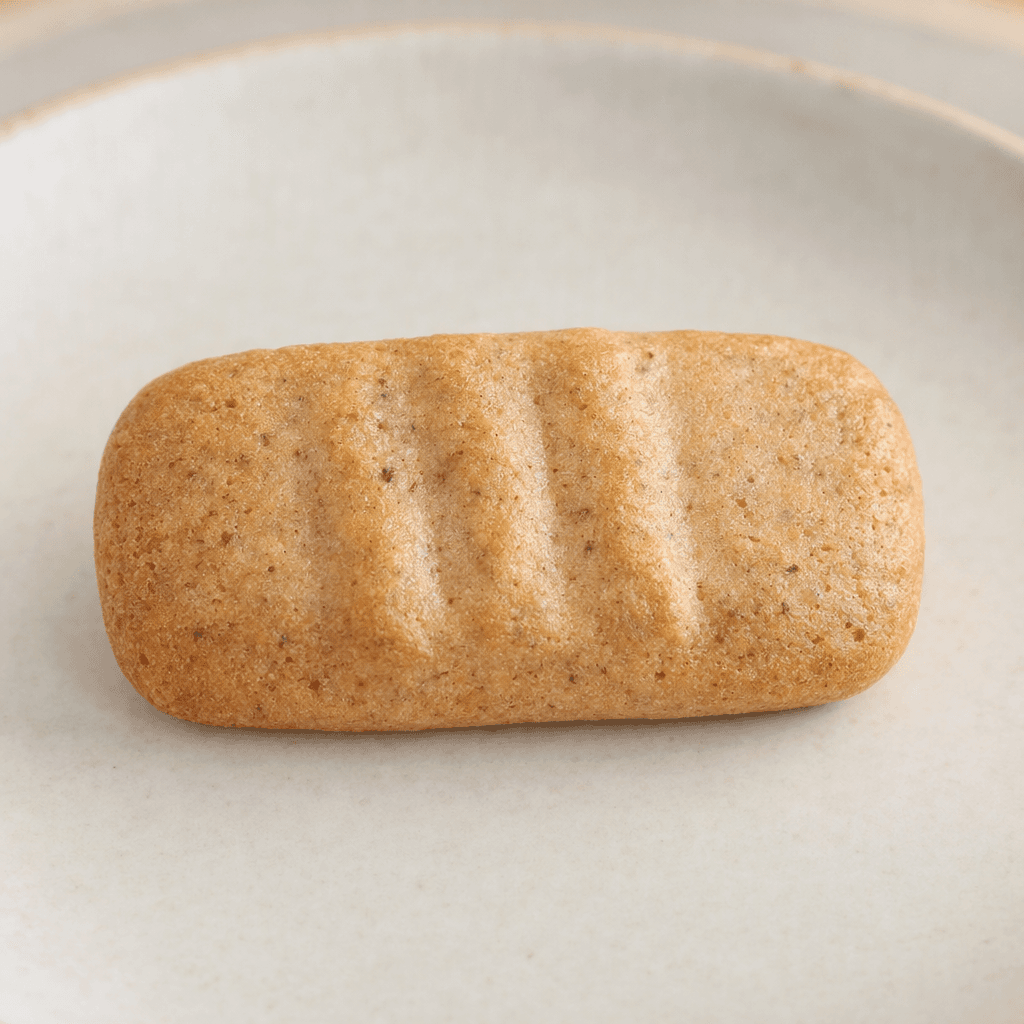
Multigrain baby biscuit Calories
Multigrain baby biscuit, typically fortified with iron and made for infants
CALORIES · 100 G
GI
POTASSIUM · 100 G
FIBER · 100 G
Quick answer
4 piece (medium) of Multigrain baby biscuit (24 g) has 103 calories. That works out to 430 calories per 100 g. It contains 17.8 g of carbs, 2 g of protein, 2.5 g of fat and 0.8 g of fiber. Its 0.2 mg of B2 covers 13% of the Daily Value. Its glycemic index is 68 (medium), so it raises blood sugar at a moderate pace.
Multigrain baby biscuit Nutrition Facts
Selected: 4 piece (medium) · 24 g
103
KCAL / 24G
Carbs
17.8g
· 6% DV
Protein
2g
· 4% DV
Fat
2.5g
· 3% DV
Fiber
0.8g
· 3% DV
DV is the share of the daily value covered, on a 2,000 kcal reference diet.
Calories come from: Carbs 70% · Protein 8% · Fat 22%
Multigrain baby biscuit nutrition facts table · 4 piece (medium) (24 g)
| Nutrient | Amount | % DV |
|---|---|---|
| Calories | 103 kcal | |
| Total fat | 2.5 g | 3% |
| Saturated fat | 0.74 g | 4% |
| Trans fat | 0.01 g | |
| Sodium | 43 mg | 2% |
| Total carbohydrate | 17.8 g | 6% |
| Fiber | 0.8 g | 3% |
| Protein | 2 g | 4% |
Calories: Calories measure energy. Average daily need is 2,000 kcal. Excess calories are stored as fat, too few cause weight loss.
Carbs: Your body's primary energy source. The brain runs exclusively on carbs. Daily need: 275g.
Protein: Essential for muscle repair and cell growth. Daily need: 50g. Keeps you full and boosts metabolism.
Fat: Needed for hormone production and vitamin absorption. Daily need: 78g. Limit saturated fats, choose unsaturated.
Fiber: Critical for digestive health and satiety. Daily need: 28g. Stabilizes blood sugar, lowers cholesterol.

Log this food in EatBetter
100,000+ people use it
- Get your daily calorie target
- Snap your meal, log it in seconds
- See every vitamin and mineral

📸 Scan the code to get the app free.

How Many Calories in 4 Pieces of Multigrain baby biscuit?
| Serving | Amount | Calories |
|---|---|---|
| 4 piece (medium) | 24 g | 103 kcal |
| 1 piece (small) | 6 g | 26 kcal |
| 2 piece (medium) | 12 g | 52 kcal |
| 1 serving (small) | 20 g | 86 kcal |
| 1 serving (medium) | 30 g | 129 kcal |
| 6 piece (large) | 36 g | 155 kcal |
| 1 serving (large) | 45 g | 194 kcal |
| 8 piece (extra large) | 48 g | 206 kcal |
| 100 g | 100 g | 430 kcal |
Calculated from 430 calories per 100 g.
Frequently Asked Questions About Multigrain baby biscuit
At what age can babies eat multigrain baby biscuits?
They can generally be offered from around 6 months, once a baby is ready for solid foods; do not give them before 6 months. Make sure the baby can sit upright and supervise closely while they eat.
Can you mix multigrain baby biscuits with milk?
Yes, you can crumble one into milk to make a spoon-fed mixture, if the product instructions allow it. Don’t put biscuit or thickened mixtures in a baby’s bottle: they can increase choking risk and make it harder to learn spoon-feeding.
Are multigrain baby biscuits a choking hazard?
They can be, particularly if a baby bites off a hard piece or is given a chunk that is too large. Soften or prepare the biscuit to suit the baby’s feeding skills, keep the baby upright, and stay within arm’s reach during eating.
Do multigrain baby biscuits contain added sugar?
It varies by product; the name does not guarantee that a biscuit is sugar-free. Look for sugar, glucose syrup, or other sweeteners in the ingredients, and avoid making sweetened biscuits a regular part of a baby’s diet.
Are multigrain baby biscuits a good everyday snack for babies?
They are not necessary every day. Multigrain baby biscuits are ultra-processed products, so they should not displace varied complementary foods such as vegetables, fruit, eggs, and other age-appropriate options.
Can multigrain baby biscuits replace a meal?
No. A multigrain baby biscuit is not a complete meal, even if it is fortified with iron. Offer it, if at all, as a small addition to a varied meal rather than relying on it to meet a baby’s nutritional needs.
Are multigrain baby biscuits fortified with iron?
Many are, but fortification varies between products and does not make the biscuit a complete source of iron. Check the product’s ingredients and nutrition information, and continue offering other appropriate iron-containing complementary foods.
How do you serve multigrain baby biscuits to a baby?
Crumble the biscuit and soften it with a suitable liquid or mix it into yogurt, then feed the mixture by spoon. Prepare only what the baby will eat and don’t leave softened biscuit sitting out for later.
Can multigrain baby biscuits cause constipation?
They do not cause constipation in every baby, but frequent servings can crowd out fruits, vegetables, and other foods that contribute fiber. If constipation is an issue, offer a varied diet and age-appropriate fluids.
How should you store an opened pack of multigrain baby biscuits?
Keep the biscuits sealed in an airtight container in a cool, dry place, and follow the package’s storage instructions. Discard any that have become damp, softened, or changed in smell or appearance.
Multigrain baby biscuit Vitamins & Minerals
Vitamins
B2
0.17mg · 13% DV
B1
0.14mg · 12% DV
B5
0.6mg · 12% DV
B3
1.44mg · 9% DV
Minerals
Iron
1.92mg · 11% DV
Phosphorus
53mg · 8% DV
Manganese
0.17mg · 7% DV
Calcium
67mg · 7% DV
Sodium
43mg · 2% DV
Potassium ⭐
55mg · 2% DV
Multigrain baby biscuit Glycemic Index
GLYCEMIC INDEX
GLYCEMIC LOAD
Accounts for portion size — a more realistic measure than GI alone.
How to Burn Off Multigrain baby biscuit
To burn the 103 calories in 4 piece (medium) (24 g):
🚶
Walking (5 km/h)
🏃
Running (8 km/h)
🚴
Cycling
🏊
Swimming
Times are calculated with the MET equation for a 70 kg adult. Actual burn varies with your weight, age and pace.
What is Multigrain baby biscuit?
Multigrain baby biscuit is a packaged biscuit made with a mix of cereal flours for infants, and it is often fortified with iron. It is commonly offered at breakfast or as a snack, either as a finger food when suitable or softened in milk or formula. The biscuits are mildly sweet and crisp when dry, becoming soft and easy to mash once moistened.
They are mainly a source of carbohydrate and energy, with some protein and fibre; 100 g provides 430 calories. A modest portion can fit into a varied feeding routine, but it is best not to let biscuits replace more varied foods. For a simple snack, serve a little alongside age-appropriate mashed fruit.
How Nutritious Is Multigrain baby biscuit?
Nutrient density
Medium
How many vitamins, minerals and how much fiber this food carries per calorie. A high score means a lot of nutrition for few calories.
Satiety score
Low
An EatBetter score computed from fiber, protein and calorie density. A high score means staying full longer on the same calories.
Both scores are calculated per 100 g and do not change with the selected portion. The satiety score is EatBetter's own calculation, not a clinical measure.
Is Multigrain baby biscuit Processed?
NOVA 4
Ultra-Processed
1. Unprocessed
2. Minimally Processed
3. Processed
4. Ultra-Processed
NOVA classifies foods into 4 groups by industrial processing. NOVA 1 (unprocessed) is the healthiest.
Does Multigrain baby biscuit Contain Allergens?
Contains these allergens:
Which Diets Is Multigrain baby biscuit Good For?
Vegan
— Not suitable
Vegetarian
✓ Suitable
Gluten-Free
— Not suitable
Dairy-Free
— Not suitable
Mediterranean
— Not suitable
Paleo
— Not suitable
Whole30
— Not suitable
DASH
— Not suitable
Keto
— Not suitable
Low FODMAP
— Not suitable
Multigrain baby biscuit Fat Profile
SATURATED
0.74g
MONOUNSATURATED
0.72g
POLYUNSATURATED
0.62g
Omega 6:3 ratio 29:1
Above the ideal 4:1 (29:1).
Compare Multigrain baby biscuit
Foods Similar to Multigrain baby biscuit
Have another question about Multigrain baby biscuit?
Ask the AI nutrition coach — calories, portions, alternatives and more, answered in seconds in the app.

Scan calories with your camera
Instant AI nutrition analysis

Nutrition data compiled from USDA FoodData Central and scientific sources.