

Ready & Packaged Foods
All →Vegetables & Legumes
All →Desserts & Confectionery
All →Meat & Protein
All →Grains & Bakery
All →Beverages
All →Milk & Dairy
All →

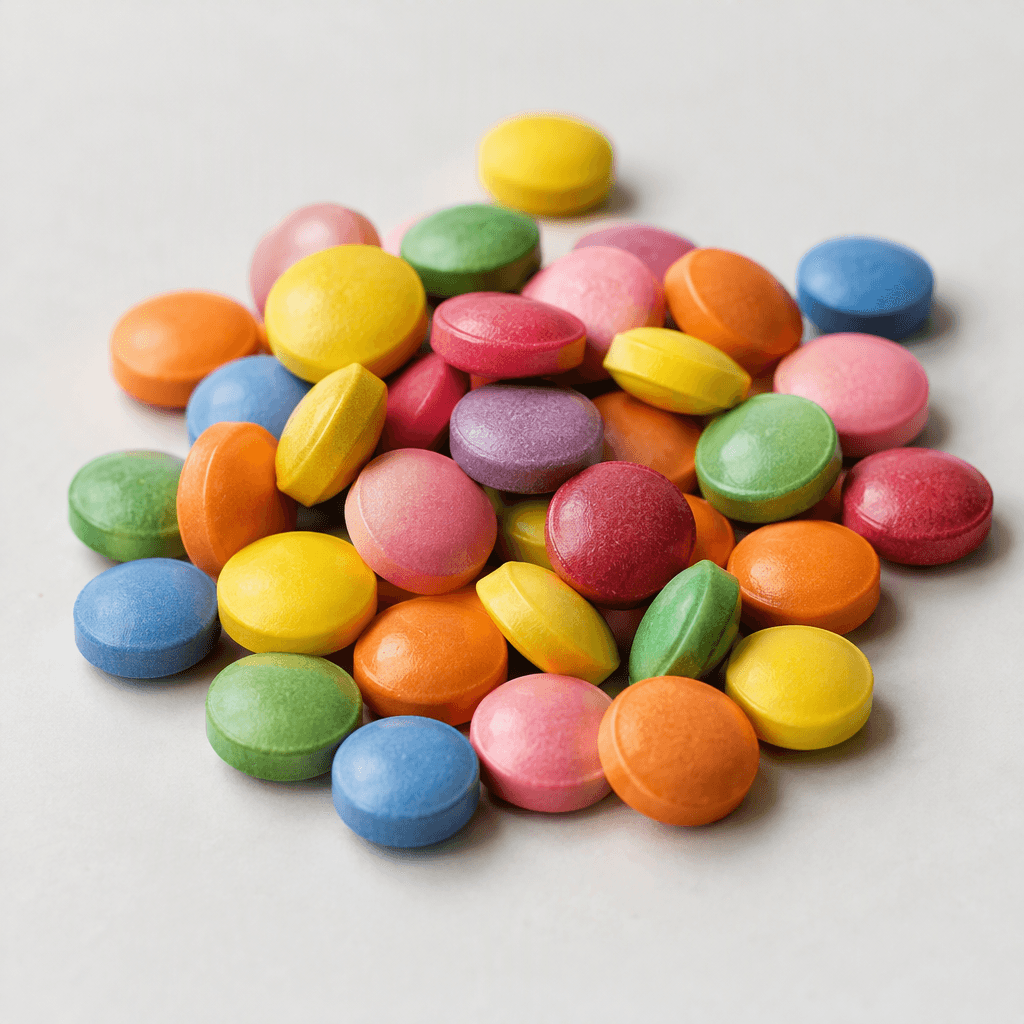
Multi vitamin Calories
Supplement containing various vitamins and minerals
CALORIES · 100 G
GI
POTASSIUM · 100 G
FIBER · 100 G
Quick answer
1 piece (medium) of Multi vitamin (1 g) has 0 calories. That works out to 5 calories per 100 g. It contains 0 g of carbs, 0 g of protein, 0 g of fat and 0 g of fiber. Its glycemic index is 0 (low), so it raises blood sugar slowly.
Multi vitamin Nutrition Facts
Selected: 1 piece (medium) · 1.2 g
0
KCAL / 1.2G
Carbs
0g
· 0% DV
Protein
0g
· 0% DV
Fat
0g
· 0% DV
Fiber
0g
· 0% DV
DV is the share of the daily value covered, on a 2,000 kcal reference diet.
Calories come from: Carbs 0% · Protein 0% · Fat 100%
Multi vitamin nutrition facts table · 1 piece (medium) (1.2 g)
| Nutrient | Amount | % DV |
|---|---|---|
| Calories | 0 kcal | |
| Total fat | 0 g | 0% |
| Saturated fat | 0 g | 0% |
| Trans fat | 0 g | |
| Sodium | 0.12 mg | 0% |
| Total carbohydrate | 0 g | 0% |
| Fiber | 0 g | 0% |
| Protein | 0 g | 0% |
Calories: Calories measure energy. Average daily need is 2,000 kcal. Excess calories are stored as fat, too few cause weight loss.
Carbs: Your body's primary energy source. The brain runs exclusively on carbs. Daily need: 275g.
Protein: Essential for muscle repair and cell growth. Daily need: 50g. Keeps you full and boosts metabolism.
Fat: Needed for hormone production and vitamin absorption. Daily need: 78g. Limit saturated fats, choose unsaturated.
Fiber: Critical for digestive health and satiety. Daily need: 28g. Stabilizes blood sugar, lowers cholesterol.

Log this food in EatBetter
100,000+ people use it
- Get your daily calorie target
- Snap your meal, log it in seconds
- See every vitamin and mineral

📸 Scan the code to get the app free.

How Many Calories in 1 Medium Multi vitamin?
| Serving | Amount | Calories |
|---|---|---|
| 1 piece (medium) | 1.2 g | 0 kcal |
| 1 piece (small) | 0.6 g | 0 kcal |
| 1 piece (extra large) | 2 g | 0 kcal |
| 2 piece (large) | 2.4 g | 0 kcal |
| 1 pack (medium) | 36 g | 2 kcal |
| 1 pack (large) | 60 g | 3 kcal |
| 100 g | 100 g | 5 kcal |
Calculated from 5 calories per 100 g.
Frequently Asked Questions About Multi vitamin
When should you take a multivitamin?
Take a multivitamin at a time you can follow consistently, usually with a meal. Taking it with food may reduce stomach upset, and products containing fat-soluble vitamins are generally better absorbed alongside a meal that includes some fat.
Should you take a multivitamin with food?
Yes, taking a multivitamin with food is often more comfortable and can help with absorption of fat-soluble vitamins. Follow the product directions, since formulations differ, and take it with water rather than relying on food or drink to replace the supplement.
Can you take a multivitamin at night?
Yes, you can take a multivitamin at night if that suits your routine and the directions do not say otherwise. If it causes stomach discomfort or seems to affect your sleep, try taking it with an earlier meal instead.
Can a multivitamin make you feel sick?
Yes, a multivitamin can cause nausea or stomach discomfort, especially when taken on an empty stomach. Taking it with a meal may help; stop using it if symptoms are severe or persistent, and check whether you are combining overlapping supplements.
Can a multivitamin turn your urine bright yellow?
Yes, a multivitamin can make urine bright yellow, commonly because it contains riboflavin, also known as vitamin B2. This color change is usually harmless and does not mean the supplement is curing a condition or that you need a higher dose.
Can a multivitamin interact with medications?
Yes, a multivitamin can interact with some medications because ingredients such as vitamin K, iron, or calcium may affect how certain drugs work or are absorbed. Ask your doctor or pharmacist to check your specific medicines before you start taking one.
Can you take a multivitamin with other supplements?
Sometimes, but combining a multivitamin with other supplements can add up to excessive amounts of the same vitamins or minerals. Compare their active ingredients and serving directions before using them together, particularly if more than one product contains iron or vitamins A and D.
Do multivitamins give you more energy?
A multivitamin is not a stimulant and does not reliably boost energy in someone who already gets enough nutrients. It may help fatigue caused by a nutrient deficiency, but ongoing tiredness can have other causes that a supplement will not address.
Do multivitamins help your immune system?
Multivitamins provide nutrients involved in normal immune function, but taking one does not reliably prevent infections or strengthen immunity beyond what adequate nutrition supports. Correcting a genuine deficiency may help restore normal function; taking extra is not a shortcut to avoiding illness.
Do multivitamins expire?
Yes, multivitamins have an expiration or best-before date, and their potency can decline over time. Keep the container closed in a cool, dry place, follow its storage instructions, and do not use tablets that have changed appearance, smell, or texture.
Multi vitamin Vitamins & Minerals
Vitamins
Biotin
0.6µg · 2% DV
B2
0.02mg · 2% DV
B5
0.07mg · 1% DV
B12
0.03µg · 1% DV
Minerals
Copper
0.01mg · 1% DV
Iodine
1.8µg · 1% DV
Selenium
0.66µg · 1% DV
Zinc
0.12mg · 1% DV
Potassium ⭐
0.48mg · 0% DV
Sodium
0.12mg · 0% DV
Multi vitamin Glycemic Index
GLYCEMIC INDEX
GLYCEMIC LOAD
Accounts for portion size — a more realistic measure than GI alone.
How to Burn Off Multi vitamin
What is Multi vitamin?
A multi vitamin is a dietary supplement that combines a selection of vitamins and minerals. It may come as a tablet, capsule or chewable, and the ingredients and directions vary by product, so check the label rather than assuming all formulas are alike.
People commonly take one with water, often alongside a meal; whether it should be taken with food depends on the product’s instructions. It is not usually chosen for its taste or texture, and its nutritional role is to provide a range of micronutrients, with little energy. Use it as a supplement to a varied diet, not a replacement for one. If you have questions about whether a particular formula suits you, ask a qualified health professional.
How Nutritious Is Multi vitamin?
Nutrient density
Very high
How many vitamins, minerals and how much fiber this food carries per calorie. A high score means a lot of nutrition for few calories.
Satiety score
Medium
An EatBetter score computed from fiber, protein and calorie density. A high score means staying full longer on the same calories.
Both scores are calculated per 100 g and do not change with the selected portion. The satiety score is EatBetter's own calculation, not a clinical measure.
Is Multi vitamin Processed?
NOVA 3
Processed
1. Unprocessed
2. Minimally Processed
3. Processed
4. Ultra-Processed
NOVA classifies foods into 4 groups by industrial processing. NOVA 1 (unprocessed) is the healthiest.
Does Multi vitamin Contain Allergens?
No known major allergens
Which Diets Is Multi vitamin Good For?
Vegan
✓ Suitable
Vegetarian
✓ Suitable
Gluten-Free
✓ Suitable
Dairy-Free
— Not suitable
Mediterranean
✓ Suitable
Paleo
✓ Suitable
Whole30
— Not suitable
DASH
— Not suitable
Keto
— Not suitable
Low FODMAP
— Not suitable
Multi vitamin Fat Profile
SATURATED
0g
MONOUNSATURATED
0g
POLYUNSATURATED
0g
Compare Multi vitamin
Foods Similar to Multi vitamin
Have another question about Multi vitamin?
Ask the AI nutrition coach — calories, portions, alternatives and more, answered in seconds in the app.

Scan calories with your camera
Instant AI nutrition analysis

Nutrition data compiled from USDA FoodData Central and scientific sources.