

Ready & Packaged Foods
All →Vegetables & Legumes
All →Desserts & Confectionery
All →Meat & Protein
All →Grains & Bakery
All →Beverages
All →Milk & Dairy
All →

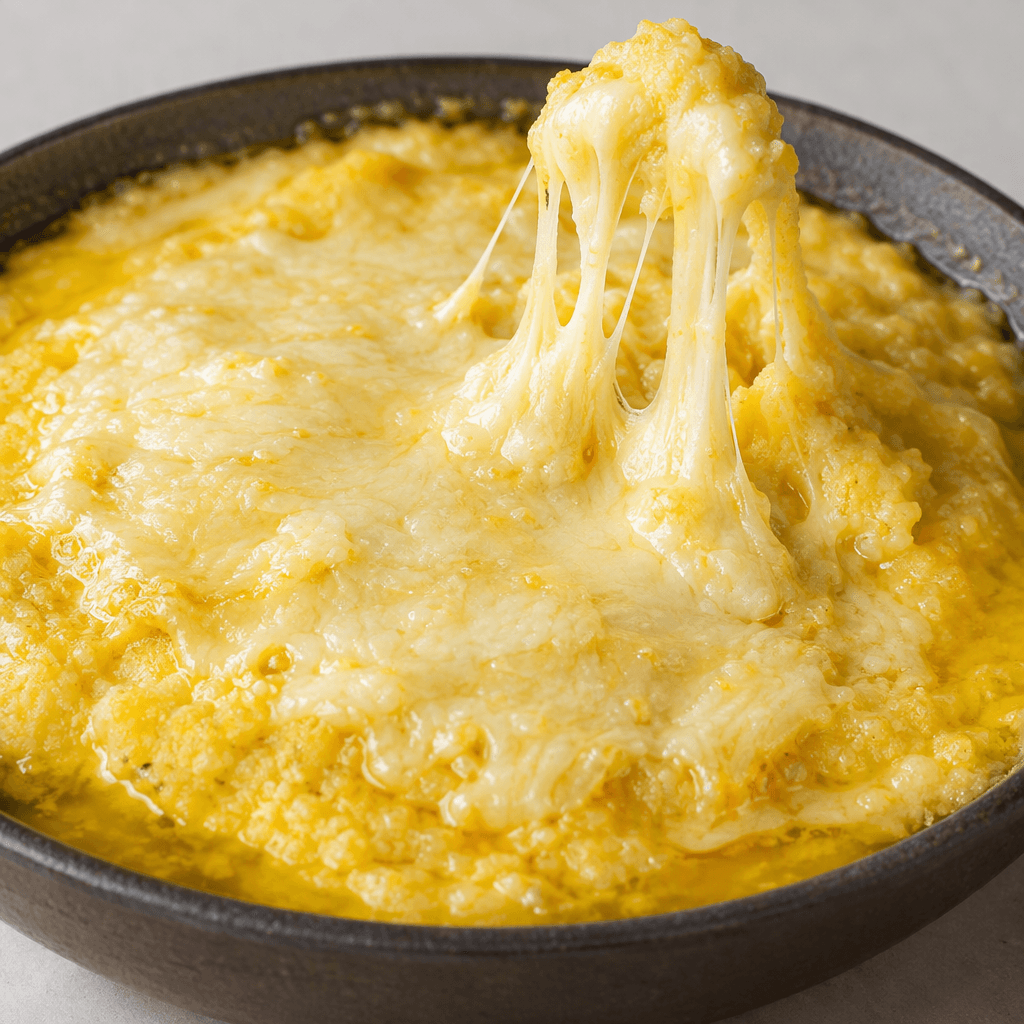
Muhlama Calories
Traditional Black Sea Turkish dish made with cornmeal, butter, and melting cheese.
In season: Spring · Summer · Autumn · Winter
CALORIES
GI
POTASSIUM
FIBER
Quick answer
1 serving (medium) of Muhlama (120 g) has 324 calories. That works out to 270 calories per 100 g. It contains 21.6 g of carbs, 11.4 g of protein, 20.4 g of fat and 1.4 g of fiber. Its 0.8 µg of B12 covers 35% of the Daily Value. Its glycemic index is 65 (medium), so it raises blood sugar at a moderate pace.
What is Muhlama?
Muhlama is a hot, pan-cooked dish from Turkey’s Black Sea region, made by stirring cornmeal into butter and melting cheese until the mixture turns thick and stretchy. Recipes vary across the region, especially in the choice of cheese and the balance between cornmeal and butter.
It is usually brought to the table straight from the pan, while the cheese is still soft and stringy. Tear off pieces of bread to scoop it up; in its home region, it is a favourite at breakfast and is also shared as a hearty meal at other times of day. Butter and cheese make it rich and filling, while cornmeal provides much of its substance. For a lighter spread, serve a smaller portion with fresh vegetables.
Muhlama Nutrition Facts
Selected: 100 g
270
KCAL / 100G
Carbs
18g
· 7% DV
Protein
9.5g
· 19% DV
Fat
17g
· 22% DV
Fiber
1.2g
· 4% DV
DV is the share of the daily value covered, on a 2,000 kcal reference diet.
Calories come from: Carbs 27% · Protein 14% · Fat 59%
Muhlama Vitamins & Minerals
Vitamins
B12
0.7µg · 29% DV
Biotin
8µg · 27% DV
B2
0.32mg · 25% DV
Vitamin A
180µg · 20% DV
Minerals
Calcium
260mg · 26% DV
Phosphorus
170mg · 24% DV
Sodium
480mg · 21% DV
Selenium
7µg · 13% DV
How Nutritious Is Muhlama?
Nutrient density
Medium
How many vitamins, minerals and how much fiber this food carries per calorie. A high score means a lot of nutrition for few calories.
Satiety score
Low
An EatBetter score computed from fiber, protein and calorie density. A high score means staying full longer on the same calories.
Both scores are calculated per 100 g and do not change with the selected portion. The satiety score is EatBetter's own calculation, not a clinical measure.
Muhlama Glycemic Index
GLYCEMIC INDEX
GLYCEMIC LOAD
Accounts for portion size — a more realistic measure than GI alone.
How to Burn Off Muhlama
To burn the 270 calories in 100 g:
🚶
Walking (5 km/h)
🏃
Running (8 km/h)
🚴
Cycling
🏊
Swimming
Times are calculated with the MET equation for a 70 kg adult. Actual burn varies with your weight, age and pace.
Is Muhlama Processed?
NOVA 3
Processed
1. Unprocessed
2. Minimally Processed
3. Processed
4. Ultra-Processed
NOVA classifies foods into 4 groups by industrial processing. NOVA 1 (unprocessed) is the healthiest.
Does Muhlama Contain Allergens?
Contains these allergens:
Which Diets Is Muhlama Good For?
Vegan
— Not suitable
Vegetarian
✓ Suitable
Gluten-Free
— Not suitable
Dairy-Free
— Not suitable
Mediterranean
✓ Suitable
Paleo
— Not suitable
Whole30
— Not suitable
DASH
— Not suitable
Keto
— Not suitable
Low FODMAP
— Not suitable
Muhlama Fat Profile
SATURATED
10.5g
MONOUNSATURATED
4.8g
POLYUNSATURATED
1.1g
Omega 6:3 ratio 5.5:1
Above the ideal 4:1 (5.5:1).
Compare Muhlama
Foods Similar to Muhlama
Frequently Asked Questions About Muhlama
What is Muhlama?
Muhlama is a hot, cheese-based dish from Turkey’s Black Sea region, made with cornmeal, butter and melting cheese. It is served straight from the pan while the cheese is soft and stretchy, often as part of a breakfast spread.
How do you make Muhlama?
To make Muhlama, briefly toast cornmeal in melted butter, stir in hot water and cook until thick, then add melting cheese. Keep stirring over low heat until the cheese combines with the cornmeal, and serve it immediately.
What cheese is used in Muhlama?
Traditional Muhlama uses a local Black Sea cheese that melts smoothly and pulls into strands, often kolot cheese. If that cheese is unavailable, use a mild, good-melting cheese; a firm cheese that stays in lumps will not give the characteristic texture.
Is Muhlama the same as kuymak?
Muhlama and kuymak are closely related Black Sea dishes, and people sometimes use the names interchangeably. Regional recipes differ; in common descriptions, Muhlama tends to emphasize the melted cheese, while kuymak may have a more noticeable cornmeal texture.
Where does Muhlama come from?
Muhlama comes from Turkey’s Black Sea region, where cornmeal, butter and local melting cheeses are familiar ingredients. It is especially associated with northeastern Black Sea cooking and is commonly served hot as a breakfast or shared dish.
Why is there a pool of butter on top of Muhlama?
A golden butter pool is a traditional feature of Muhlama, not necessarily a sign that it has gone wrong. Butter can separate around the edges as the cheese melts; gentle heat and stirring help the mixture combine without scorching.
What do you serve with Muhlama?
Muhlama is usually served with crusty bread or another bread for scooping up the melted cheese. It also fits into a Turkish-style breakfast with tea and other savory dishes; serve it straight from the pan before the cheese firms up.
Can you make Muhlama without cheese?
Not in the traditional sense: melted cheese gives Muhlama its signature stretchy texture and rich flavor. Without cheese, buttered cornmeal can still be cooked as a separate dish, but it will not have the defining character of Muhlama.
Can you keep leftover Muhlama?
Yes, refrigerate leftover Muhlama in a covered container and reheat it gently in a pan. Stir over low heat and add a small splash of water if it has become too stiff; reheated Muhlama is usually less stretchy than freshly made.
Is Muhlama usually eaten for breakfast?
Yes, Muhlama is often eaten at breakfast in Turkey’s Black Sea region, though it can also be served as a hot shared dish at other meals. Because it thickens as it cools, it is brought to the table straight from the pan.
Have another question about Muhlama?
Ask the AI nutrition coach — calories, portions, alternatives and more, answered in seconds in the app.

Scan calories with your camera
Instant AI nutrition analysis

Nutrition data compiled from USDA FoodData Central and scientific sources.