

Ready & Packaged Foods
All →Vegetables & Legumes
All →Desserts & Confectionery
All →Meat & Protein
All →Grains & Bakery
All →Beverages
All →Milk & Dairy
All →

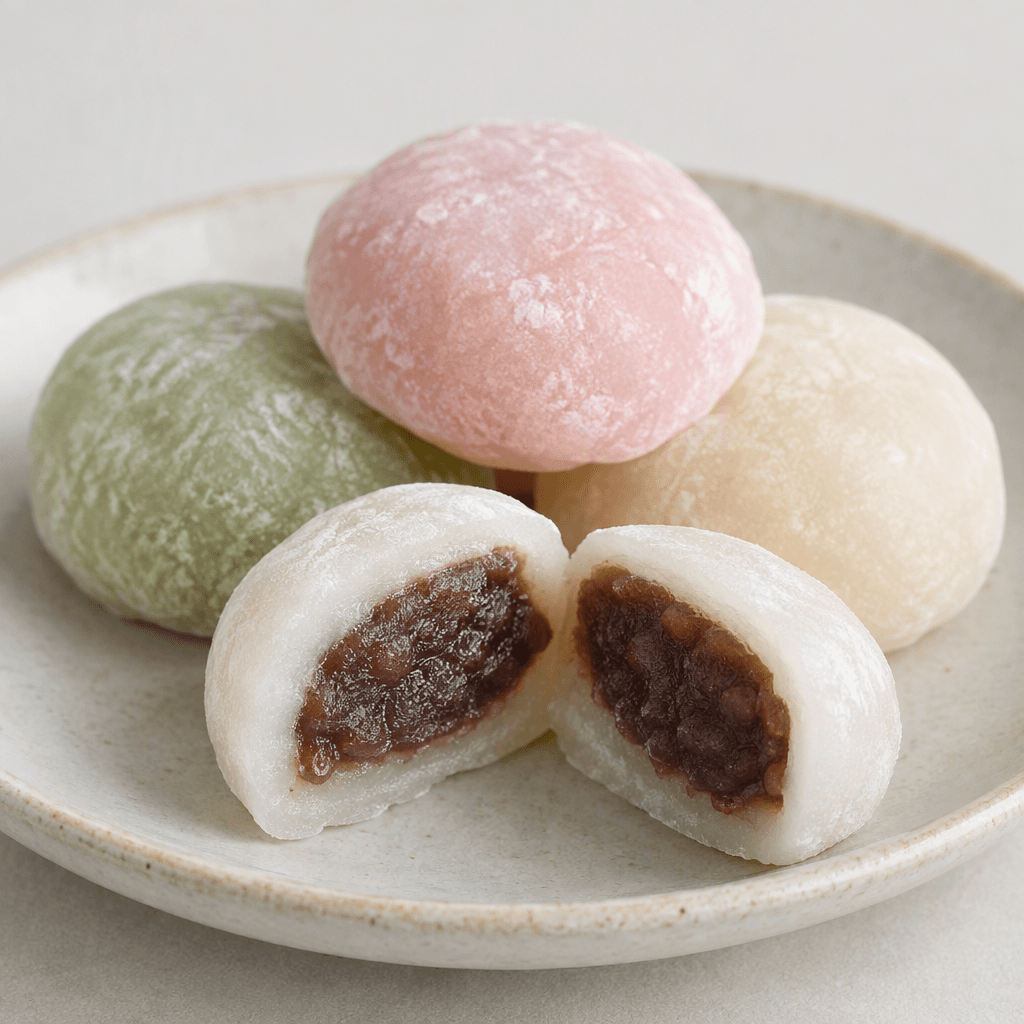
Mochi Calories
Japanese rice cake, sweet, gluten-free
In season: Winter · Spring
CALORIES
GI
POTASSIUM
FIBER
Quick answer
1 piece (medium) of Mochi (45 g) has 43 calories. That works out to 96 calories per 100 g. It contains 9.5 g of carbs, 0.8 g of protein, 0.1 g of fat and 0.3 g of fiber. Its glycemic index is 85 (high), so it raises blood sugar quickly.
What is Mochi?
Mochi is a Japanese rice cake made by pounding glutinous rice into a smooth, stretchy dough. It can be served plain or shaped around a sweet filling; daifuku, often filled with sweet red bean paste, is a familiar variation. Despite the name “glutinous rice,” the rice itself is naturally gluten-free.
Its texture is soft, chewy and slightly sticky, with a mild flavour that lets fillings such as bean paste or fruit stand out. In Japan, mochi is enjoyed as a sweet throughout the year and has a special place in New Year celebrations. Elsewhere, you may find it in Japanese shops, restaurants and cafés, and serve it with tea or coffee. It is mainly a source of carbohydrate, with little protein or fat, so a small piece works well as a sweet treat rather than a filling snack.
Mochi Nutrition Facts
Selected: 100 g
96
KCAL / 100G
Carbs
21.1g
· 8% DV
Protein
1.8g
· 4% DV
Fat
0.2g
· 0% DV
Fiber
0.6g
· 2% DV
DV is the share of the daily value covered, on a 2,000 kcal reference diet.
Calories come from: Carbs 90% · Protein 8% · Fat 2%
Mochi Vitamins & Minerals
Vitamins
B1
0.03mg · 3% DV
B2
0.01mg · 1% DV
B3
0.2mg · 1% DV
B5
0.06mg · 1% DV
Minerals
Phosphorus
28mg · 4% DV
Selenium
1.5µg · 3% DV
Magnesium
7mg · 2% DV
Calcium
6mg · 1% DV
How Nutritious Is Mochi?
Nutrient density
Low
How many vitamins, minerals and how much fiber this food carries per calorie. A high score means a lot of nutrition for few calories.
Satiety score
Medium
An EatBetter score computed from fiber, protein and calorie density. A high score means staying full longer on the same calories.
Both scores are calculated per 100 g and do not change with the selected portion. The satiety score is EatBetter's own calculation, not a clinical measure.
Mochi Glycemic Index
GLYCEMIC INDEX
GLYCEMIC LOAD
Accounts for portion size — a more realistic measure than GI alone.
How to Burn Off Mochi
To burn the 96 calories in 100 g:
🚶
Walking (5 km/h)
🏃
Running (8 km/h)
🚴
Cycling
🏊
Swimming
Times are calculated with the MET equation for a 70 kg adult. Actual burn varies with your weight, age and pace.
Is Mochi Processed?
NOVA 3
Processed
1. Unprocessed
2. Minimally Processed
3. Processed
4. Ultra-Processed
NOVA classifies foods into 4 groups by industrial processing. NOVA 1 (unprocessed) is the healthiest.
Does Mochi Contain Allergens?
No known major allergens
Which Diets Is Mochi Good For?
Vegan
✓ Suitable
Vegetarian
✓ Suitable
Gluten-Free
✓ Suitable
Dairy-Free
— Not suitable
Mediterranean
— Not suitable
Paleo
— Not suitable
Whole30
— Not suitable
DASH
— Not suitable
Keto
— Not suitable
Low FODMAP
— Not suitable
Mochi Fat Profile
SATURATED
0.04g
MONOUNSATURATED
0.03g
POLYUNSATURATED
0.02g
Compare Mochi
Foods Similar to Mochi
Frequently Asked Questions About Mochi
What is mochi?
Mochi is a Japanese rice cake made by steaming and pounding glutinous rice until it becomes soft and stretchy. It can be served plain, filled with sweet bean paste, or wrapped around ice cream; these are different styles of mochi.
How do you eat mochi?
Eat mochi in small bites and chew it thoroughly because its stretchy texture can be difficult to swallow. Plain mochi may be toasted or grilled and served with sweet or savoury toppings, while filled mochi is often eaten at room temperature.
What does mochi taste like?
Plain mochi tastes mild and slightly sweet, with a subtle rice flavour. Its signature quality is the soft, chewy texture rather than a strong taste. Fillings such as sweet bean paste or ice cream add most of the flavour.
What is mochi made of?
Traditional mochi is made from glutinous rice, which is steamed and pounded into a cohesive, stretchy cake. Despite its name, glutinous rice does not contain gluten. Some quick homemade recipes use glutinous rice flour instead of whole rice.
Is mochi the same as daifuku?
No. Mochi is the stretchy rice cake itself, while daifuku is a type of mochi usually filled with sweet bean paste or another filling. The terms are sometimes used loosely, but not every mochi is daifuku.
How is mochi made?
Traditional mochi is made by steaming glutinous rice and pounding it until the grains form a smooth, elastic mass. At home, you can make a quicker version by mixing glutinous rice flour with water and cooking it until it becomes sticky and pliable.
Why is mochi so sticky?
Mochi is sticky because glutinous rice is rich in starches that create a cohesive, elastic texture when cooked and pounded. To make fresh mochi easier to handle, dust your hands or work surface lightly with starch or use a damp knife.
How long does mochi last?
Fresh mochi dries out and hardens quickly, so keep it in an airtight container and eat it soon, or freeze it for longer storage. Ice cream mochi must stay frozen. For packaged mochi, follow the storage directions after opening.
Can you freeze mochi?
Yes, plain mochi freezes well when wrapped or stored airtight so it does not dry out or absorb freezer odours. Thaw it before eating, or warm it as directed for your recipe. Ice cream mochi should remain frozen until serving.
Can mochi cause choking?
Yes. Mochi’s dense, stretchy texture can block the throat, particularly if someone swallows a large piece without chewing well. Cut it into small bites, eat slowly, and take extra care when serving it to young children or anyone with swallowing difficulties.
Have another question about Mochi?
Ask the AI nutrition coach — calories, portions, alternatives and more, answered in seconds in the app.

Scan calories with your camera
Instant AI nutrition analysis

Nutrition data compiled from USDA FoodData Central and scientific sources.