

Ready & Packaged Foods
All →Vegetables & Legumes
All →Desserts & Confectionery
All →Meat & Protein
All →Grains & Bakery
All →Beverages
All →Milk & Dairy
All →

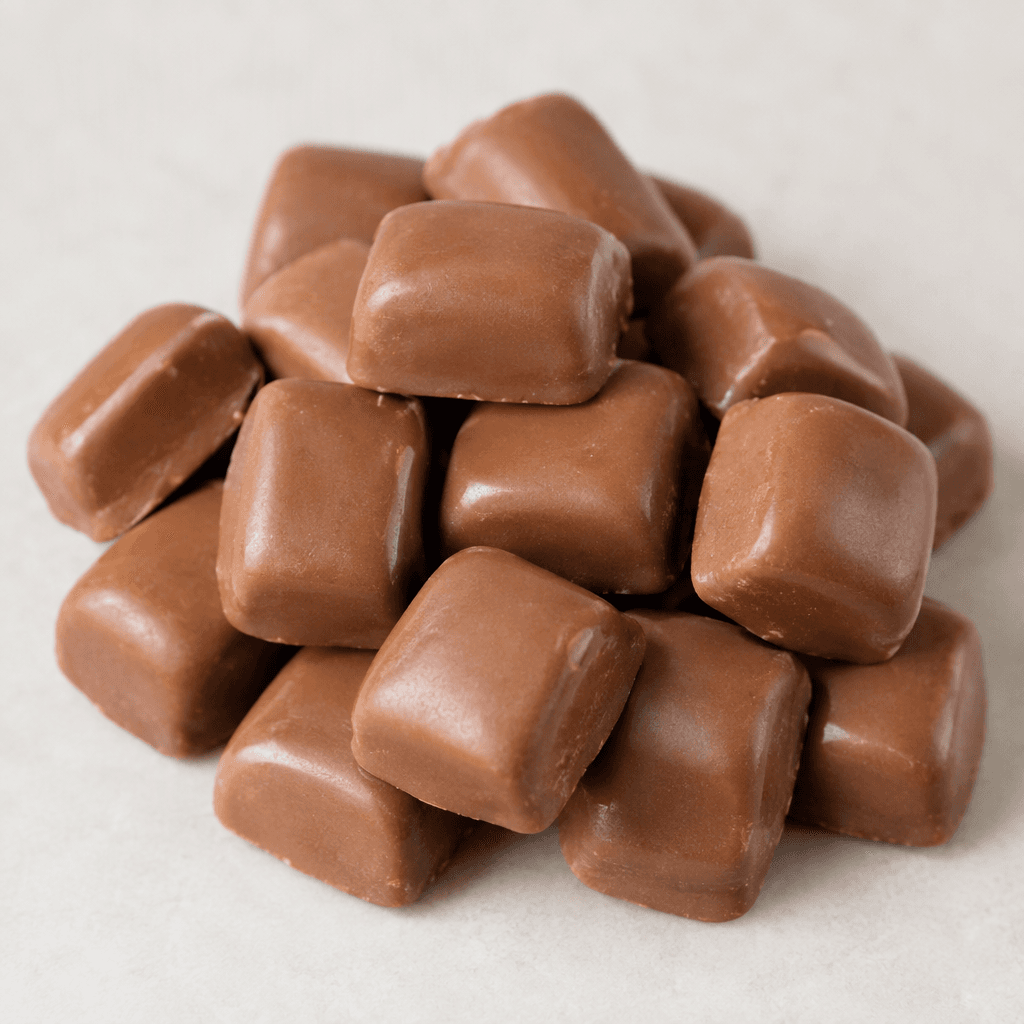
Mini milk chocolate Calories
Small portion milk chocolate, quick energy, sweet snack
In season: Spring · Summer · Autumn · Winter
CALORIES · 100 G
GI
POTASSIUM · 100 G
FIBER · 100 G
Quick answer
1 piece (mini) of Mini milk chocolate (10 g) has 54 calories. That works out to 535 calories per 100 g. It contains 5.6 g of carbs, 0.7 g of protein, 3.1 g of fat and 0.3 g of fiber. Its glycemic index is 40 (medium), so it raises blood sugar at a moderate pace.
Mini milk chocolate Nutrition Facts
Selected: 1 piece (mini) · 10 g
54
KCAL / 10G
Carbs
5.6g
· 2% DV
Protein
0.7g
· 1% DV
Fat
3.1g
· 4% DV
Fiber
0.3g
· 1% DV
DV is the share of the daily value covered, on a 2,000 kcal reference diet.
Calories come from: Carbs 42% · Protein 5% · Fat 53%
Mini milk chocolate nutrition facts table · 1 piece (mini) (10 g)
| Nutrient | Amount | % DV |
|---|---|---|
| Calories | 54 kcal | |
| Total fat | 3.1 g | 4% |
| Saturated fat | 1.9 g | 10% |
| Trans fat | 0.01 g | |
| Sodium | 8 mg | 0% |
| Total carbohydrate | 5.6 g | 2% |
| Fiber | 0.3 g | 1% |
| Protein | 0.7 g | 1% |
Calories: Calories measure energy. Average daily need is 2,000 kcal. Excess calories are stored as fat, too few cause weight loss.
Carbs: Your body's primary energy source. The brain runs exclusively on carbs. Daily need: 275g.
Protein: Essential for muscle repair and cell growth. Daily need: 50g. Keeps you full and boosts metabolism.
Fat: Needed for hormone production and vitamin absorption. Daily need: 78g. Limit saturated fats, choose unsaturated.
Fiber: Critical for digestive health and satiety. Daily need: 28g. Stabilizes blood sugar, lowers cholesterol.

Log this food in EatBetter
100,000+ people use it
- Get your daily calorie target
- Snap your meal, log it in seconds
- See every vitamin and mineral

📸 Scan the code to get the app free.

How Many Calories in 1 Mini milk chocolate?
| Serving | Amount | Calories |
|---|---|---|
| 1 piece (mini) | 10 g | 54 kcal |
| 1 piece (small) | 15 g | 80 kcal |
| 2 piece (mini) | 20 g | 107 kcal |
| 1 piece (medium) | 20 g | 107 kcal |
| 1 serving (mini) | 25 g | 134 kcal |
| 1 piece (large) | 30 g | 161 kcal |
| 1 pack (mini) | 40 g | 214 kcal |
| 5 piece (mini) | 50 g | 268 kcal |
| 100 g | 100 g | 535 kcal |
Calculated from 535 calories per 100 g.
Frequently Asked Questions About Mini milk chocolate
Can dogs eat Mini milk chocolate?
No, dogs should not eat Mini milk chocolate. Cocoa contains theobromine, which dogs cannot process safely, and chocolate can cause poisoning; contact a veterinarian promptly if your dog has eaten some, especially if you do not know how much.
Is Mini milk chocolate bad for you?
Mini milk chocolate is fine as an occasional treat for most people, but it is not a nutritious everyday snack. Its sugar and saturated fat make frequent or large servings less suitable than fruit or other everyday snacks.
Does Mini milk chocolate contain caffeine?
Yes, Mini milk chocolate contains some caffeine from cocoa, though generally less than a comparable dark chocolate. The amount varies by product, so people who are particularly sensitive to caffeine may prefer not to eat it close to bedtime.
Why does Mini milk chocolate turn white?
A pale coating on Mini milk chocolate is usually fat bloom or sugar bloom, caused by temperature changes or moisture. It can affect the chocolate’s appearance and texture, but the coating alone does not mean it has spoiled.
How should you store Mini milk chocolate?
Store Mini milk chocolate in a cool, dry place away from sunlight and strong smells, with its packaging sealed. A steady temperature helps prevent melting and bloom; avoid leaving it in a warm car or beside an oven.
Can you keep Mini milk chocolate in the fridge?
You usually do not need to refrigerate Mini milk chocolate; a cool, dry cupboard is preferable. If the room is very warm, seal it well before chilling, then let it reach room temperature while still wrapped to limit condensation.
How do you melt Mini milk chocolate without burning it?
Melt Mini milk chocolate gently in a dry bowl over barely simmering water, stirring as it softens. Keep water and steam out of the chocolate, and avoid high direct heat because milk chocolate can scorch or turn grainy quickly.
Can Mini milk chocolate be used for baking?
Yes, Mini milk chocolate can be chopped into cookies, brownies, or cake batter. It melts into sweeter, creamier pockets than dark chocolate, so consider reducing the recipe’s added sugar to keep the finished bake from becoming overly sweet.
Is Mini milk chocolate the same as dark chocolate?
No, Mini milk chocolate contains milk ingredients and is generally sweeter and creamier, while dark chocolate has a higher proportion of cocoa ingredients and no milk in many varieties. Their flavor and melting behavior differ, so they are not always interchangeable in recipes.
Can children have Mini milk chocolate?
Yes, children can have Mini milk chocolate as an occasional small treat, but it should not replace regular meals or everyday snacks. For young children, consider the piece size and their ability to chew safely, and encourage tooth-brushing after sweets.
Mini milk chocolate Vitamins & Minerals
Vitamins
B12
0.07µg · 3% DV
B2
0.03mg · 2% DV
B5
0.06mg · 1% DV
Vitamin E
0.15mg · 1% DV
Minerals
Copper
0.03mg · 3% DV
Phosphorus
21mg · 3% DV
Calcium
22mg · 2% DV
Zinc
0.2mg · 2% DV
Potassium ⭐
33mg · 1% DV
Sodium
8mg · 0% DV
Mini milk chocolate Glycemic Index
GLYCEMIC INDEX
GLYCEMIC LOAD
Accounts for portion size — a more realistic measure than GI alone.
How to Burn Off Mini milk chocolate
To burn the 54 calories in 1 piece (mini) (10 g):
🚶
Walking (5 km/h)
🏃
Running (8 km/h)
🚴
Cycling
🏊
Swimming
Times are calculated with the MET equation for a 70 kg adult. Actual burn varies with your weight, age and pace.
What is Mini milk chocolate?
Mini milk chocolate is milk chocolate made with cocoa ingredients, milk and sugar, shaped into small portions. It is usually enjoyed as a quick sweet snack; one mini piece is typically about 10 g.
Its smooth, creamy texture and sweet flavour make it an easy treat alongside coffee or tea, or as a small dessert after a meal. Like other milk chocolate, it is energy-dense: the provided value is 535 kcal per 100 g, so the small format can help with portioning. Pair it with fruit or a few plain nuts if you want a more sustaining snack.
How Nutritious Is Mini milk chocolate?
Nutrient density
Low
How many vitamins, minerals and how much fiber this food carries per calorie. A high score means a lot of nutrition for few calories.
Satiety score
Low
An EatBetter score computed from fiber, protein and calorie density. A high score means staying full longer on the same calories.
Both scores are calculated per 100 g and do not change with the selected portion. The satiety score is EatBetter's own calculation, not a clinical measure.
Is Mini milk chocolate Processed?
NOVA 3
Processed
1. Unprocessed
2. Minimally Processed
3. Processed
4. Ultra-Processed
NOVA classifies foods into 4 groups by industrial processing. NOVA 1 (unprocessed) is the healthiest.
Does Mini milk chocolate Contain Allergens?
Contains these allergens:
Which Diets Is Mini milk chocolate Good For?
Vegan
— Not suitable
Vegetarian
✓ Suitable
Gluten-Free
— Not suitable
Dairy-Free
— Not suitable
Mediterranean
— Not suitable
Paleo
— Not suitable
Whole30
— Not suitable
DASH
— Not suitable
Keto
— Not suitable
Low FODMAP
— Not suitable
Mini milk chocolate Fat Profile
SATURATED
1.9g
MONOUNSATURATED
0.9g
POLYUNSATURATED
0.1g
Compare Mini milk chocolate
Foods Similar to Mini milk chocolate
Have another question about Mini milk chocolate?
Ask the AI nutrition coach — calories, portions, alternatives and more, answered in seconds in the app.

Scan calories with your camera
Instant AI nutrition analysis

Nutrition data compiled from USDA FoodData Central and scientific sources.