

Ready & Packaged Foods
All →Vegetables & Legumes
All →Desserts & Confectionery
All →Meat & Protein
All →Grains & Bakery
All →Beverages
All →Milk & Dairy
All →

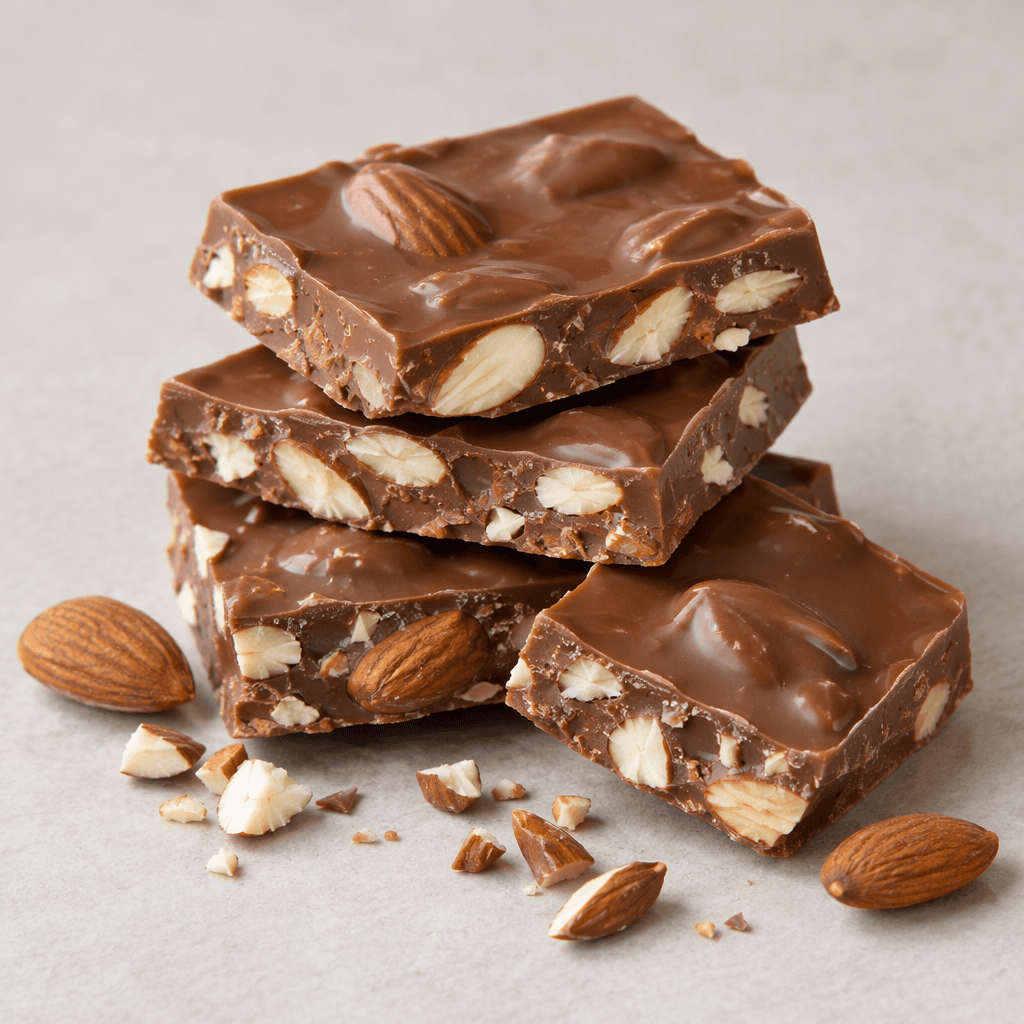
Milk Chocolate with Almonds Calories
Milk chocolate with almonds, source of energy and magnesium
In season: Winter · Spring · Summer · Autumn
CALORIES
GI
POTASSIUM
FIBER
Quick answer
1 piece (medium) of Milk Chocolate with Almonds (30 g) has 162 calories. That works out to 540 calories per 100 g. It contains 14.4 g of carbs, 2.6 g of protein, 10.2 g of fat and 1.6 g of fiber. Its 0.1 mg of Copper covers 12% of the Daily Value. Its glycemic index is 45 (medium), so it raises blood sugar at a moderate pace.
What is Milk Chocolate with Almonds?
Milk Chocolate with Almonds combines sweet, creamy milk chocolate with whole or chopped almonds. It is a widely made chocolate confection rather than a dish tied to one particular place. The chocolate melts smoothly, while the almonds bring a crisp, nutty contrast.
Enjoy it as a small treat with coffee or tea, break off a piece for an afternoon snack, or serve it alongside fruit after a meal. It is energy-dense, with much of its energy coming from the chocolate’s fat and carbohydrate; the almonds contribute some protein and fibre. If you’d like a lighter snack, keep the portion modest and pair a piece with fresh fruit.
Milk Chocolate with Almonds Nutrition Facts
Selected: 100 g
540
KCAL / 100G
Carbs
48g
· 17% DV
Protein
8.5g
· 17% DV
Fat
34g
· 44% DV
Fiber
5.2g
· 19% DV
DV is the share of the daily value covered, on a 2,000 kcal reference diet.
Calories come from: Carbs 36% · Protein 6% · Fat 58%
Milk Chocolate with Almonds Vitamins & Minerals
Vitamins
B12
0.7µg · 29% DV
B2
0.32mg · 25% DV
Biotin
6µg · 20% DV
Vitamin E
2.6mg · 17% DV
Minerals
Manganese
1mg · 43% DV
Phosphorus
210mg · 30% DV
Magnesium
85mg · 20% DV
Calcium
180mg · 18% DV
How Nutritious Is Milk Chocolate with Almonds?
Nutrient density
Medium
How many vitamins, minerals and how much fiber this food carries per calorie. A high score means a lot of nutrition for few calories.
Satiety score
Medium
An EatBetter score computed from fiber, protein and calorie density. A high score means staying full longer on the same calories.
Both scores are calculated per 100 g and do not change with the selected portion. The satiety score is EatBetter's own calculation, not a clinical measure.
Milk Chocolate with Almonds Glycemic Index
GLYCEMIC INDEX
GLYCEMIC LOAD
Accounts for portion size — a more realistic measure than GI alone.
How to Burn Off Milk Chocolate with Almonds
To burn the 540 calories in 100 g:
🚶
Walking (5 km/h)
🏃
Running (8 km/h)
🚴
Cycling
🏊
Swimming
Times are calculated with the MET equation for a 70 kg adult. Actual burn varies with your weight, age and pace.
Is Milk Chocolate with Almonds Processed?
NOVA 3
Processed
1. Unprocessed
2. Minimally Processed
3. Processed
4. Ultra-Processed
NOVA classifies foods into 4 groups by industrial processing. NOVA 1 (unprocessed) is the healthiest.
Does Milk Chocolate with Almonds Contain Allergens?
Contains these allergens:
Which Diets Is Milk Chocolate with Almonds Good For?
Vegan
— Not suitable
Vegetarian
✓ Suitable
Gluten-Free
— Not suitable
Dairy-Free
— Not suitable
Mediterranean
✓ Suitable
Paleo
— Not suitable
Whole30
— Not suitable
DASH
— Not suitable
Keto
— Not suitable
Low FODMAP
— Not suitable
Milk Chocolate with Almonds Fat Profile
SATURATED
15.5g
MONOUNSATURATED
13.2g
POLYUNSATURATED
3.4g
Omega 6:3 ratio 53.3:1
Above the ideal 4:1 (53.3:1).
Compare Milk Chocolate with Almonds
Foods Similar to Milk Chocolate with Almonds
Frequently Asked Questions About Milk Chocolate with Almonds
Is milk chocolate with almonds healthy?
Milk chocolate with almonds can provide some nutrients from cocoa, milk, and nuts, but it is still a sweet treat rather than a health food. Enjoying a modest portion occasionally is more sensible than treating it as a daily source of nutrients.
Does milk chocolate with almonds contain caffeine?
Yes, milk chocolate with almonds contains a small amount of caffeine from cocoa, along with theobromine. It generally has less caffeine than coffee, but people who are very sensitive to stimulants may prefer not to eat it close to bedtime.
How is milk chocolate with almonds made?
Milk chocolate with almonds is made by mixing whole or chopped almonds into melted milk chocolate, then shaping and cooling the mixture. Commercial bars may use different almond sizes and chocolate formulations, so the crunch and sweetness vary by brand.
Why does milk chocolate with almonds turn white?
A whitish film on milk chocolate with almonds is usually fat bloom or sugar bloom caused by temperature changes or moisture. It is generally a quality issue rather than a sign of spoilage, though the chocolate may taste or feel different.
Should you refrigerate milk chocolate with almonds?
Usually, no: store milk chocolate with almonds in a cool, dry place away from sunlight and strong-smelling foods. Refrigeration can expose it to moisture and odors; if heat makes chilling necessary, seal it in an airtight container.
How do you melt milk chocolate with almonds without burning it?
Melt milk chocolate with almonds slowly over a double boiler, stirring gently and keeping water out of the bowl. Because milk chocolate scorches easily, use low heat; for a microwave, heat briefly in intervals and stir between them.
Can you freeze milk chocolate with almonds?
Yes, you can freeze milk chocolate with almonds if you protect it from moisture and odors in an airtight, freezer-safe package. Thaw it while still wrapped so condensation forms on the packaging rather than on the chocolate.
How can you tell if milk chocolate with almonds has gone bad?
Discard milk chocolate with almonds if it has mold, an unusual sour smell, or a distinctly rancid or unpleasant taste. A pale surface bloom alone is commonly caused by storage conditions and does not necessarily mean the chocolate is unsafe.
Can dogs eat milk chocolate with almonds?
No, do not give dogs milk chocolate with almonds. Chocolate contains theobromine, which can poison dogs, and the danger depends on the amount eaten and the dog's size; contact a veterinarian promptly if your dog gets into it.
Does milk chocolate with almonds keep you awake?
It can affect sleep in people who are sensitive to caffeine or theobromine, although it contains much less caffeine than coffee. If you notice that chocolate disrupts your sleep, avoid eating milk chocolate with almonds near bedtime.
Have another question about Milk Chocolate with Almonds?
Ask the AI nutrition coach — calories, portions, alternatives and more, answered in seconds in the app.

Scan calories with your camera
Instant AI nutrition analysis

Nutrition data compiled from USDA FoodData Central and scientific sources.