

Ready & Packaged Foods
All →Vegetables & Legumes
All →Desserts & Confectionery
All →Meat & Protein
All →Grains & Bakery
All →Beverages
All →Milk & Dairy
All →

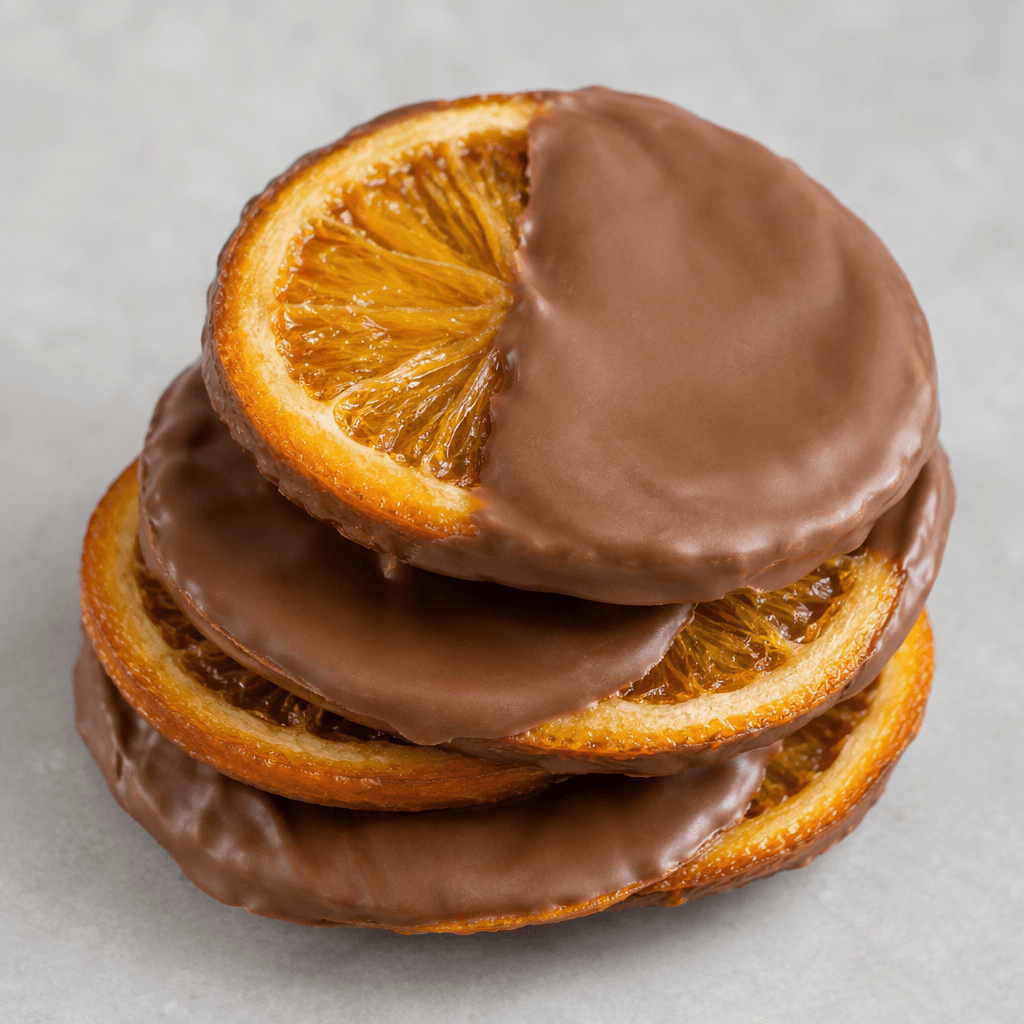
Milk chocolate covered dried orange Calories
Dried orange slices, milk chocolate coating, sweet and fruity snack
In season: Winter
CALORIES
GI
POTASSIUM
FIBER
Quick answer
3 piece (medium) of Milk chocolate covered dried orange (30 g) has 123 calories. That works out to 410 calories per 100 g. It contains 20.1 g of carbs, 1.2 g of protein, 4.4 g of fat and 1.6 g of fiber. Its 5.7 mg of Vitamin C covers 6% of the Daily Value. Its glycemic index is 55 (medium), so it raises blood sugar at a moderate pace.
What is Milk chocolate covered dried orange?
Milk chocolate covered dried orange is a confection made by drying orange slices and coating them in milk chocolate. It is less a traditional dish tied to one place than a sweet snack that brings together the fruit’s tang and the chocolate’s creamy sweetness.
The orange is chewy and concentrated, while the coating adds a smooth, sweet bite. Enjoy it with coffee or tea, serve it on a dessert platter, or offer a few pieces after a meal. It is energy- and carbohydrate-rich, with some fibre from the orange and relatively little protein. For a modest treat, a serving of about 30 g—roughly three medium pieces—works well; unsweetened tea or coffee makes a good pairing.
Milk chocolate covered dried orange Nutrition Facts
Selected: 100 g
410
KCAL / 100G
Carbs
67g
· 24% DV
Protein
4.1g
· 8% DV
Fat
14.5g
· 19% DV
Fiber
5.2g
· 19% DV
DV is the share of the daily value covered, on a 2,000 kcal reference diet.
Calories come from: Carbs 65% · Protein 4% · Fat 31%
Milk chocolate covered dried orange Vitamins & Minerals
Vitamins
Vitamin C
19mg · 21% DV
B2
0.14mg · 11% DV
B5
0.38mg · 8% DV
B12
0.2µg · 8% DV
Minerals
Phosphorus
68mg · 10% DV
Potassium ⭐
330mg · 10% DV
Magnesium
38mg · 9% DV
Zinc
1mg · 9% DV
How Nutritious Is Milk chocolate covered dried orange?
Nutrient density
Low
How many vitamins, minerals and how much fiber this food carries per calorie. A high score means a lot of nutrition for few calories.
Satiety score
Low
An EatBetter score computed from fiber, protein and calorie density. A high score means staying full longer on the same calories.
Both scores are calculated per 100 g and do not change with the selected portion. The satiety score is EatBetter's own calculation, not a clinical measure.
Milk chocolate covered dried orange Glycemic Index
GLYCEMIC INDEX
GLYCEMIC LOAD
Accounts for portion size — a more realistic measure than GI alone.
How to Burn Off Milk chocolate covered dried orange
To burn the 410 calories in 100 g:
🚶
Walking (5 km/h)
🏃
Running (8 km/h)
🚴
Cycling
🏊
Swimming
Times are calculated with the MET equation for a 70 kg adult. Actual burn varies with your weight, age and pace.
Is Milk chocolate covered dried orange Processed?
NOVA 3
Processed
1. Unprocessed
2. Minimally Processed
3. Processed
4. Ultra-Processed
NOVA classifies foods into 4 groups by industrial processing. NOVA 1 (unprocessed) is the healthiest.
Does Milk chocolate covered dried orange Contain Allergens?
Contains these allergens:
Which Diets Is Milk chocolate covered dried orange Good For?
Vegan
— Not suitable
Vegetarian
✓ Suitable
Gluten-Free
— Not suitable
Dairy-Free
— Not suitable
Mediterranean
— Not suitable
Paleo
— Not suitable
Whole30
— Not suitable
DASH
— Not suitable
Keto
— Not suitable
Low FODMAP
— Not suitable
Milk chocolate covered dried orange Fat Profile
SATURATED
8.3g
MONOUNSATURATED
4.2g
POLYUNSATURATED
1.1g
Omega 6:3 ratio 9.5:1
Above the ideal 4:1 (9.5:1).
Compare Milk chocolate covered dried orange
Foods Similar to Milk chocolate covered dried orange
Frequently Asked Questions About Milk chocolate covered dried orange
What does milk chocolate-covered dried orange taste like?
Milk chocolate-covered dried orange tastes sweet, fruity, and slightly tangy, with a chewy or firm bite depending on how the orange was dried. The peel can add a pleasantly bitter note beneath the milky chocolate coating.
Is milk chocolate-covered dried orange the same as chocolate-covered candied orange?
No, milk chocolate-covered dried orange is not necessarily the same as chocolate-covered candied orange. Dried orange loses moisture, while candied orange is cooked in sugar syrup and tends to be softer, stickier, and sweeter.
Can you make milk chocolate-covered dried orange with fresh orange slices?
Yes, you can dip fresh orange pieces in chocolate, but they will be juicy rather than chewy and will not keep like milk chocolate-covered dried orange. Dry the fruit’s surface first, and refrigerate the fresh version.
Does chocolate for milk chocolate-covered dried orange need to be tempered?
Tempering helps the chocolate on milk chocolate-covered dried orange set with a smooth finish and a firm snap. If you skip tempering, the coating may still harden, but it can look dull or soften more easily at room temperature.
Why does the chocolate fall off milk chocolate-covered dried orange?
The coating can fall off milk chocolate-covered dried orange when the fruit is damp, oily, or coated unevenly. Make sure the slices are fully dry and dip them in a thin, continuous layer of chocolate.
How should you store milk chocolate-covered dried orange?
Store milk chocolate-covered dried orange in an airtight container in a cool, dry place, away from sunlight and heat. Refrigeration can help in a warm climate, but keep the container sealed to limit condensation and absorbed odors.
Can you freeze milk chocolate-covered dried orange?
Yes, milk chocolate-covered dried orange can be frozen in a sealed, freezer-safe container. Let it come to room temperature while still sealed before serving, so condensation forms on the container rather than on the chocolate.
Why does milk chocolate-covered dried orange get a white coating?
A white film on milk chocolate-covered dried orange is often chocolate bloom, caused by cocoa butter or sugar moving to the surface after temperature or moisture changes. Bloom affects appearance and texture, but is not automatically a sign of spoilage.
What can you serve with milk chocolate-covered dried orange?
Serve milk chocolate-covered dried orange with coffee, black tea, or a cheese board for a sweet, citrusy contrast. It also works as a small dessert garnish, especially alongside plain yogurt or other unsweetened accompaniments.
Can dogs eat milk chocolate-covered dried orange?
No, do not give dogs milk chocolate-covered dried orange. Chocolate contains theobromine, which is toxic to dogs, and the sugary treat is not suitable for them; contact a veterinarian promptly if your dog eats some.
Have another question about Milk chocolate covered dried orange?
Ask the AI nutrition coach — calories, portions, alternatives and more, answered in seconds in the app.

Scan calories with your camera
Instant AI nutrition analysis

Nutrition data compiled from USDA FoodData Central and scientific sources.