

Ready & Packaged Foods
All →Vegetables & Legumes
All →Desserts & Confectionery
All →Meat & Protein
All →Grains & Bakery
All →Beverages
All →Milk & Dairy
All →

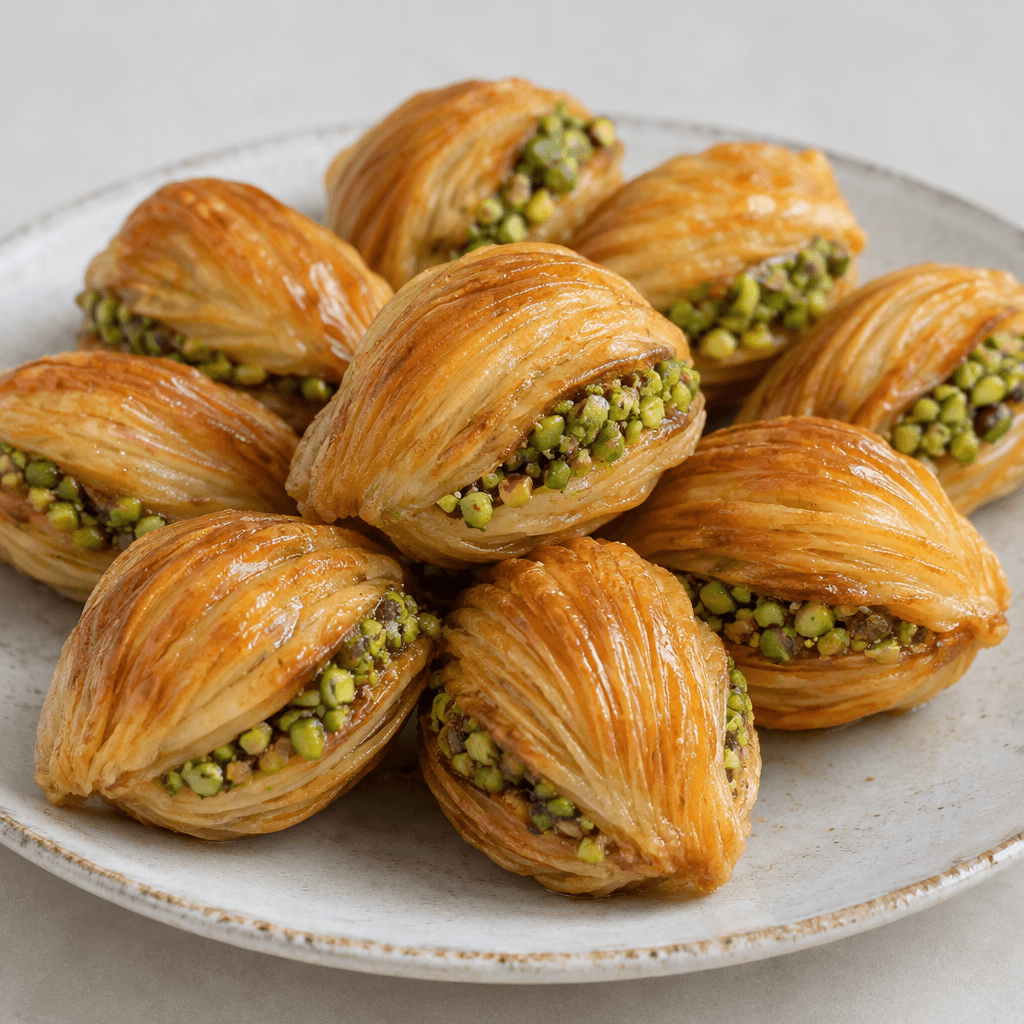
Midye Baklava Calories
Traditional Turkish dessert with layers of pastry, pistachio, and syrup
In season: Spring · Summer · Autumn · Winter
CALORIES
GI
POTASSIUM
FIBER
Quick answer
1 piece (medium) of Midye Baklava (45 g) has 185 calories. That works out to 410 calories per 100 g. It contains 24.1 g of carbs, 2.7 g of protein, 8.6 g of fat and 1 g of fiber. Its 0.1 mg of Copper covers 12% of the Daily Value. Its glycemic index is 65 (high), so it raises blood sugar quickly.
What is Midye Baklava?
Midye baklava is a Turkish syrup-soaked pastry made from thin layers of filo folded into a ridged, shell-like shape and filled with pistachios. Despite its name, it contains no mussels; the name refers to its resemblance to a mussel shell.
The pastry is crisp at the edges, tender inside, and rich with nutty filling and sweet syrup. In Turkey it is commonly offered after a meal or alongside tea when welcoming guests; elsewhere, it works well as a small dessert with coffee or tea. Filo, fat and syrup make it an energy-dense sweet, while pistachios give it its distinctive flavour. A single piece is satisfying, so serve it in modest portions if you prefer a lighter treat.
Midye Baklava Nutrition Facts
Selected: 100 g
410
KCAL / 100G
Carbs
53.5g
· 19% DV
Protein
6.1g
· 12% DV
Fat
19.2g
· 25% DV
Fiber
2.2g
· 8% DV
DV is the share of the daily value covered, on a 2,000 kcal reference diet.
Calories come from: Carbs 52% · Protein 6% · Fat 42%
Midye Baklava Vitamins & Minerals
Vitamins
Vitamin E
1.5mg · 10% DV
B1
0.09mg · 8% DV
B2
0.11mg · 8% DV
B5
0.35mg · 7% DV
Minerals
Zinc
1mg · 9% DV
Phosphorus
62mg · 9% DV
Iron
1mg · 6% DV
Magnesium
27mg · 6% DV
How Nutritious Is Midye Baklava?
Nutrient density
Low
How many vitamins, minerals and how much fiber this food carries per calorie. A high score means a lot of nutrition for few calories.
Satiety score
Low
An EatBetter score computed from fiber, protein and calorie density. A high score means staying full longer on the same calories.
Both scores are calculated per 100 g and do not change with the selected portion. The satiety score is EatBetter's own calculation, not a clinical measure.
Midye Baklava Glycemic Index
GLYCEMIC INDEX
GLYCEMIC LOAD
Accounts for portion size — a more realistic measure than GI alone.
How to Burn Off Midye Baklava
To burn the 410 calories in 100 g:
🚶
Walking (5 km/h)
🏃
Running (8 km/h)
🚴
Cycling
🏊
Swimming
Times are calculated with the MET equation for a 70 kg adult. Actual burn varies with your weight, age and pace.
Is Midye Baklava Processed?
NOVA 3
Processed
1. Unprocessed
2. Minimally Processed
3. Processed
4. Ultra-Processed
NOVA classifies foods into 4 groups by industrial processing. NOVA 1 (unprocessed) is the healthiest.
Does Midye Baklava Contain Allergens?
Contains these allergens:
Which Diets Is Midye Baklava Good For?
Vegan
— Not suitable
Vegetarian
— Not suitable
Gluten-Free
— Not suitable
Dairy-Free
— Not suitable
Mediterranean
✓ Suitable
Paleo
— Not suitable
Whole30
— Not suitable
DASH
— Not suitable
Keto
— Not suitable
Low FODMAP
— Not suitable
Midye Baklava Fat Profile
SATURATED
7.2g
MONOUNSATURATED
7.8g
POLYUNSATURATED
2.1g
Omega 6:3 ratio 20:1
Above the ideal 4:1 (20:1).
Compare Midye Baklava
Foods Similar to Midye Baklava
Frequently Asked Questions About Midye Baklava
What is Midye Baklava?
Midye Baklava is a Turkish syrup-soaked pastry shaped to resemble a mussel shell, usually with pistachio filling. Thin layers of pastry bake into a ridged exterior, while the filling shows through the opening.
Is there actually mussel in Midye Baklava?
No, Midye Baklava does not contain mussel. “Midye” means mussel in Turkish, but the name describes the pastry’s shell-like shape; the traditional filling is usually pistachio.
How is Midye Baklava different from regular baklava?
Midye Baklava is folded into individual shell-shaped pastries, with filling tucked inside and often visible at the opening. Traditional baklava is more commonly assembled in a flat tray and cut into squares, diamonds, or other pieces.
How is Midye Baklava made?
Midye Baklava is made by layering and buttering thin pastry, folding it into a ridged shell shape, and adding pistachio filling. It is baked until golden, then soaked with syrup; careful folding gives each piece its distinctive shape.
What filling is used in Midye Baklava?
Pistachio is the classic filling for Midye Baklava, especially in Turkish pastry shops. Some versions may use a different nut or filling, but pistachio is what gives the familiar green center and rich, nutty flavor.
Should Midye Baklava be served warm or cold?
Midye Baklava is usually served at room temperature rather than piping hot. This lets the syrup settle into the pastry and makes the layers easier to enjoy; it is often offered with Turkish coffee or tea.
How do you keep Midye Baklava crisp?
Keep Midye Baklava in a covered container in a cool, dry place, away from steam and direct sunlight. Refrigeration can make its pastry lose crispness, so store it at room temperature unless the room is very warm.
How long does Midye Baklava keep?
Midye Baklava is best eaten while its pastry is still crisp, and it generally keeps for a few days in a sealed container at room temperature. Moisture and heat can soften the layers, so keep it somewhere cool and dry.
Can you freeze Midye Baklava?
Yes, Midye Baklava can be frozen in an airtight container, although its pastry may be less crisp after thawing. Defrost it at room temperature before serving, and avoid freezing it again once thawed.
Can people with diabetes eat Midye Baklava?
People with diabetes can include Midye Baklava only if it fits their individual blood-sugar and meal plan; its syrup makes it a sugary dessert. Anyone managing diabetes or taking glucose-lowering medication should ask their clinician or dietitian about a suitable portion.
Have another question about Midye Baklava?
Ask the AI nutrition coach — calories, portions, alternatives and more, answered in seconds in the app.

Scan calories with your camera
Instant AI nutrition analysis

Nutrition data compiled from USDA FoodData Central and scientific sources.