

Ready & Packaged Foods
All →Vegetables & Legumes
All →Desserts & Confectionery
All →Meat & Protein
All →Grains & Bakery
All →Beverages
All →Milk & Dairy
All →

Meze Calories
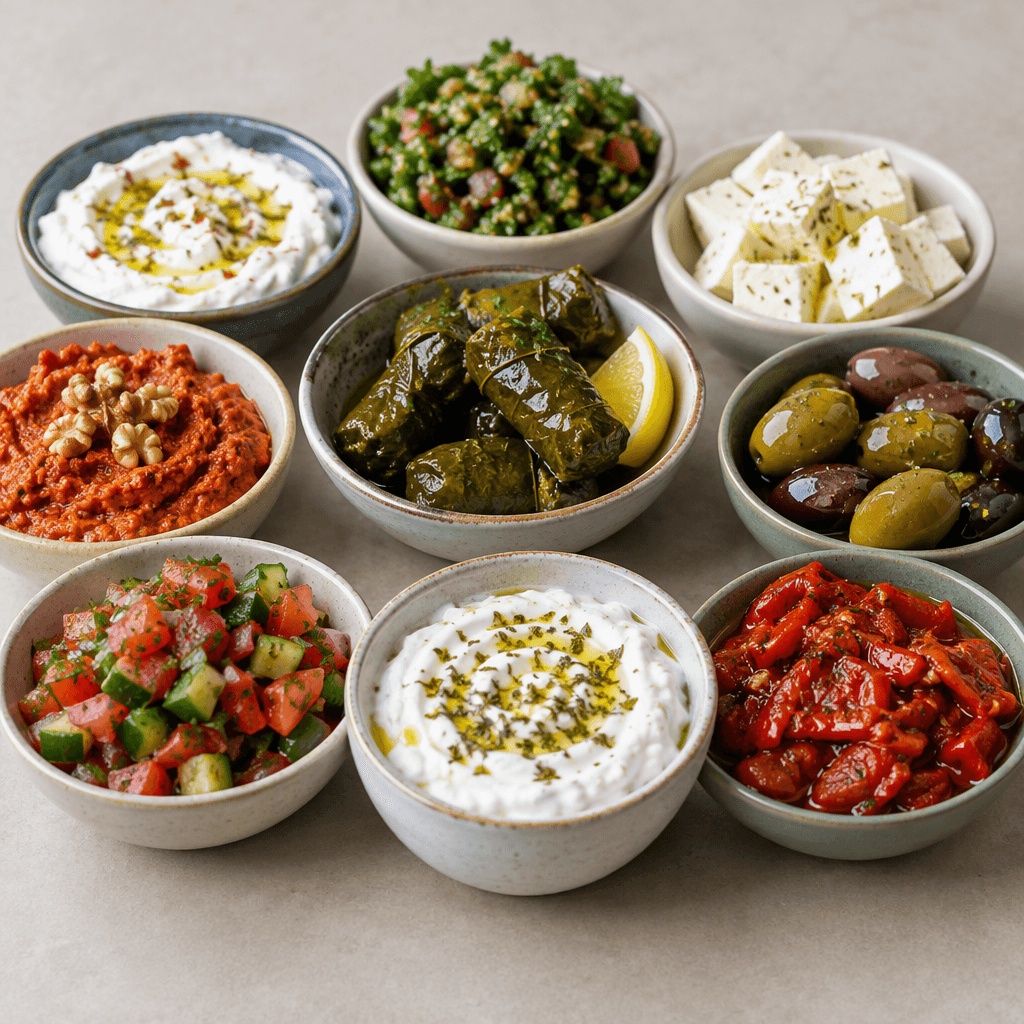
Assorted cold and hot small plates, Mediterranean and Middle Eastern cuisine
In season: Spring · Summer · Autumn · Winter
CALORIES
GI
POTASSIUM
FIBER
Quick answer
1 serving (medium) of Meze (80 g) has 96 calories. That works out to 120 calories per 100 g. It contains 8 g of carbs, 2.8 g of protein, 5.6 g of fat and 2 g of fiber. Its 14.4 µg of Vitamin K covers 12% of the Daily Value. Its glycemic index is 40 (low), so it raises blood sugar slowly.
What is Meze?
Meze is a spread of small hot and cold dishes, especially associated with Turkish cuisine and the wider eastern Mediterranean and Middle East. A table might include vegetable and herb salads, pepper pastes, creamy dips, olives or cheese; the exact selection varies by place and season.
Meze is usually served for sharing before or alongside a meal, with bread to scoop up dips. In Turkey it is a familiar feature of leisurely evening meals and rakı tables; elsewhere, it also works well as a casual starter or part of a shared dinner. Its nutritional profile depends on the mix: vegetable- and legume-based plates bring fibre, while oil-rich dips and cheese make the spread more filling. For a lighter selection, choose more vegetables and beans and serve bread on the side.
Meze Nutrition Facts
Selected: 100 g
120
KCAL / 100G
Carbs
10g
· 4% DV
Protein
3.5g
· 7% DV
Fat
7g
· 9% DV
Fiber
2.5g
· 9% DV
DV is the share of the daily value covered, on a 2,000 kcal reference diet.
Calories come from: Carbs 34% · Protein 12% · Fat 54%
Meze Vitamins & Minerals
Vitamins
Vitamin K
18µg · 15% DV
Vitamin E
1.5mg · 10% DV
Biotin
2.5µg · 8% DV
Vitamin C
7mg · 8% DV
Minerals
Sodium
340mg · 15% DV
Calcium
55mg · 6% DV
Iron
1mg · 6% DV
Magnesium
22mg · 5% DV
How Nutritious Is Meze?
Nutrient density
Medium
How many vitamins, minerals and how much fiber this food carries per calorie. A high score means a lot of nutrition for few calories.
Satiety score
Medium
An EatBetter score computed from fiber, protein and calorie density. A high score means staying full longer on the same calories.
Both scores are calculated per 100 g and do not change with the selected portion. The satiety score is EatBetter's own calculation, not a clinical measure.
Meze Glycemic Index
GLYCEMIC INDEX
GLYCEMIC LOAD
Accounts for portion size — a more realistic measure than GI alone.
How to Burn Off Meze
To burn the 120 calories in 100 g:
🚶
Walking (5 km/h)
🏃
Running (8 km/h)
🚴
Cycling
🏊
Swimming
Times are calculated with the MET equation for a 70 kg adult. Actual burn varies with your weight, age and pace.
Is Meze Processed?
NOVA 3
Processed
1. Unprocessed
2. Minimally Processed
3. Processed
4. Ultra-Processed
NOVA classifies foods into 4 groups by industrial processing. NOVA 1 (unprocessed) is the healthiest.
Does Meze Contain Allergens?
No known major allergens
Which Diets Is Meze Good For?
Vegan
✓ Suitable
Vegetarian
✓ Suitable
Gluten-Free
— Not suitable
Dairy-Free
— Not suitable
Mediterranean
✓ Suitable
Paleo
— Not suitable
Whole30
— Not suitable
DASH
— Not suitable
Keto
— Not suitable
Low FODMAP
— Not suitable
Meze Fat Profile
SATURATED
1.2g
MONOUNSATURATED
3.2g
POLYUNSATURATED
1.1g
Omega 6:3 ratio 8:1
Above the ideal 4:1 (8:1).
Compare Meze
Foods Similar to Meze
Frequently Asked Questions About Meze
What is Meze?
Meze is a collection of small dishes served for sharing, often before or alongside a main meal. Turkish meze can include vegetable dishes, dips, salads, seafood, and cheese, served either cold or hot.
What is usually included in a Meze platter?
A Meze platter usually mixes dips, vegetables, and bread rather than following one fixed recipe. A Turkish spread might include hummus, ezme, stuffed vine leaves, olives, cheese, and a yogurt-based dip; the selection varies by region and occasion.
Is Meze Turkish or Greek?
Meze is part of both Turkish and Greek food traditions, as well as cuisines across the eastern Mediterranean and Middle East. The dishes and serving customs overlap, but names, recipes, and local favorites differ from one country to another.
How do you eat Meze?
Meze is usually shared from small plates, with diners taking portions onto their own plates or eating a bite with bread. At a Turkish meal, several meze may be served together before the main course or enjoyed as the meal itself.
What is the difference between Meze and tapas?
Meze and tapas are both small dishes shared at the table, but they come from different food traditions. Meze commonly features eastern Mediterranean dips, vegetables, and seafood, while tapas refers to Spanish small plates with their own ingredients and serving customs.
Can Meze be served as a full meal?
Yes, a varied Meze spread can make a full meal, especially when it includes filling choices such as hummus, beans, yogurt dips, vegetables, and bread. A few small garnishes alone are unlikely to be as satisfying as a complete spread.
Which dips are common in Turkish Meze?
Hummus, haydari, and acılı ezme are familiar choices in Turkish Meze. Haydari is a thick, herby yogurt dip, while acılı ezme is a finely chopped spicy pepper and tomato mixture; recipes vary between households.
Can you make Meze ahead of time?
Yes, many Meze dishes can be prepared a day ahead. Keep dips and cooked vegetables covered in the refrigerator, then add fresh herbs, dressing, or crunchy toppings shortly before serving so they keep their texture.
How long does leftover Meze keep in the fridge?
Most homemade Meze keeps for about three days in a covered container in the refrigerator. Eat seafood-based dishes sooner, and discard anything that has been left at room temperature for an extended period.
What should you serve with Meze?
Serve Meze with flatbread or crusty bread, and add grilled fish, kebabs, or other main dishes if you want a larger meal. For a spread of dips and vegetables, bread helps scoop up the sauces and makes the plates easier to share.
Have another question about Meze?
Ask the AI nutrition coach — calories, portions, alternatives and more, answered in seconds in the app.

Scan calories with your camera
Instant AI nutrition analysis

Nutrition data compiled from USDA FoodData Central and scientific sources.