

Ready & Packaged Foods
All →Vegetables & Legumes
All →Desserts & Confectionery
All →Meat & Protein
All →Grains & Bakery
All →Beverages
All →Milk & Dairy
All →

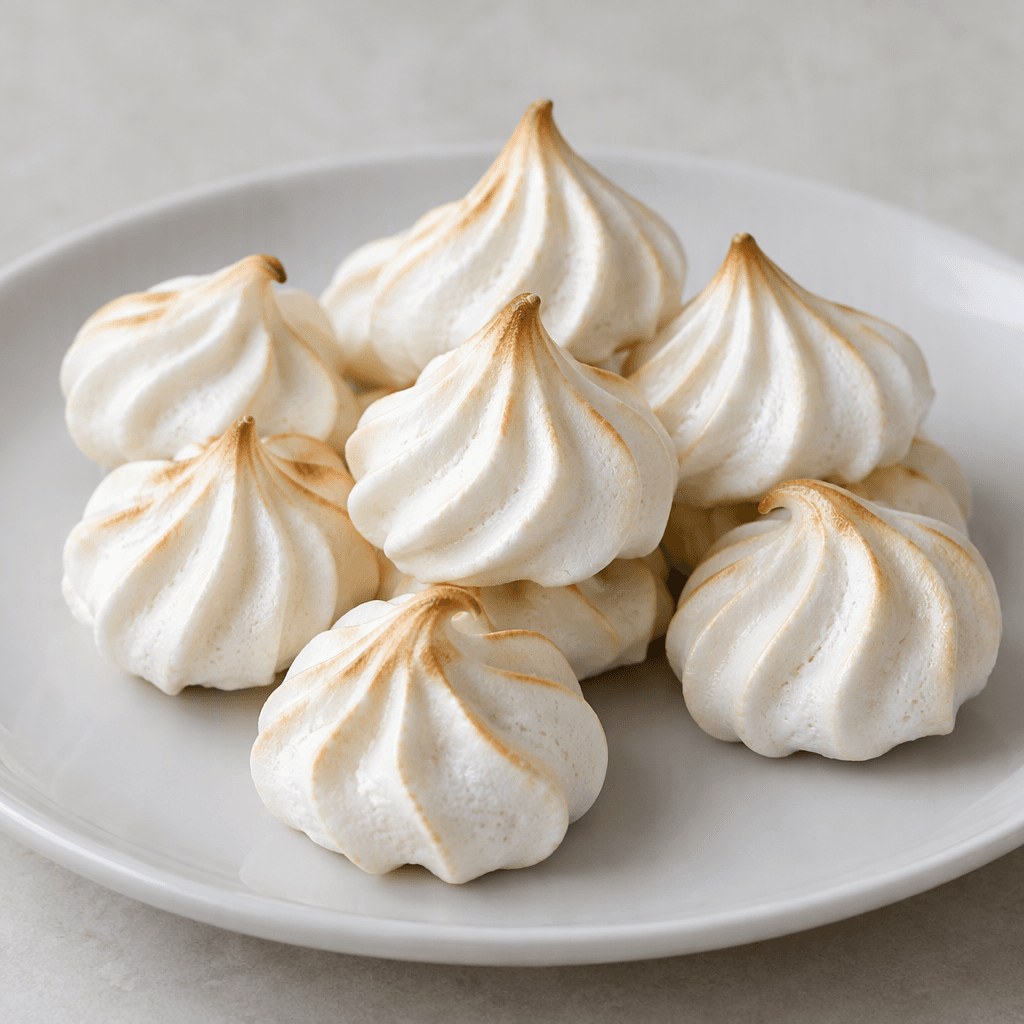
Meringue Calories
Light sweet made from egg whites and sugar
In season: Spring · Summer · Autumn · Winter
CALORIES
GI
POTASSIUM
FIBER
Quick answer
2 piece (medium) of Meringue (20 g) has 76 calories. That works out to 380 calories per 100 g. It contains 17.6 g of carbs, 0.6 g of protein, 0 g of fat and 0 g of fiber. Its glycemic index is 85 (high), so it raises blood sugar quickly.
What is Meringue?
Meringue is made by whipping egg whites with sugar, then baking the mixture until dry and crisp. It is a familiar feature of European baking, with different traditions shaping how it is prepared and used. Small meringues are often served plain, while larger versions can form the base of desserts or garnish cakes and fruit.
Expect a delicate crunch and a very sweet taste; some meringues stay slightly soft in the centre. They pair well with fresh berries, cream or coffee, and are also easy to serve alongside tea. Meringue is low in fat but mainly provides sugar and carbohydrates, so a small piece or two makes a more modest treat than using it as a substantial snack.
Meringue Nutrition Facts
Selected: 100 g
380
KCAL / 100G
Carbs
88g
· 32% DV
Protein
3.2g
· 6% DV
Fat
0.2g
· 0% DV
Fiber
0g
· 0% DV
DV is the share of the daily value covered, on a 2,000 kcal reference diet.
Calories come from: Carbs 96% · Protein 3% · Fat 1%

Log this food in EatBetter
100,000+ people use it
- Get your daily calorie target
- Snap your meal, log it in seconds
- See every vitamin and mineral

📸 Scan the code to get the app free.

Meringue Vitamins & Minerals
Vitamins
Biotin
1.5µg · 5% DV
B2
0.05mg · 4% DV
B1
0.01mg · 1% DV
B6
0.01mg · 1% DV
Minerals
Selenium
2µg · 4% DV
Sodium
25mg · 1% DV
Phosphorus
5mg · 1% DV
Copper
0mg · 0% DV
Potassium ⭐
15mg · 0% DV
How Nutritious Is Meringue?
Nutrient density
Low
How many vitamins, minerals and how much fiber this food carries per calorie. A high score means a lot of nutrition for few calories.
Satiety score
Low
An EatBetter score computed from fiber, protein and calorie density. A high score means staying full longer on the same calories.
Both scores are calculated per 100 g and do not change with the selected portion. The satiety score is EatBetter's own calculation, not a clinical measure.
Meringue Glycemic Index
GLYCEMIC INDEX
GLYCEMIC LOAD
Accounts for portion size — a more realistic measure than GI alone.
How to Burn Off Meringue
To burn the 380 calories in 100 g:
🚶
Walking (5 km/h)
🏃
Running (8 km/h)
🚴
Cycling
🏊
Swimming
Times are calculated with the MET equation for a 70 kg adult. Actual burn varies with your weight, age and pace.
Is Meringue Processed?
NOVA 3
Processed
1. Unprocessed
2. Minimally Processed
3. Processed
4. Ultra-Processed
NOVA classifies foods into 4 groups by industrial processing. NOVA 1 (unprocessed) is the healthiest.
Does Meringue Contain Allergens?
Contains these allergens:
Which Diets Is Meringue Good For?
Vegan
— Not suitable
Vegetarian
✓ Suitable
Gluten-Free
— Not suitable
Dairy-Free
— Not suitable
Mediterranean
— Not suitable
Paleo
— Not suitable
Whole30
— Not suitable
DASH
— Not suitable
Keto
— Not suitable
Low FODMAP
— Not suitable
Meringue Fat Profile
SATURATED
0.02g
MONOUNSATURATED
0.03g
POLYUNSATURATED
0.01g
Compare Meringue
Foods Similar to Meringue
Frequently Asked Questions About Meringue
What is meringue made of?
Meringue is made mainly from whipped egg whites and sugar. Some recipes add a little acid, such as lemon juice or cream of tartar, to help stabilize the foam, while flavorings are optional.
What is the difference between French, Swiss, and Italian meringue?
French meringue is made by whipping sugar into uncooked egg whites, Swiss meringue is gently warmed while whisking, and Italian meringue uses hot sugar syrup beaten into the whites. Their textures and typical uses differ.
Why does meringue weep?
Meringue weeps when moisture or dissolved sugar forms droplets on its surface. Undissolved sugar, overbaking, or humid storage can contribute; add sugar gradually and let baked meringue cool and stay dry.
Why does meringue crack in the oven?
Meringue often cracks when the oven is too hot or it cools too quickly. Bake it gently, then turn off the oven and let it cool gradually inside rather than moving it straight into a cooler room.
How can you tell when meringue cookies are done?
Meringue cookies are ready when they feel dry, lift cleanly from the baking paper, and have a crisp shell. Let one cool before judging, since it firms as it cools; a sticky center means it needs more drying.
How do you store meringue so it stays crisp?
Store fully cooled meringue in an airtight container at room temperature in a dry place. Refrigeration and humid air can make it sticky or soft, so keep the container sealed until serving.
Can you freeze meringue?
Yes, plain baked meringue can be frozen in a tightly sealed container, with layers separated to prevent breakage. Thaw it while still covered, then serve promptly; exposure to condensation can soften its crisp texture.
Why won't my meringue reach stiff peaks?
Meringue may fail to reach stiff peaks if the bowl or beaters have grease on them, or if even a little yolk gets into the whites. Use clean, dry equipment and separate each egg before adding its white to the bowl.
Can you make meringue on a humid day?
Yes, but humid weather makes meringue harder to dry and more likely to turn sticky. Bake it on a dry day when possible, cool it fully, and seal it in an airtight container as soon as it reaches room temperature.
What is the difference between meringue and pavlova?
Pavlova is a dessert made with a meringue base designed to stay crisp outside and soft inside, usually topped with cream and fruit. Small meringue cookies are typically dried until crisp throughout.
Have another question about Meringue?
Ask the AI nutrition coach — calories, portions, alternatives and more, answered in seconds in the app.

Scan calories with your camera
Instant AI nutrition analysis

Nutrition data compiled from USDA FoodData Central and scientific sources.