

Ready & Packaged Foods
All →Vegetables & Legumes
All →Desserts & Confectionery
All →Meat & Protein
All →Grains & Bakery
All →Beverages
All →Milk & Dairy
All →

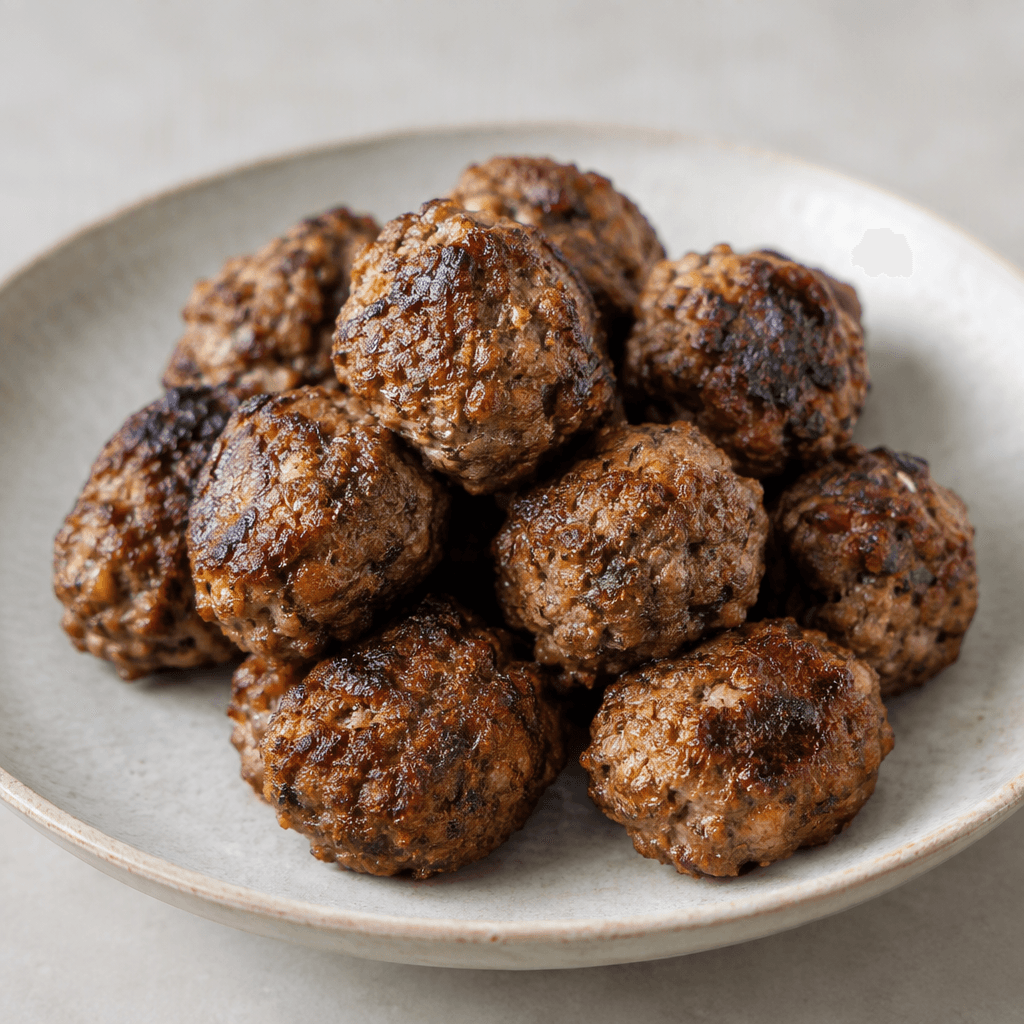
Roasted meatball Calories
Roasted meatball, rich in protein and iron
In season: Spring · Summer · Autumn · Winter
CALORIES
GI
POTASSIUM
FIBER
Quick answer
3 piece (medium) of Roasted meatball (120 g) has 252 calories. That works out to 210 calories per 100 g. It contains 7.4 g of carbs, 22.2 g of protein, 15 g of fat and 1 g of fiber. Its 1.4 µg of B12 covers 60% of the Daily Value. Its glycemic index is 35 (low), so it raises blood sugar slowly.
What is Roasted meatball?
Roasted meatball is a Turkish-style köfte: seasoned ground meat, often mixed with onion and herbs, shaped into small rounds and cooked in the oven. The browned, sometimes lightly charred outside gives way to a tender, savoury centre; recipes commonly use beef, lamb, or a blend.
In Turkey, it is served hot with rice, salad, roasted vegetables or yoghurt, and may also be tucked into bread. Elsewhere, it works well as a main dish or in a sandwich, with potatoes or a crisp salad alongside. It is a protein-rich, filling choice; pair it with vegetables for a lighter, balanced plate.
Roasted meatball Nutrition Facts
Selected: 100 g
210
KCAL / 100G
Carbs
6.2g
· 2% DV
Protein
18.5g
· 37% DV
Fat
12.5g
· 16% DV
Fiber
0.8g
· 3% DV
DV is the share of the daily value covered, on a 2,000 kcal reference diet.
Calories come from: Carbs 12% · Protein 35% · Fat 53%
Roasted meatball Vitamins & Minerals
Vitamins
B12
1.2µg · 50% DV
B3
3.8mg · 24% DV
B6
0.32mg · 19% DV
B2
0.19mg · 15% DV
Minerals
Zinc
3mg · 27% DV
Phosphorus
185mg · 26% DV
Selenium
13µg · 24% DV
Sodium
420mg · 18% DV
How Nutritious Is Roasted meatball?
Nutrient density
High
How many vitamins, minerals and how much fiber this food carries per calorie. A high score means a lot of nutrition for few calories.
Satiety score
Medium
An EatBetter score computed from fiber, protein and calorie density. A high score means staying full longer on the same calories.
Both scores are calculated per 100 g and do not change with the selected portion. The satiety score is EatBetter's own calculation, not a clinical measure.
Roasted meatball Glycemic Index
GLYCEMIC INDEX
GLYCEMIC LOAD
Accounts for portion size — a more realistic measure than GI alone.
How to Burn Off Roasted meatball
To burn the 210 calories in 100 g:
🚶
Walking (5 km/h)
🏃
Running (8 km/h)
🚴
Cycling
🏊
Swimming
Times are calculated with the MET equation for a 70 kg adult. Actual burn varies with your weight, age and pace.
Is Roasted meatball Processed?
NOVA 2
Minimally Processed
1. Unprocessed
2. Minimally Processed
3. Processed
4. Ultra-Processed
NOVA classifies foods into 4 groups by industrial processing. NOVA 1 (unprocessed) is the healthiest.
Does Roasted meatball Contain Allergens?
No known major allergens
Which Diets Is Roasted meatball Good For?
Vegan
— Not suitable
Vegetarian
— Not suitable
Gluten-Free
✓ Suitable
Dairy-Free
— Not suitable
Mediterranean
✓ Suitable
Paleo
✓ Suitable
Whole30
— Not suitable
DASH
— Not suitable
Keto
✓ Suitable
Low FODMAP
— Not suitable
Roasted meatball Fat Profile
SATURATED
4.5g
MONOUNSATURATED
5.2g
POLYUNSATURATED
1.1g
Omega 6:3 ratio 2:1
Below the ideal 4:1 — a good omega balance.
Compare Roasted meatball
Foods Similar to Roasted meatball
Frequently Asked Questions About Roasted meatball
How do you make roasted meatballs?
Roasted meatballs are made by mixing ground meat with seasoning and any chosen binders, shaping the mixture, and baking it on a tray. Keep the pieces similar in size so they cook evenly, and avoid packing them tightly together.
Why do roasted meatballs turn out dry?
Roasted meatballs usually turn dry when they are overcooked or made with very lean meat. Use meat with some fat, handle the mixture gently, and take the meatballs out as soon as they are cooked through.
How long do roasted meatballs take to cook in the oven?
Medium roasted meatballs often take about 20–25 minutes in a preheated 400°F oven. The exact time depends on their size and your oven, so check that the centers are fully cooked rather than relying on the clock alone.
What temperature should roasted meatballs reach inside?
Roasted meatballs made with ground beef, pork, or lamb should reach 160°F (71°C) at the center. If they contain ground poultry, cook them to 165°F (74°C); a food thermometer is the most reliable way to check.
Do roasted meatballs need egg and breadcrumbs?
No, roasted meatballs do not always need both egg and breadcrumbs. They help bind the mixture and soften its texture, but you can leave them out or use another binder; shape the meatballs gently so they hold together.
How do you stop roasted meatballs from falling apart?
To keep roasted meatballs intact, mix the ingredients until combined, chill the mixture briefly, and shape it firmly without compressing it excessively. If it feels loose, add a small amount of breadcrumbs or another suitable binder.
Can you freeze roasted meatballs?
Yes, roasted meatballs freeze well after cooking. Cool them completely, freeze in a sealed container, and thaw them in the refrigerator before reheating. You can also freeze uncooked shaped meatballs, then cook them thoroughly after thawing.
What should you serve with roasted meatballs?
Roasted meatballs pair well with pasta and tomato sauce, roasted vegetables, salad, or mashed potatoes. For a simple sheet-pan meal, roast vegetables alongside them, spacing everything out so it browns instead of steaming.
Are roasted meatballs better than pan-fried meatballs?
Roasted meatballs are easier to cook in a large batch and need less hands-on attention than pan-fried ones. Pan-frying gives more direct browning, while oven roasting cooks the meatballs more evenly when they are shaped to a consistent size.
How should you reheat roasted meatballs without drying them out?
Reheat roasted meatballs covered in the oven with a spoonful of sauce or water, or warm them gently in a covered pan. If using a microwave, heat in short bursts and turn them so the centers warm through without overcooking.
Have another question about Roasted meatball?
Ask the AI nutrition coach — calories, portions, alternatives and more, answered in seconds in the app.

Scan calories with your camera
Instant AI nutrition analysis

Nutrition data compiled from USDA FoodData Central and scientific sources.