

Ready & Packaged Foods
All →Vegetables & Legumes
All →Desserts & Confectionery
All →Meat & Protein
All →Grains & Bakery
All →Beverages
All →Milk & Dairy
All →

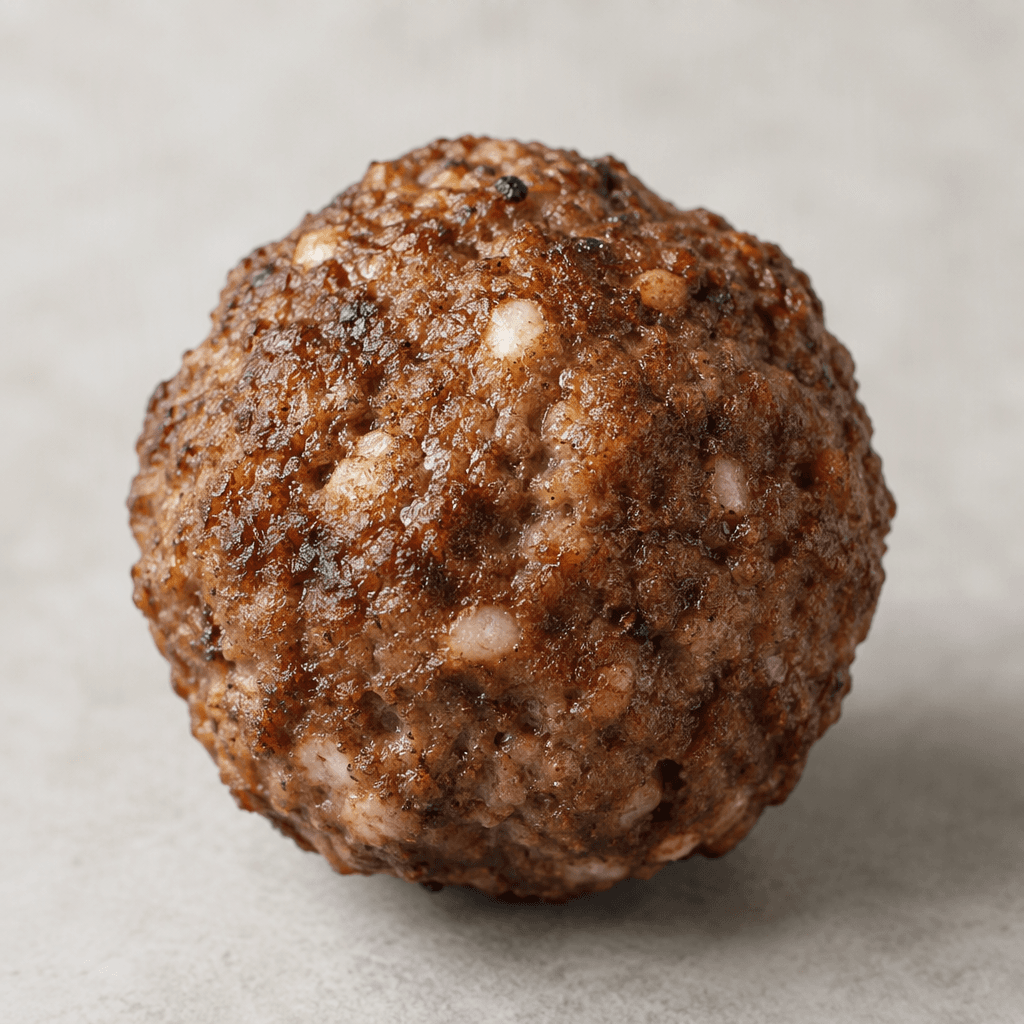
Meatball (Medium Fat) Calories
Protein and iron source, traditional meatball made with medium-fat beef.
In season: Spring · Summer · Autumn · Winter
CALORIES
GI
POTASSIUM
FIBER
Quick answer
3 piece (medium) of Meatball (Medium Fat) (120 g) has 276 calories. That works out to 230 calories per 100 g. It contains 7.2 g of carbs, 22.2 g of protein, 16.8 g of fat and 1 g of fiber. Its 2.5 µg of B12 covers 105% of the Daily Value. Its glycemic index is 35 (low), so it raises blood sugar slowly.
What is Meatball (Medium Fat)?
Medium-fat meatballs are a familiar Turkish home-style dish made by seasoning and shaping ground beef. Recipes vary by region and household; onion, bread and spices may be mixed in, and the meat is formed into balls or flattened patties before cooking.
Grilling or pan-frying gives them a browned exterior and a tender, juicy centre. In Turkey, they are often served with salad, rice, bread or grilled vegetables; elsewhere, they also fit easily into a sandwich or a simple weeknight meal. They provide protein while being moderately rich in fat, with 18.5 grams of protein per 100 grams. For a lighter plate, pair them with vegetables and salad rather than a large serving of rice.
Meatball (Medium Fat) Nutrition Facts
Selected: 100 g
230
KCAL / 100G
Carbs
6g
· 2% DV
Protein
18.5g
· 37% DV
Fat
14g
· 18% DV
Fiber
0.8g
· 3% DV
DV is the share of the daily value covered, on a 2,000 kcal reference diet.
Calories come from: Carbs 11% · Protein 33% · Fat 56%
Meatball (Medium Fat) Vitamins & Minerals
Vitamins
B12
2.1µg · 88% DV
B3
3.5mg · 22% DV
B2
0.22mg · 17% DV
B6
0.28mg · 16% DV
Minerals
Zinc
4mg · 36% DV
Selenium
13µg · 24% DV
Phosphorus
170mg · 24% DV
Sodium
420mg · 18% DV
How Nutritious Is Meatball (Medium Fat)?
Nutrient density
High
How many vitamins, minerals and how much fiber this food carries per calorie. A high score means a lot of nutrition for few calories.
Satiety score
Medium
An EatBetter score computed from fiber, protein and calorie density. A high score means staying full longer on the same calories.
Both scores are calculated per 100 g and do not change with the selected portion. The satiety score is EatBetter's own calculation, not a clinical measure.
Meatball (Medium Fat) Glycemic Index
GLYCEMIC INDEX
GLYCEMIC LOAD
Accounts for portion size — a more realistic measure than GI alone.
How to Burn Off Meatball (Medium Fat)
To burn the 230 calories in 100 g:
🚶
Walking (5 km/h)
🏃
Running (8 km/h)
🚴
Cycling
🏊
Swimming
Times are calculated with the MET equation for a 70 kg adult. Actual burn varies with your weight, age and pace.
Is Meatball (Medium Fat) Processed?
NOVA 2
Minimally Processed
1. Unprocessed
2. Minimally Processed
3. Processed
4. Ultra-Processed
NOVA classifies foods into 4 groups by industrial processing. NOVA 1 (unprocessed) is the healthiest.
Does Meatball (Medium Fat) Contain Allergens?
No known major allergens
Which Diets Is Meatball (Medium Fat) Good For?
Vegan
— Not suitable
Vegetarian
— Not suitable
Gluten-Free
✓ Suitable
Dairy-Free
— Not suitable
Mediterranean
✓ Suitable
Paleo
✓ Suitable
Whole30
— Not suitable
DASH
— Not suitable
Keto
✓ Suitable
Low FODMAP
— Not suitable
Meatball (Medium Fat) Fat Profile
SATURATED
5.2g
MONOUNSATURATED
6.1g
POLYUNSATURATED
1g
Omega 6:3 ratio 2:1
Below the ideal 4:1 — a good omega balance.
Compare Meatball (Medium Fat)
Foods Similar to Meatball (Medium Fat)
Frequently Asked Questions About Meatball (Medium Fat)
How long should medium-fat meatballs cook?
Medium-fat meatballs usually take about 15–20 minutes in a 400°F (200°C) oven, depending on their size. For a skillet, turn them as they brown and check that the centers are fully cooked rather than relying on time alone.
What internal temperature should medium-fat meatballs reach?
Medium-fat meatballs made with ground beef should reach 160°F (71°C) in the center. Check the thickest meatball with a food thermometer; browned outsides alone do not show whether the middle is safely cooked.
How do you keep medium-fat meatballs tender?
Keep medium-fat meatballs tender by mixing the ingredients only until combined and avoiding a long cooking time. A small amount of soaked bread or breadcrumbs can help retain moisture, while compacting the mixture too firmly can make the texture dense.
Can you cook medium-fat meatballs from frozen?
Yes, medium-fat meatballs can be cooked from frozen, but they need longer than thawed ones. Bake or simmer them until the centers reach 160°F (71°C); avoid leaving them partly cooked or thawing them on the counter.
Do medium-fat meatballs need egg?
No, medium-fat meatballs do not always need egg. Egg can help bind a mixture, but breadcrumbs or soaked bread can also hold it together; use enough binder for the meatballs to keep their shape without making them heavy.
Why do medium-fat meatballs shrink when cooked?
Medium-fat meatballs shrink because heat makes the meat proteins tighten and releases some moisture and fat. Shaping them evenly and cooking them just until done helps limit shrinkage; pressing them flat can squeeze out more juices.
Can you make medium-fat meatballs ahead of time?
Yes, you can shape medium-fat meatballs ahead and keep them covered in the refrigerator until cooking. Use them within a day, and keep raw meat separate from ready-to-eat foods and utensils to prevent cross-contamination.
What sauce goes best with medium-fat meatballs?
Tomato sauce is a classic choice for medium-fat meatballs, while brown gravy works well for a richer, savory meal. Choose a sauce that suits the cooking method: simmering cooked meatballs in sauce also lets them absorb its flavor.
What should you serve with medium-fat meatballs?
Serve medium-fat meatballs with pasta, rice, roasted vegetables, or a crisp salad. For a sandwich, put them in a roll with sauce; for a lighter plate, pair them with vegetables and a tangy yogurt-based dip.
How should you reheat medium-fat meatballs without drying them out?
Reheat medium-fat meatballs gently in a covered pan with a little sauce or water, or microwave them covered in short intervals. Heat until steaming hot throughout; adding moisture helps prevent the cooked meat from becoming tough and dry.
Have another question about Meatball (Medium Fat)?
Ask the AI nutrition coach — calories, portions, alternatives and more, answered in seconds in the app.

Scan calories with your camera
Instant AI nutrition analysis

Nutrition data compiled from USDA FoodData Central and scientific sources.