

Ready & Packaged Foods
All →Vegetables & Legumes
All →Desserts & Confectionery
All →Meat & Protein
All →Grains & Bakery
All →Beverages
All →Milk & Dairy
All →

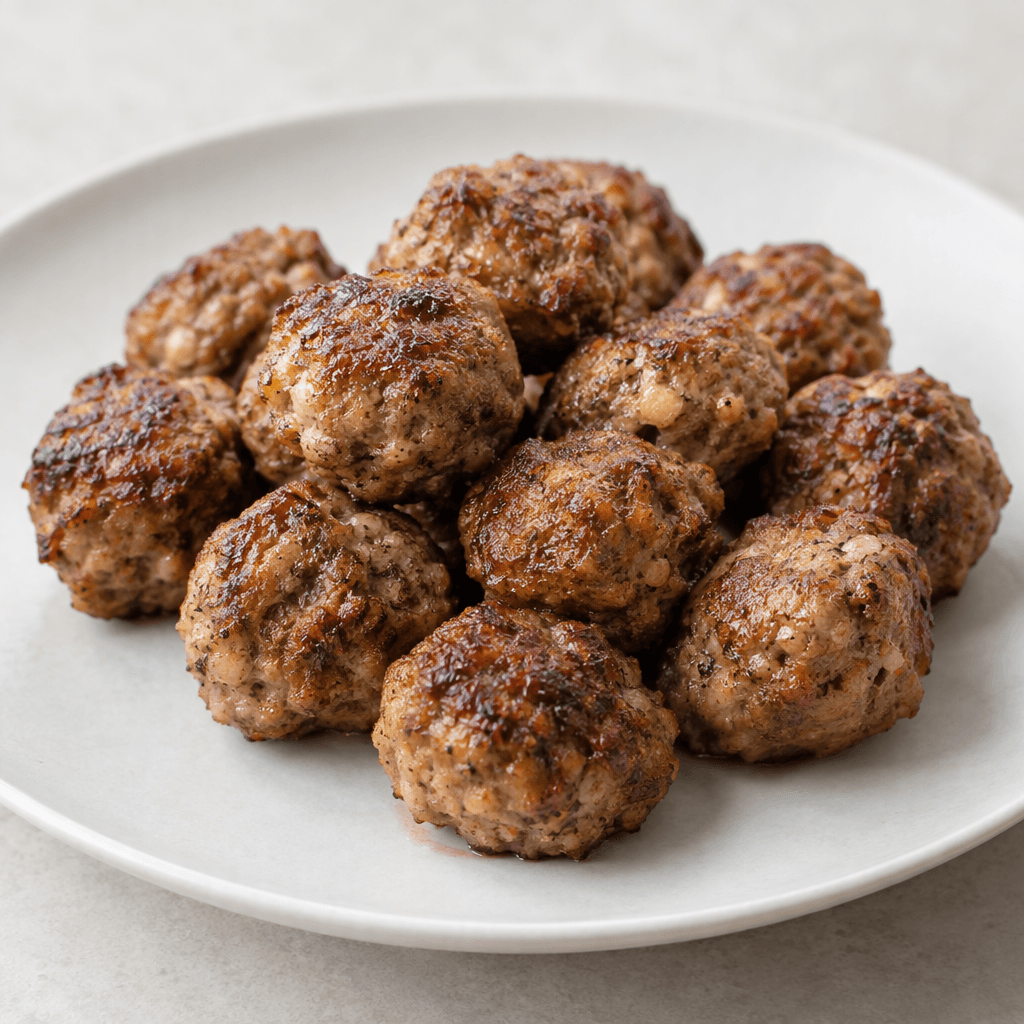
Meatball (cooked) Calories
Protein and iron source, classic comfort food
In season: Spring · Summer · Autumn · Winter
CALORIES
GI
POTASSIUM
FIBER
Quick answer
3 piece (medium) of Meatball (cooked) (90 g) has 189 calories. That works out to 210 calories per 100 g. It contains 6.5 g of carbs, 14.9 g of protein, 11.9 g of fat and 0.7 g of fiber. Its 1 µg of B12 covers 41% of the Daily Value. Its glycemic index is 35 (low), so it raises blood sugar slowly.
What is Meatball (cooked)?
Cooked meatballs are seasoned portions of minced meat shaped into balls or small patties and cooked by grilling, frying or baking. In Turkey, köfte recipes vary from home to home and by region, often using beef or lamb with onion and spices; some include breadcrumbs or soaked bread. They are browned outside, tender within, and pleasantly savoury, with a texture that can be slightly coarse.
In Turkey they are commonly served at lunch or dinner with rice, bread, salad or yoghurt, rather than as a breakfast food. Turkish-style meatballs also turn up at grills and in casual restaurants. They provide protein and iron, while also contributing fat, so a serving can be filling. For a lighter meal, choose grilled or oven-cooked meatballs and pair them with a generous salad.
Meatball (cooked) Nutrition Facts
Selected: 100 g
210
KCAL / 100G
Carbs
7.2g
· 3% DV
Protein
16.5g
· 33% DV
Fat
13.2g
· 17% DV
Fiber
0.8g
· 3% DV
DV is the share of the daily value covered, on a 2,000 kcal reference diet.
Calories come from: Carbs 13% · Protein 31% · Fat 56%
Meatball (cooked) Vitamins & Minerals
Vitamins
B12
1.1µg · 46% DV
B3
3.2mg · 20% DV
B2
0.22mg · 17% DV
B5
0.7mg · 14% DV
Minerals
Zinc
3mg · 27% DV
Selenium
13µg · 24% DV
Phosphorus
170mg · 24% DV
Sodium
420mg · 18% DV
How Nutritious Is Meatball (cooked)?
Nutrient density
High
How many vitamins, minerals and how much fiber this food carries per calorie. A high score means a lot of nutrition for few calories.
Satiety score
Medium
An EatBetter score computed from fiber, protein and calorie density. A high score means staying full longer on the same calories.
Both scores are calculated per 100 g and do not change with the selected portion. The satiety score is EatBetter's own calculation, not a clinical measure.
Meatball (cooked) Glycemic Index
GLYCEMIC INDEX
GLYCEMIC LOAD
Accounts for portion size — a more realistic measure than GI alone.
How to Burn Off Meatball (cooked)
To burn the 210 calories in 100 g:
🚶
Walking (5 km/h)
🏃
Running (8 km/h)
🚴
Cycling
🏊
Swimming
Times are calculated with the MET equation for a 70 kg adult. Actual burn varies with your weight, age and pace.
Is Meatball (cooked) Processed?
NOVA 2
Minimally Processed
1. Unprocessed
2. Minimally Processed
3. Processed
4. Ultra-Processed
NOVA classifies foods into 4 groups by industrial processing. NOVA 1 (unprocessed) is the healthiest.
Does Meatball (cooked) Contain Allergens?
No known major allergens
Which Diets Is Meatball (cooked) Good For?
Vegan
— Not suitable
Vegetarian
— Not suitable
Gluten-Free
— Not suitable
Dairy-Free
— Not suitable
Mediterranean
✓ Suitable
Paleo
✓ Suitable
Whole30
— Not suitable
DASH
— Not suitable
Keto
— Not suitable
Low FODMAP
— Not suitable
Meatball (cooked) Fat Profile
SATURATED
5.2g
MONOUNSATURATED
5.8g
POLYUNSATURATED
1.1g
Omega 6:3 ratio 3.5:1
Below the ideal 4:1 — a good omega balance.
Compare Meatball (cooked)
Foods Similar to Meatball (cooked)
Frequently Asked Questions About Meatball (cooked)
How long do cooked meatballs last in the fridge?
Cooked meatballs keep for 3–4 days in the refrigerator when chilled within two hours of cooking. Store them in a covered container, and discard them if they have been left at room temperature for too long.
Can you freeze cooked meatballs?
Yes, cooked meatballs freeze well. Let them cool, package them airtight, and freeze them; separating portions makes it easier to use only what you need. Thaw them in the refrigerator and reheat until piping hot.
How do you reheat cooked meatballs without drying them out?
Reheat cooked meatballs gently in a covered pan with a splash of water, stock, or sauce. Turn them occasionally and heat them through. If using a microwave, cover the dish and use short bursts so the edges do not dry out.
Why do meatballs fall apart when cooking?
Meatballs often fall apart when the mixture has too little binder, has not been mixed enough to hold together, or is turned before a crust forms. Chill the shaped meatballs briefly and let them brown before moving them.
How do you keep meatballs tender?
For tender meatballs, mix the ingredients only until combined and avoid packing the mixture tightly when shaping. Breadcrumbs soaked with milk can add moisture, while overcooking is a common reason meatballs turn dry and firm.
Should you brown meatballs before adding them to sauce?
Browning meatballs first adds a browned, savory exterior and helps them keep their shape in the sauce. You can also cook them directly in simmering sauce for a softer texture, but make sure they are cooked through before serving.
What do breadcrumbs do in meatballs?
Breadcrumbs absorb moisture and help bind the meatball mixture, giving the cooked meatballs a softer texture. Too many can make them pasty or dry, so use only enough for the mixture to hold its shape.
What sauce goes well with cooked meatballs?
Tomato sauce is a classic match for cooked meatballs, while a creamy mushroom sauce works well for a richer meal. For a quick option, warm the meatballs in marinara or another seasoned sauce so they absorb its flavor.
Can cooked meatballs be eaten cold?
Yes, cooked meatballs can be eaten cold if they were cooled promptly and kept refrigerated. Do not eat them if they sat at room temperature for more than two hours or if you are unsure how they were stored.
What can you make with leftover cooked meatballs?
Leftover cooked meatballs work well in meatball subs, pasta, grain bowls, or soups. Add them near the end of cooking when using a simmering sauce or soup, so they heat through without becoming tough.
Have another question about Meatball (cooked)?
Ask the AI nutrition coach — calories, portions, alternatives and more, answered in seconds in the app.

Scan calories with your camera
Instant AI nutrition analysis

Nutrition data compiled from USDA FoodData Central and scientific sources.