

Ready & Packaged Foods
All →Vegetables & Legumes
All →Desserts & Confectionery
All →Meat & Protein
All →Grains & Bakery
All →Beverages
All →Milk & Dairy
All →

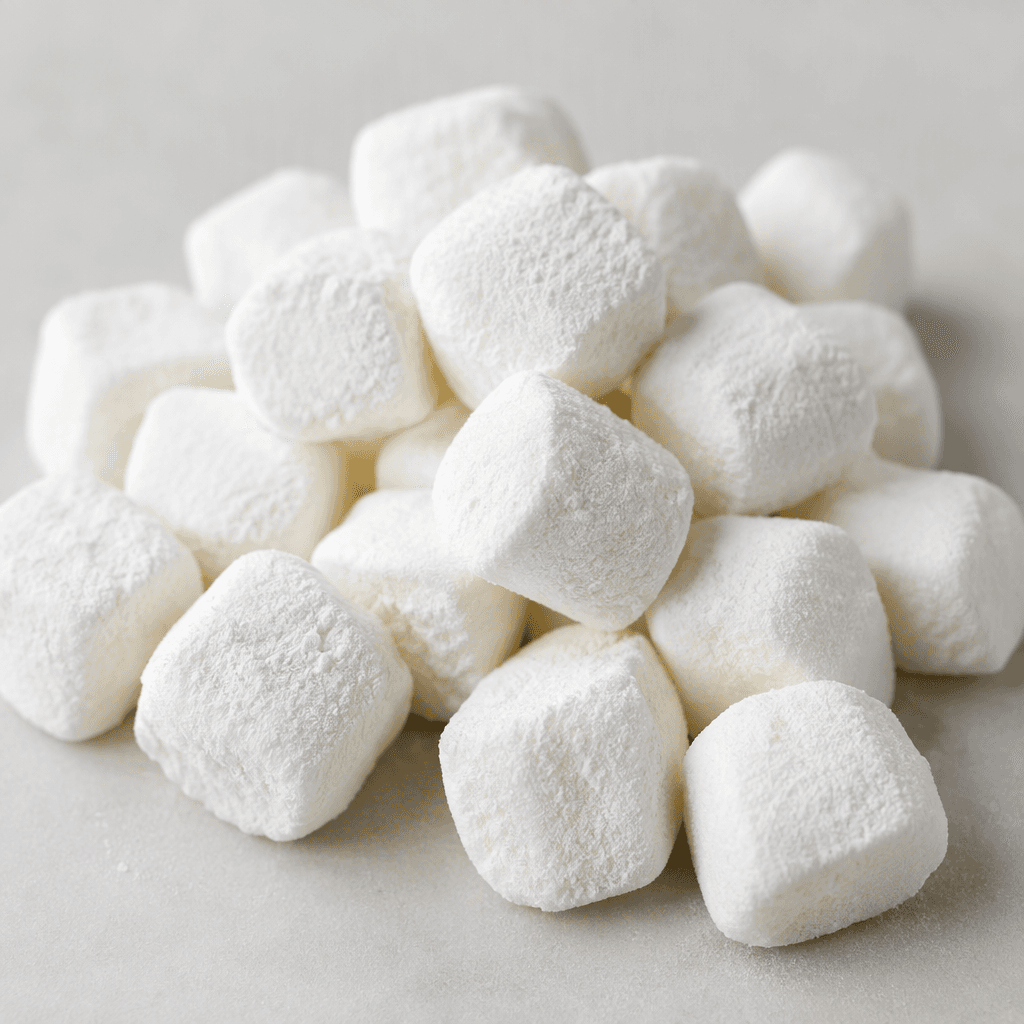
Marshmallow Calories
Soft, sweet confection
In season: Winter · Summer
CALORIES
GI
POTASSIUM
FIBER
Quick answer
5 piece (medium) of Marshmallow (28 g) has 89 calories. That works out to 318 calories per 100 g. It contains 21.8 g of carbs, 0.5 g of protein, 0.1 g of fat and 0 g of fiber. Its glycemic index is 70 (high), so it raises blood sugar quickly.
What is Marshmallow?
Marshmallows are soft, airy sweets made mainly from sugar and syrup, with gelatin commonly used to give them their springy texture; some recipes also include egg white. The modern confection developed in Europe, while its name comes from the marshmallow plant, whose sap was once used in earlier versions.
They’re eaten as a treat on their own, stirred into hot chocolate, or toasted over a fire until the outside turns golden and the centre becomes gooey. In the US, toasted marshmallows are also paired with chocolate and crackers in s’mores. Nutritionally, they are mostly carbohydrate, with very little protein or fat. Their sweetness makes a small serving go well with fresh fruit or an unsweetened drink.
Marshmallow Nutrition Facts
Selected: 100 g
318
KCAL / 100G
Carbs
78g
· 28% DV
Protein
1.8g
· 4% DV
Fat
0.2g
· 0% DV
Fiber
0g
· 0% DV
DV is the share of the daily value covered, on a 2,000 kcal reference diet.
Calories come from: Carbs 97% · Protein 2% · Fat 1%
Marshmallow Vitamins & Minerals
Vitamins
B2
0.02mg · 2% DV
B1
0.01mg · 1% DV
Vitamin A
0µg · 0% DV
B3
0mg · 0% DV
Minerals
Sodium
45mg · 2% DV
Calcium
3mg · 0% DV
Iron
0mg · 0% DV
Magnesium
1mg · 0% DV
How Nutritious Is Marshmallow?
Nutrient density
Low
How many vitamins, minerals and how much fiber this food carries per calorie. A high score means a lot of nutrition for few calories.
Satiety score
Low
An EatBetter score computed from fiber, protein and calorie density. A high score means staying full longer on the same calories.
Both scores are calculated per 100 g and do not change with the selected portion. The satiety score is EatBetter's own calculation, not a clinical measure.
Marshmallow Glycemic Index
GLYCEMIC INDEX
GLYCEMIC LOAD
Accounts for portion size — a more realistic measure than GI alone.
How to Burn Off Marshmallow
To burn the 318 calories in 100 g:
🚶
Walking (5 km/h)
🏃
Running (8 km/h)
🚴
Cycling
🏊
Swimming
Times are calculated with the MET equation for a 70 kg adult. Actual burn varies with your weight, age and pace.
Is Marshmallow Processed?
NOVA 4
Ultra-Processed
1. Unprocessed
2. Minimally Processed
3. Processed
4. Ultra-Processed
NOVA classifies foods into 4 groups by industrial processing. NOVA 1 (unprocessed) is the healthiest.
Does Marshmallow Contain Allergens?
Contains these allergens:
Which Diets Is Marshmallow Good For?
Vegan
— Not suitable
Vegetarian
✓ Suitable
Gluten-Free
— Not suitable
Dairy-Free
— Not suitable
Mediterranean
— Not suitable
Paleo
— Not suitable
Whole30
— Not suitable
DASH
— Not suitable
Keto
— Not suitable
Low FODMAP
— Not suitable
Marshmallow Fat Profile
SATURATED
0.02g
MONOUNSATURATED
0.01g
POLYUNSATURATED
0.01g
Compare Marshmallow
Foods Similar to Marshmallow
Frequently Asked Questions About Marshmallow
What are marshmallows made of?
Most marshmallows are made with sugar, corn syrup, gelatin, and air whipped into the mixture. Some recipes also use egg whites, while plant-based versions may use alternatives such as agar. The exact ingredients vary by product.
How do you make marshmallows at home?
Homemade marshmallows are made by combining gelatin with hot sugar syrup, then whipping the mixture until thick and fluffy. Let it set in a pan before cutting, and coat the pieces with powdered sugar and cornstarch to reduce sticking.
How do you roast marshmallows without burning them?
Hold a marshmallow above hot coals rather than directly in the flame, and turn it slowly until evenly golden. Direct flames can char the sugary surface before the center softens; use a long skewer and take care around the fire.
Do marshmallows contain gelatin?
Most conventional marshmallows contain gelatin, which gives them their springy texture. Some products use other setting agents instead, so check the ingredient list if you need to avoid gelatin or want to know its source.
Can you melt marshmallows in the microwave?
Yes, marshmallows can be melted in the microwave. Put them in a large microwave-safe bowl and heat in short bursts, stirring between each one; they expand quickly and the melted sugar mixture can become very hot.
How do you keep marshmallows from getting sticky?
Keep marshmallows in an airtight container in a cool, dry place after opening. Humidity makes their sugary coating tacky, while a light dusting of powdered sugar and cornstarch can help separate pieces that have begun sticking together.
Do marshmallows expire?
Yes, marshmallows can lose quality over time, becoming dry, firm, or sticky even if they do not show obvious spoilage. Keep them sealed and dry, and discard them if you notice mold, an unusual smell, or a changed appearance.
Can you freeze marshmallows?
Yes, marshmallows can be frozen in an airtight freezer-safe container. Let them come back to room temperature while still sealed to limit condensation; their texture may change slightly, so frozen marshmallows work especially well in recipes where they will be melted.
Why do marshmallows catch fire when you roast them?
Marshmallows can catch fire when their sugary surface meets a direct flame. Roast them over glowing coals and keep turning the skewer; if the outside darkens too quickly, move it farther from the heat.
Why do marshmallows puff up in the microwave?
Marshmallows puff up because heat expands the air whipped into them and softens their sugar structure. Use a bowl with plenty of room and heat in short bursts, since an unattended marshmallow can swell enough to spill over.
Have another question about Marshmallow?
Ask the AI nutrition coach — calories, portions, alternatives and more, answered in seconds in the app.

Scan calories with your camera
Instant AI nutrition analysis

Nutrition data compiled from USDA FoodData Central and scientific sources.