

Ready & Packaged Foods
All →Vegetables & Legumes
All →Desserts & Confectionery
All →Meat & Protein
All →Grains & Bakery
All →Beverages
All →Milk & Dairy
All →

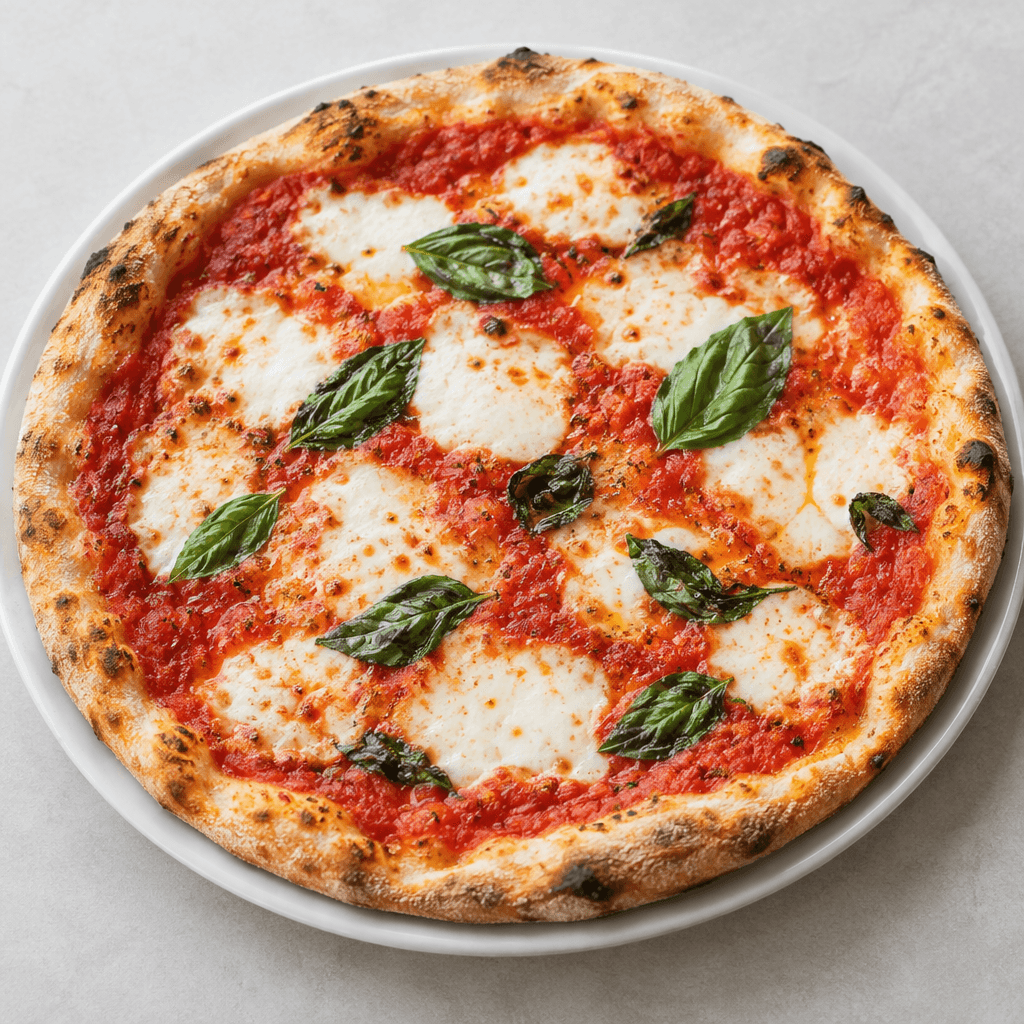
Margherita pizza Calories
Classic Italian pizza with tomato sauce, mozzarella cheese, and basil.
In season: Spring · Summer · Autumn · Winter
CALORIES
GI
POTASSIUM
FIBER
Quick answer
1 slice (medium) of Margherita pizza (80 g) has 188 calories. That works out to 235 calories per 100 g. It contains 23.2 g of carbs, 7.4 g of protein, 6.6 g of fat and 1.6 g of fiber. Its 344 mg of Sodium covers 15% of the Daily Value. Its glycemic index is 60 (medium), so it raises blood sugar at a moderate pace.
What is Margherita pizza?
Margherita pizza comes from Naples, Italy, and keeps its topping simple: tomato sauce, mozzarella and fresh basil on pizza dough. The crust may be thin or more pillowy; in the oven, its edge turns golden while the cheese melts into the tangy tomato. Basil adds a fresh, aromatic finish.
It is served hot and commonly shared at the table or eaten as a meal on its own. For English-speaking diners, it works as an easy restaurant order or a casual homemade dinner. Its dough supplies most of the carbohydrates, while mozzarella contributes protein; a 100 g portion has 9.2 g of protein. Pair it with a crisp salad or serve a smaller portion for a lighter meal.
Margherita pizza Nutrition Facts
Selected: 100 g
235
KCAL / 100G
Carbs
29g
· 11% DV
Protein
9.2g
· 18% DV
Fat
8.2g
· 11% DV
Fiber
2g
· 7% DV
DV is the share of the daily value covered, on a 2,000 kcal reference diet.
Calories come from: Carbs 51% · Protein 16% · Fat 33%
Margherita pizza Vitamins & Minerals
Vitamins
B12
0.35µg · 15% DV
B2
0.18mg · 14% DV
Vitamin A
120µg · 13% DV
B3
2.1mg · 13% DV
Minerals
Sodium
430mg · 19% DV
Phosphorus
120mg · 17% DV
Calcium
140mg · 14% DV
Selenium
7.5µg · 14% DV
How Nutritious Is Margherita pizza?
Nutrient density
Medium
How many vitamins, minerals and how much fiber this food carries per calorie. A high score means a lot of nutrition for few calories.
Satiety score
Medium
An EatBetter score computed from fiber, protein and calorie density. A high score means staying full longer on the same calories.
Both scores are calculated per 100 g and do not change with the selected portion. The satiety score is EatBetter's own calculation, not a clinical measure.
Margherita pizza Glycemic Index
GLYCEMIC INDEX
GLYCEMIC LOAD
Accounts for portion size — a more realistic measure than GI alone.
How to Burn Off Margherita pizza
To burn the 235 calories in 100 g:
🚶
Walking (5 km/h)
🏃
Running (8 km/h)
🚴
Cycling
🏊
Swimming
Times are calculated with the MET equation for a 70 kg adult. Actual burn varies with your weight, age and pace.
Is Margherita pizza Processed?
NOVA 3
Processed
1. Unprocessed
2. Minimally Processed
3. Processed
4. Ultra-Processed
NOVA classifies foods into 4 groups by industrial processing. NOVA 1 (unprocessed) is the healthiest.
Does Margherita pizza Contain Allergens?
Contains these allergens:
Which Diets Is Margherita pizza Good For?
Vegan
— Not suitable
Vegetarian
✓ Suitable
Gluten-Free
— Not suitable
Dairy-Free
— Not suitable
Mediterranean
✓ Suitable
Paleo
— Not suitable
Whole30
— Not suitable
DASH
— Not suitable
Keto
— Not suitable
Low FODMAP
— Not suitable
Margherita pizza Fat Profile
SATURATED
3.2g
MONOUNSATURATED
2.6g
POLYUNSATURATED
0.4g
Omega 6:3 ratio 10.7:1
Above the ideal 4:1 (10.7:1).
Compare Margherita pizza
Foods Similar to Margherita pizza
Frequently Asked Questions About Margherita pizza
What is on a Margherita pizza?
A classic Margherita pizza is topped with tomato sauce, mozzarella, and fresh basil. Its simple toppings are meant to let the tomato, cheese, and herbs stand out rather than burying the crust under lots of ingredients.
Why is it called a Margherita pizza?
The Margherita pizza is commonly said to be named after Queen Margherita of Italy. A popular story links its tomato, mozzarella, and basil to the red, white, and green of the Italian flag, though the history is debated.
How do you make Margherita pizza at home?
To make Margherita pizza, spread a thin layer of tomato sauce over the dough, add mozzarella, bake, and finish with basil. Preheat the oven thoroughly, and avoid adding too much sauce or cheese if you want the crust to stay crisp.
Is Margherita pizza the same as Neapolitan pizza?
No. Margherita describes a topping combination of tomato, mozzarella, and basil, while Neapolitan refers to a traditional pizza style associated with Naples. A Margherita pizza can be made in the Neapolitan style, but the terms do not mean the same thing.
What kind of mozzarella is best for Margherita pizza?
Fresh mozzarella is a classic choice for Margherita pizza because it melts into soft, milky patches. Drain excess liquid before using it so the cheese does not make the center of the pizza watery.
Should basil go on Margherita pizza before or after baking?
Basil is often added to Margherita pizza near the end of baking or just after it comes out of the oven. This helps keep the leaves from scorching and preserves their fresh aroma.
What is the difference between Margherita pizza and cheese pizza?
Margherita pizza includes tomato sauce, mozzarella, and basil, while a cheese pizza may use a different cheese blend and may not include basil. The tomato and fresh herb flavors give Margherita its distinctive balance.
What should you serve with Margherita pizza?
Margherita pizza pairs well with a simple green salad or roasted vegetables. Their fresh, lighter flavors complement the tomato and mozzarella without competing with the pizza’s basil.
How long does leftover Margherita pizza last in the fridge?
Leftover Margherita pizza keeps for about three to four days in the refrigerator when stored in a covered container. Reheat slices in a skillet or oven for a firmer crust; add fresh basil after reheating if you have it.
Can you freeze Margherita pizza?
Yes, Margherita pizza can be frozen. Freeze slices in an airtight wrapping with space between them, and add fresh basil after reheating for a brighter flavor and better texture.
Have another question about Margherita pizza?
Ask the AI nutrition coach — calories, portions, alternatives and more, answered in seconds in the app.

Scan calories with your camera
Instant AI nutrition analysis

Nutrition data compiled from USDA FoodData Central and scientific sources.